1997·Howden Moors, Peak District, South Yorkshire/Derbyshire border
United Kingdom.Howden Moor · rescue operation for a phantom object
On the night of March 24, 1997, after reports of an object that crashed or exploded over the Howden Moors (Peak District), emergency services mounted one of the region's largest search operations (~200 personnel, £50,000+). The British Geological Survey recorded two 'sonic events' that night, at 9:52 and 10:06pm, and many witnesses saw low-flying military jets, although the Ministry of Defence only acknowledged training flights booked until 9:07pm. No aircraft turned up and the radars checked showed nothing significant. A multi-agency case about an object the official apparatus searched for but never confirmed.
Tier A · AcceptableWhat do they mean? →
Institutional evidence: several identified independent witnesses, or contemporary official documentation, without an instrumental record to corroborate them.
What it was
74%natural or human cause
Most likely explanation: airplane
See the split across the six explanations
Natural or human cause
No known cause
Read the full reasoning
A British Geological Survey seismologist said the signal "was definitely caused by an aircraft, probably a military aircraft, reaching supersonic speed". Jacqueline Mitton proposed a bolide, which per Clarke Fylingdales apparently ruled out; the RAF at first denied any flights, and Clarke believes part of the exercise was covert.Primary documents
Hansard: written answers to Helen Jackson on the night of 24 March 1997 (30 March and 7 April 1998)
Written answers in the House of Commons to MP Helen Jackson. On 30 March 1998 minister John Spellar says a number of military aircraft were booked for low-flying training in northern England that evening, that Defence received 13 complaints and no reports of 'UFOs', that the Danger Area of 25 March around Howden Reservoir was for an RAF rescue helicopter searching at the police's request, and that there is no record of sonic events from RAF or NATO aircraft. The Home Office adds that police found no trace of the aircraft thought to have crashed. On 7 April he puts the booking over the Peak District at 20:30 to 21:07. The PDF reproduces the text of the digital Hansard (api.parliament.uk); it is not a scan of the printed volume.
Hansard, Cámara de los Comunes: HC Deb 30 mar 1998 vol 309 cc393W y 414-415W; 7 abr 1998 vol 310 c222W (texto de api.parliament.uk/historic-hansard, maquetado en PDF) · Open Parliament Licence v3.0 · open original
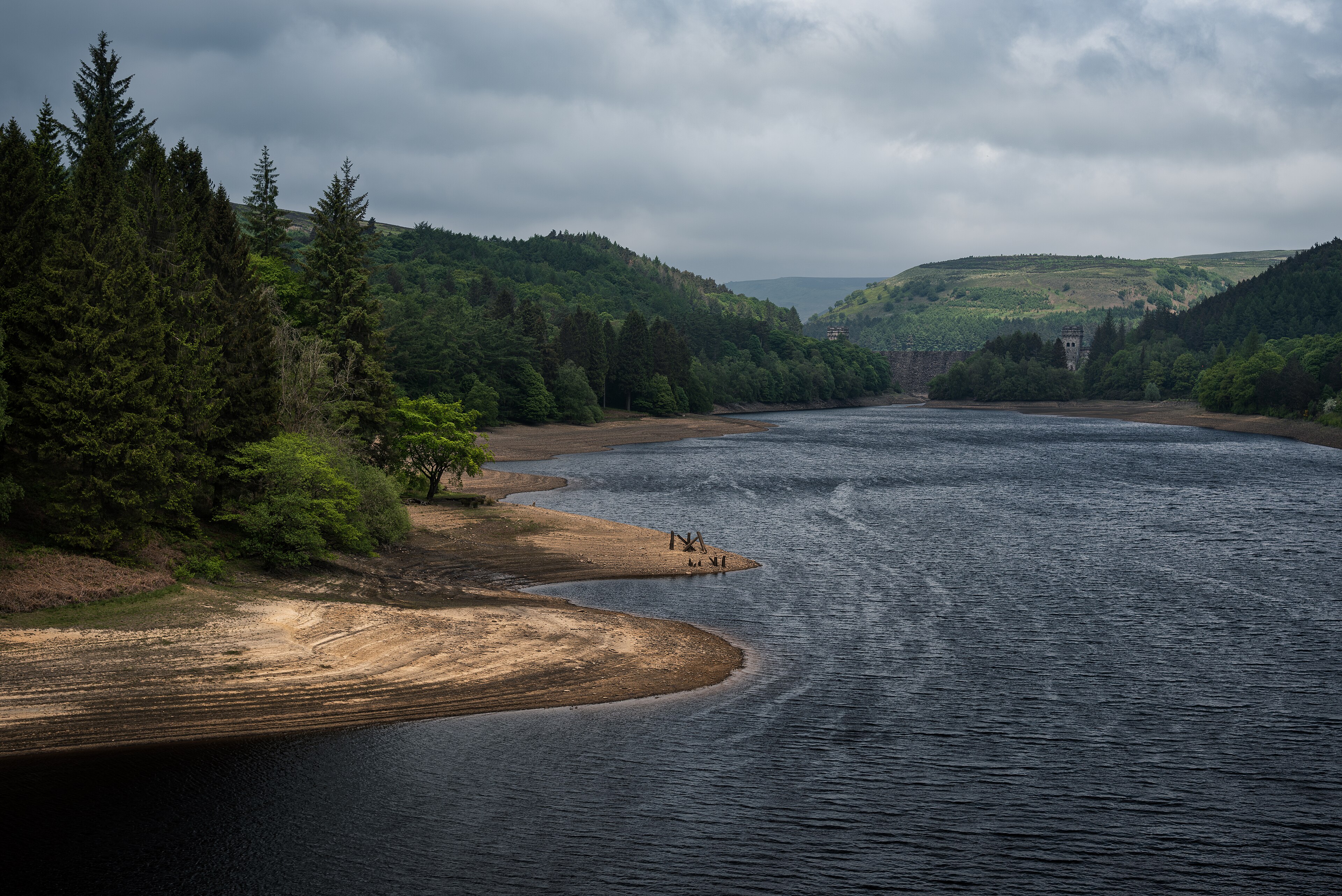
Context · Howden (Peak District, England)
Howden Dam Upper Derwent Reservoir 2023 01.jpg · Wikimedia Commons · CC BY 4.0 · open original
The night in question
On the night of Monday, March 24, 1997, clear and cold, with many locals out on the moors to watch comet Hale-Bopp, several witnesses saw formations of low-flying military jets between 8:30 and 9:50pm and, shortly after 10pm, a single aircraft flying low westwards over the moors north-west of Sheffield. At 10:15pm two farmers at Bolsterstone called the police: they had seen a low, slow aircraft with navigation lights disappear behind the Featherbed Moss ridge, followed by an orange glow, several plumes of smoke and a smell of burning; gamekeepers at Strines heard an explosion that drowned out their television, and a special constable driving with her husband, a pilot, saw a light aircraft so low it seemed about to hit the moor. It all happened on the Howden Moors, on the border between South Yorkshire and the Derbyshire Peak District. The sequence was consistent with an aircraft crashing. South Yorkshire Police responded by mobilizing, together with fire and ambulance services and with support from four counties, one of the largest air and ground rescue operations in the region's recent history: on the order of 200 personnel and a cost exceeding £50,000, on the working hypothesis of an air disaster. The search, with a police helicopter, an RAF Sea King and 141 volunteers from all seven Peak District mountain rescue teams, lasted about 15 hours, until 2pm the following day.
The search found nothing: no downed aircraft, no debris, no casualties. Calls to civilian and military airports came back negative (no one reported aircraft lost over the moors); according to the police log, the RAF rescue centre at Kinloss checked the radar tapes and found 'nothing significant', and Manchester's radar showed 'nothing in the area at the time'. Yet instrumental evidence did remain: the Leeds University low-frequency microphone, part of the British Geological Survey network, recorded two 'sonic events' 14 minutes apart, at 9:52 and 10:06pm, and the second, which matches the explosion heard at Strines, also reached two seismographs; according to the BGS, the signal was atmospheric, came from the direction of Sheffield and was not consistent with a ground impact. Many witnesses in Dronfield and Sheffield saw low-flying military jets between 9:30 and 9:50pm.
David Clarke, who covered the event for the Sheffield Star and later reconstructed the night from the police log, BGS data and witness interviews, examined two explanations. The astronomer Jacqueline Mitton proposed a bolide, which would account for the lights and the bang; but, according to Clarke, RAF Fylingdales apparently ruled out meteorites and space debris. BGS seismologist Glenn Ford said that 'on the balance of probabilities' the signal was caused by an aircraft, probably military, reaching supersonic speed, and that he believed it was a covert operation. The RAF denied any military flights that night; a year later, in parliamentary answers to MP Helen Jackson, the Ministry of Defence admitted that a number of military aircraft were booked for low-flying training over the Peak District between 8:30 and 9:07pm, said it had received 13 complaints about aircraft activity that day, and said it had no record of sonic events generated by RAF or NATO aircraft. Yorkshire Water workers told Clarke that the police stood them down because the RAF had admitted a jet on a night exercise had broken the sound barrier, which the police and the mountain rescue coordinator say the RAF denied to them. The police log's closing entry speaks of 'a combination of circumstances that would lead people to believe a plane might have crashed', and South Yorkshire Police categorised the incident as 'unexplained'.
The framing is deliberately cautious. What is solidly documented is the massive institutional response and the BGS independent acoustic and seismic record, not the nature of the object. There was no radar-confirmed object and no recovered debris, and the most economical explanation combines mundane phenomena: a low-flying exercise, a supersonic boom and the perception of a public watching the sky for the comet. It is a borderline case: a real event credible enough to mobilize the state at scale, but whose core (what exactly crossed the Howden Moors sky that night) was never closed.
Why it matters
It documents something uncommon: the state mounting a large-scale rescue operation for an object that never appeared on the ground or on radar, with an independent British Geological Survey seismic record. It is a case strong on institutional response and weak on object identification. Its analytic value is precisely that asymmetry: it shows that a massive state deployment does not equal a confirmed anomaly. The mobilization proves that many witnesses, police included, perceived something real and alarming; it does not prove that something was exotic. Distinguishing the solidity of the institutional response from the solidity of the phenomenon's identification is the central exercise, and Howden Moor embodies it almost in pure form.
It was investigated by David Clarke, the journalist and academic who curated the British Ministry of Defence UFO files; his work supplied precisely the mundane reading: low-flying military jets on a night exercise, with the bolide as someone else's hypothesis that he does not adopt. That the principal source is a rigorous skeptic rather than a promoter reinforces the reliability of the factual record without inflating the interpretation.
What's left on paper
Documented evidence
- One of the region's largest rescue operations (~200 personnel, £50,000+), South Yorkshire Police + emergency services.
- The British Geological Survey recorded two 'sonic events' of atmospheric origin, at 9:52 and 10:06pm on March 24, 1997, from the direction of Sheffield.
- Many witnesses saw low-flying jets; in 1998 the MoD admitted low-flying training booked over the Peak District until 9:07pm, but no RAF sonic booms.
- No aircraft found; according to the police log, the Kinloss and Manchester radars showed nothing significant.
Sources
- Dr David Clarke — Secret Files: The Howden Moor Incident — Reconstruction by the journalist who covered the event in 1997; quotes the South Yorkshire Police incident log, the BGS statement of 27 Mar 1997 and the 1998 parliamentary answers.
- Wikipedia — UFO sightings in the United Kingdom (Howden Moor, 1997) — Secondary source.
- The National Archives (UK) — DEFE 24/1988, 'UFO reports' (Jan-Jul 1997) — Catalogue entry for the MoD file for the period.
Related cases
Associated actors (1)