2008·Stephenville, Texas
United States.Stephenville
Dozens of witnesses (including a constable) reported a large, silent object over Stephenville, Texas; a MUFON analysis of FAA radar data obtained via FOIA described a track with no transponder heading toward the restricted airspace of the presidential ranch at Crawford. Air Force Reserve Command, after denying it, admitted that ten F-16s were training in the area that evening.
Tier A · AcceptableWhat do they mean? →
Institutional evidence: several identified independent witnesses, or contemporary official documentation, without an instrumental record to corroborate them.
What it was
58%natural or human cause
Most likely explanation: airplane
See the split across the six explanations
Natural or human cause
No known cause
Read the full reasoning
The Air Force Reserve reversed its denial: "Ten F-16s from the 457th Fighter Squadron were performing training operations from 6 to 8 p.m." But consultant Jay Miller objected that flares do not burn silently and that jets dropping them fly in afterburner, and McGaha does not explain the MUFON radar track, which he deems noise.Primary documents
FAA FOIA response on the Stephenville Lights (26 Mar 2009): cover letter, internal Fort Worth Center e-mails and the Brownwood operating area schedule, 5 pp.
Reply from the FAA's Central Service Center to John Greenewald's FOIA request 2009-003019: it says several aircraft were in the vicinity of Stephenville and that the only air traffic record is the continuous data recording of the Fort Worth Center, supplied on CD. The January 2008 e-mails contain James McGaha's questions and the Center's quality-assurance answer: a King Air descending toward Brownwood at 18:22, four F-16s entering the Brownwood MOA at 18:17 just east of Stephenville, four more at 18:26, and exits at 18:54 and 18:58. It ends with the activation table for the Brownwood areas on 9 January 2008, 0:00-3:00 UTC.
Administración Federal de Aviación (FAA), vía The Black Vault · Public domain · US Government work · open original
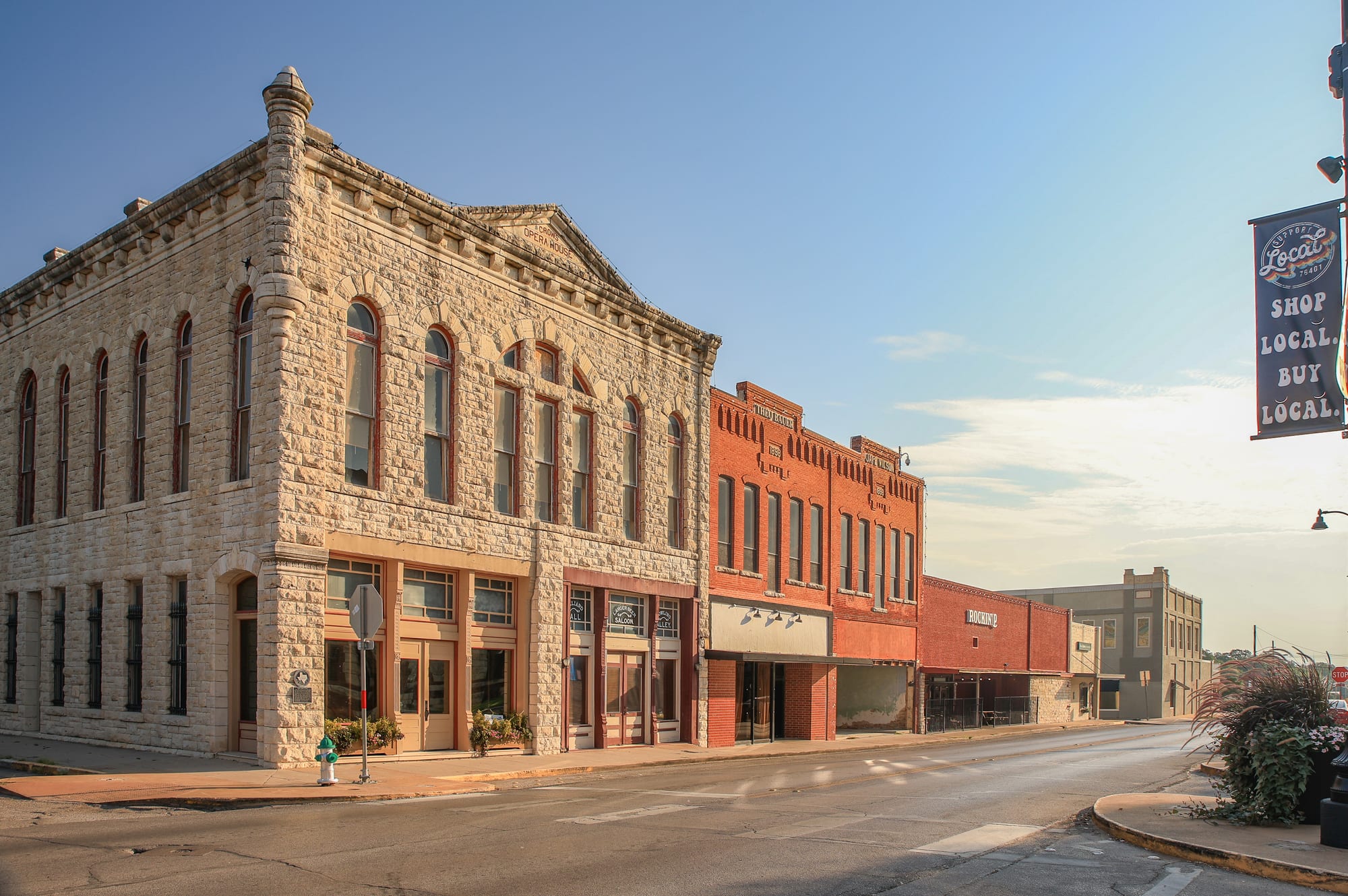
Context · Stephenville (Texas)
Downtown Stephenville 2024.jpg · Wikimedia Commons · CC BY-SA 4.0 · open original
The night in question
On January 8, 2008, around 18:15 local time, multiple residents of Stephenville and the surrounding rural areas (Erath County, Texas) observed a large, silent object with bright lights moving at low altitude. The most cited testimony was that of Steve Allen, a private pilot, one of three men who first took their sighting to the local newspaper: as he told the Dallas Morning News, he and his friends first saw a row of glowing spheres that silently changed formation before vanishing and, minutes later, two more glowing spheres with military jets in hot pursuit, flying low; the jets could be heard. Other accounts attribute to him a very large object, and some witnesses spoke of an object a mile long or of speeds of 3,000 miles per hour. Constable Lee Roy Gaitan watched the lights with his son and neighbors; other independent witnesses included farmers and residents across the county. The convergence of independent accounts of a silent, low-flying object is the case's first pillar.
The second pillar is instrumental. Researcher Robert Powell (then MUFON director of research), with radar analyst Glen Schulze, requested the FAA's radar data for that night under the Freedom of Information Act (FOIA) and reviewed on the order of 2.5 million return points. The report identified primary radar returns without a transponder (objects the radar saw but that were not identified as cooperative traffic) temporally correlated with the sightings, some at very high speeds. Critically, by the analysis, published on 4 July 2008, one of those tracks, built from 187 returns, moved at about 49 miles per hour for over an hour toward the restricted airspace of George W. Bush's ranch in Crawford, some 50 miles southeast of Stephenville, and corresponded to an object at least 524 feet in size. The same dataset confirmed F-16 jets operating in the area, which the report treated as objects distinct from the unidentified track. Astronomer and retired Air Force pilot James McGaha replied that those 187 points had been picked from 2.5 million points of noise and scatter, and that the F-16s did not react to any unknown target.
The third axis is institutional. Initially, a spokesman for the Carswell reserve base, 60 miles away, told the local paper that none of the unit's F-16s were flying. On 23 January Air Force Reserve Command corrected this in a release: 'Ten F-16s from the 457th Fighter Squadron were performing training operations from 6 to 8 p.m., Tuesday January 8, 2008, in the Brownwood Military Operating Area (MOA), which includes the airspace above Erath County'; the 301st Fighter Wing spokesman, Maj. Karl Lewis, blamed the denial on 'an internal communications error' and said he could give no details for operations-security reasons. According to the FAA, queried by McGaha, two groups of four F-16s entered the Brownwood military operations area, at a point just east of Stephenville, at 6:17 and 6:26 p.m. and left at 6:54 and 6:58 p.m., within the time of the sightings, and a medical helicopter pilot flying that night said he saw several military aircraft, some dropping flares, in that area. This correction underpins the dominant conventional explanation: that part of the sightings were F-16s in training, whose lights and reflections could be misread, and that the reported sonic booms came from those same jets. That mundane reading is plausible for some of the reports, but the case's proponents argue it does not exhaust the testimony of a single large, silent object, nor the radar track heading toward Crawford. Aviation consultant Jay Miller objected in the Dallas Morning News that flares do not burn silently and that a jet dropping them is in afterburner, and Allen said the operating area was not close enough and that what he saw was flying near the ground. The case is one of the few with exhaustive FOIA analysis of FAA primary radar published by MUFON in an extensive technical report.
Why it matters
It combines convergent civilian testimony with an exhaustive FOIA analysis of FAA primary radar, plus the aggravating circumstance of a disputed track heading toward the restricted airspace of the presidential ranch. Its methodological value is high: it shows how civil, legal tools (an information request and the scrutiny of millions of radar points) allow an event to be reconstructed objectively, without relying solely on witness memory. That is the model later cases have sought to replicate.
The 301st Fighter Wing's initial denial followed by a correction is a clean institutional data point on military communication behavior during public events: a first denial, later reversed, that (whatever its cause) erodes trust and feeds suspicion of cover-up even when the final explanation (F-16 exercises) is mundane. For calibration, the case lives in a productive tension: the conventional explanation covers much of the reports, but the unidentified radar track toward Crawford and the testimony of a single silent object keep it from full closure.
What's left on paper
Documented evidence
- FAA radar data obtained via FOIA by MUFON
- Convergent civilian testimony (constable + private pilots + residents)
- MUFON track (187 returns, ~49 mph for over an hour) toward the Crawford ranch airspace; McGaha considers it cherry-picked noise
- Initial denial and Air Force Reserve Command correction (23 Jan 2008): ten F-16s of the 457th trained from 6 to 8 p.m. over Erath County
Sources
- Powell, R. — MUFON Stephenville Report (2008)
- FAA radar data — Stephenville (FOIA release)
- Jeffrey Weiss — 'Texas UFO mystery solved? Military says fighter jets were in area; witnesses don't buy explanation', The Dallas Morning News (24 Jan 2008), reproduced on ufoevidence.org — Primary source: contemporary report with the text of the Air Force Reserve Command release and Steve Allen's statements.
- 'The Stephenville Lights: What Actually Happened', Skeptical Inquirer 33(1), Jan-Feb 2009 (James McGaha's investigation) — F-16 timings according to the FAA and critique of the MUFON radar report.
- Hanks, A. — Stephenville Lights (2014) — Journalistic reconstruction
Related cases
same object · same country
Phoenix Lights
1997 · Tier A
same object · same country
Three 'UAPs' resolved: they were three commercial aircraft, per AARO's radar cross-check
2021 · Tier A
same object · same country
The MQ-9 that filmed another MQ-9 — and a wake that was video compression
2023 · Tier A
same object · same country
Hudson Valley Boomerang
1983 · Tier A