1983–1986·Hudson Valley, NY-CT
United States.Hudson Valley Boomerang
Between 1983 and 1986, thousands of Hudson Valley residents (New York and Connecticut) reported a large V- or boomerang-shaped object with colored lights, the "Westchester Boomerang". State police attributed it in 1984 to pilots flying in formation out of Stormville airport and the FAA found no matching radar readings; CUFOS investigators argued that part of the sightings did not fit the planes.
Tier A · AcceptableWhat do they mean? →
Institutional evidence: several identified independent witnesses, or contemporary official documentation, without an instrumental record to corroborate them.
What it was
71%natural or human cause
Most likely explanation: airplane
See the split across the six explanations
Natural or human cause
No known cause
Primary documents
Nuclear Regulatory Commission reply to request FOIA-84-854 on Indian Point (21 November 1984), 1 p.
Letter from J. M. Felton, Director of the Division of Rules and Records in the Office of Administration of the U.S. Nuclear Regulatory Commission (NRC), dated 21 November 1984 and addressed to Lawrence Fawcett, Assistant Director of Citizens Against UFO Secrecy. It answers Fawcett's Freedom of Information Act request of 9 November for all records on a UFO sighting by Power Authority Police at the Indian Point Nuclear Power Station on "July 14, 1984", and states that a search of the NRC's files found no documents pertaining to the request.
Comisión Reguladora Nuclear de EE. UU., ADAMS ML21179A021 (registros de la solicitud NRC-2021-000172) · Public domain · US Government work · open original
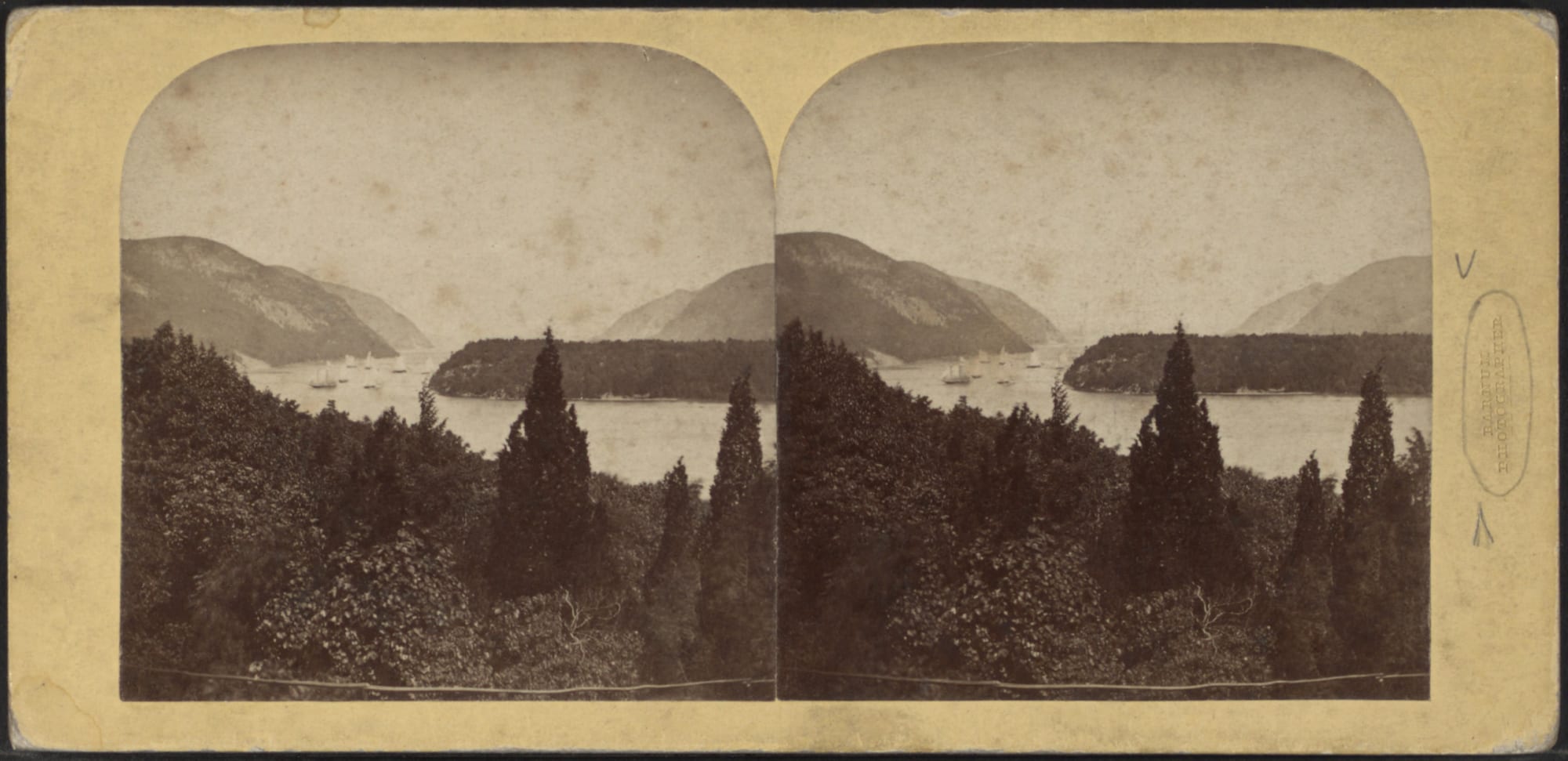
Context · the Hudson Valley (New York), scene of the 'Boomerang' wave
Entrance to Highlands, Hudson River, by Deloss Barnum.jpg · Wikimedia Commons · Public domain · open original
The years in question
Between March 1983 and the spring of 1986, the Hudson Valley (north of New York City, spanning Westchester, Putnam and Dutchess counties and reaching into Connecticut) was the stage for a wave of sightings. The first calls reached the Kent police on March 17, 1983, and the following week more than a hundred came into police stations in Carmel, Brewster, Putnam Valley, Yorktown and Mount Kisco; by August 1984 The New York Times spoke of "thousands of residents". The later figures of several thousand witnesses come from the investigators' own compilation, not from an official record. The recurrently reported object (nicknamed the 'Westchester Boomerang') was described as an enormous boomerang-, V- or triangle-shaped structure, the size of a football field according to the Times (in 1983 the estimates gathered by investigator Philip Imbrogno ran from 100 to 150 feet), flying at low altitude, with a geometric pattern of bright colored lights. Many witnesses insisted it made no sound, though not all: in April 1983 Imbrogno said many of his callers described a humming noise, and in Danbury the chairman of the city's aviation commission heard "lawnmower-like" engines.
The witness profile included local and state police, professionals and, according to Imbrogno, an IBM manager who with other commuters saw a "boomerang" over the Taconic Parkway. The FAA, by contrast, acted as a skeptical interlocutor: its Eastern Region spokesman, Robert Fulton, said in July 1984 that no radar readings had been found that corresponded with the reports and that the agency had ruled out military flights; the regional office told the Times it had received "no such reports" of flights below the 500-foot limit (although some residents said they had filed them) and therefore had made no investigation. Astronomer J. Allen Hynek (founder of CUFOS and formerly scientific consultant to Project Blue Book) and Imbrogno conducted a multi-year field investigation, gathering hundreds of testimonies, which they documented with Bob Pratt in 'Night Siege: The Hudson Valley UFO Sightings' (1987), the reference monograph on the case.
The skeptical explanation is concrete and was documented in the press at the time: private pilots from Dutchess airfields (above all Stormville) flew at night in tight formation in single-engine Cessnas and Piper Cherokees, with their undersides painted black and lights that changed color; seen from the ground, those V-formations produce the illusion of a single structure. As early as 1983 an FAA official at Dutchess County Airport and another at Stewart airport spoke of planes in formation. In July 1984 Sgt. Daniel Andriano of the East Fishkill police watched a ring of eight planes pass overhead toward Stormville and passed the FAA the tail number of a Cessna that landed there, and in August Sgt. Kenneth Spiro of State Police Troop K told the Times a trooper had tracked the lights to Stormville and that the pilots were "getting a big kick out of it". This explanation accounts well for a substantial portion of the reports. Imbrogno himself acknowledged in 1984 that five pilots from Stormville and Dutchess County Airport had staged the hoax, but argued that a subset (objects that stopped in midair or were described as a rigid mass) did not match the planes. The most cited residual is the Indian Point nuclear plant on July 24, 1984, but its documentation is weak: according to the Reporter Dispatch of White Plains (January 12, 1985), Imbrogno said a dozen guards saw a 900-foot object hover fifteen minutes over Unit 3 and that they broke out the shotguns; an anonymous guard said it "looked like helicopters in V-formation", made some noise and hovered 300 yards above the plant, and also said guards "broke out the shotguns"; the security commander denied the shotgun story and suggested Imbrogno had stretched it; the Nuclear Regulatory Commission had no documentation of the sighting, although its resident inspector, Larry Rossbach, recalled guards discussing it the next day and said he accepted them "as reasonable people"; and the power authority's spokesman, Carl Patrick, "confirmed the sightings" but said they were "of the same sort" as the others and that he knew of no regulations restricting the airspace around the plant. That same night Bob and Lori Pozzuoli videotaped the lights in Brewster, and state police attributed them to the formation flyers.
Why it matters
The Hudson Valley wave lasted several years within a bounded region. The prosaic explanation was documented almost in real time: police followed the planes to the airfield and spoke with some of the pilots, aviation officials spoke of formation flying from 1983 on, and the leading pro-UFO investigator acknowledged the hoax. The number of accounts, on its own, is susceptible to social contagion and media enthusiasm, and here it was fed by public meetings, a hotline and the local press. That makes it a case study in how a known source of false positives coexists with witnesses who say they saw something else.
The case has to be treated as a mixture. The Stormville pilots explanation is real and probably accounts for the majority of the formation-light sightings: it cannot be ignored. The open question is whether it explains everything. There is a residue (observations of a rigid mass, midair stops, the Indian Point episode) that some witnesses attribute to something else, but that residue rests on accounts gathered by the investigators, not on records: the FAA found no matching radar readings, the Indian Point episode left no documents and the plant itself, while confirming the sightings, equated it with the rest, and the memory of distant witnesses, the difficulty of estimating size and altitude at night, and the possibility of other aircraft all add to the uncertainty. Several hypotheses therefore remain in play, with misidentification as the leading one: the formation planes (documented), a possible stealthy domestic prototype or lighter-than-air platform (the giant, silent triangle signature anticipates morphologies debated a decade later), and an unresolved residual component.
What's left on paper
Documented evidence
- Calls to Putnam and Westchester police from March 17, 1983 (more than a hundred the following week); in August 1984 The New York Times speaks of "thousands of residents"
- East Fishkill police (Sgt. Daniel Andriano, July 1984): a ring of eight planes heading to Stormville and the tail number of a Cessna sent to the FAA
- New York State Police (Sgt. Kenneth Spiro, Troop K, August 1984): a trooper tracked the lights to Stormville airport; light planes in formation with undersides painted black
- FAA Eastern Region (Robert Fulton, July 1984): no radar readings correspond with the reports; military flights ruled out
- Indian Point, July 24, 1984 (Reporter Dispatch, January 12, 1985): guards' account gathered by Imbrogno and partly denied by the security commander; an anonymous guard speaks of shotguns and an object 300 yards up; the power authority confirms the sightings and the NRC resident inspector accepts the guards "as reasonable people"; NRC had no documentation; no known airspace restriction
Show 2 more items
- Bob and Lori Pozzuoli videotape, July 24, 1984, attributed by state police to the formation flyers
- CUFOS investigation (Hynek, Imbrogno) published in 'Night Siege' (1987)
Sources
- The New York Times, August 25, 1984, reprinted in UFO Newsclipping Service no. 182 (archive.org) — Contemporaneous press: "thousands of residents"; state police track the lights to Stormville; the FAA says it received "no such reports" of flights below the 500-foot limit and made no investigation.
- Reporter Dispatch (White Plains), January 12, 1985, Jon Craig, "UFOs: Did aliens buzz Indian Point plant?", reprinted in UFO Newsclipping Service no. 187 (archive.org) — Contemporaneous press on Indian Point: Imbrogno's version, anonymous guard, the security commander's denial, no NRC documents and no known airspace restriction.
- News-Times (Danbury), July 26, 1984, Janet Higbie, and FAA statements, reprinted in UFO Newsclipping Service no. 181 (archive.org) — Contemporaneous press: Sgt. Andriano sees eight planes heading to Stormville; the FAA finds no corresponding radar readings.
- News-Times (Danbury), April 1983, Janet Higbie, reprinted in UFO Newsclipping Service no. 165 (archive.org) — Contemporaneous press: first calls from March 17, 1983, estimates of 100 to 150 feet, humming noise reported and police skepticism.
- Patent Trader (Mount Kisco), April 1, 1983, and News-Times (Danbury), reprinted in UFO Newsclipping Service no. 166 (archive.org) — Contemporaneous press: an FAA official at Dutchess County Airport speaks of planes in formation; in Danbury, police and the aviation commission speak of small planes.
- Associated Press, November 29, 1983 (Schenectady Gazette), reprinted in UFO Newsclipping Service no. 174 (archive.org) — Contemporaneous press: sources at Stewart airport describe a formation of planes out of Stormville.
- Journal (Brookfield), August 15, 1984, reprinted in UFO Newsclipping Service no. 183 (archive.org) — Contemporaneous press: Imbrogno acknowledges five pilots staged the hoax and argues other sightings were not planes.
- Bob and Lori Pozzuoli, July 24, 1984 videotape (excerpt, archive.org) — Witness footage from the night of the Indian Point sighting; the archive record notes its attribution to the formation flyers.
- Hynek, J.A., Imbrogno, P. & Pratt, B. — Night Siege: The Hudson Valley UFO Sightings (1987) — Secondary source: the CUFOS investigators' monograph.
- Wikipedia: 1984 Hudson Valley UFO sightings — Secondary general-reference source.
Related cases
Associated actors (1)
