1997·Phoenix, Arizona
United States.Phoenix Lights
Thousands of witnesses watched a triangular formation drift over Phoenix; a second event that night was explained as military flares; the first has no official explanation, and skeptic Robert Sheaffer and astronomer James McGaha attribute it to a formation of A-10 aircraft. Governor Symington mocked the case in 1997 and years later said he had seen the object himself.
Tier A · AcceptableWhat do they mean? →
Institutional evidence: several identified independent witnesses, or contemporary official documentation, without an instrumental record to corroborate them.
What it was
67%natural or human cause
Most likely explanation: airplane
See the split across the six explanations
Natural or human cause
No known cause
Read the full reasoning
The 10 p.m. lights were LUU-2 flares dropped by Maryland Air National Guard A-10s, according to the Air Force and pilot Ed Jones. Many witnesses of the first event describe a solid structure, and the Air Force gave no explanation for it.Primary documents
Air Force FOIA responses about the night of 13 March 1997: Luke AFB (1 May 1997) and Davis-Monthan AFB (8 Aug 2013)
Two letters from the Department of the Air Force to John Greenewald. In the first, dated 1 May 1997, the records office of the 56th Fighter Wing at Luke answers that no records exist, that its F-16s flew "normal training missions" that night with "no involvement whatsoever with the lights observed over Phoenix", that its command post received calls, and that its public affairs office never said the cause was flares: "we don't know where the question of aerial flares come from." The second, from Davis-Monthan in 2013, answers a request about the A-10 flare explanation: those records are kept for six months and were destroyed, so no log for that date could be checked.
Departamento de la Fuerza Aérea de EE. UU. (56 CS/SCBR, Luke AFB; 355 CS, Davis-Monthan AFB), vía The Black Vault · Public domain (US Government work) · open original
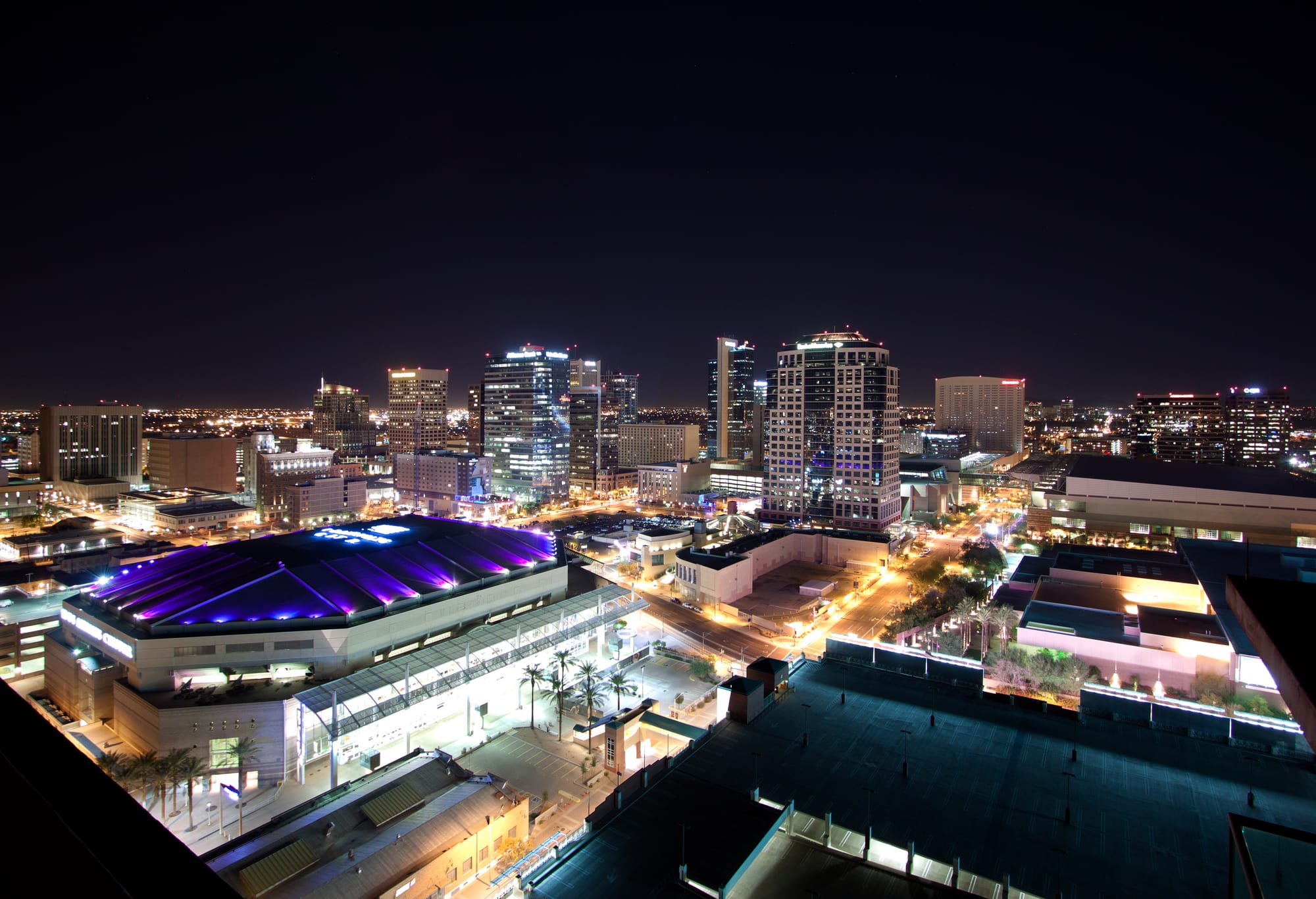
Context · Phoenix (Arizona), over whose metro area the 1997 lights were seen
Downtown Phoenix Skyline Lights.jpg · Wikimedia Commons · CC BY-SA 2.0 · open original
The night in question
On March 13, 1997, between 20:00 and 22:30, thousands of Arizona residents (from Kingman in the northwest to Tucson in the south) observed lights in V-shaped or triangular formation; later accounts extend them to Nevada and northern Sonora (Mexico). The first call to the NUFORC reporting centre came at 20:16 from Paulden, 60 miles north of Phoenix: a retired police officer saw a cluster of five red lights heading south; within minutes calls came from Prescott, Wickenburg, Glendale, Phoenix, Scottsdale and Tempe. Later analysis separated two distinct events that the public experienced as one: (1) a formation of lights that drifted slowly north to south over Phoenix between roughly 20:00 and 20:30, described by many witnesses as a solid, dark, wedge-shaped structure that blocked the stars as it passed (a Phoenix witness told USA Today they could see 'the outline of a mass behind the lights'), and which the Sky Harbor tower controllers saw without anything showing on their radar screens; and (2) a set of stationary lights that appeared over southern Phoenix around 22:00 and switched off in sequence.
The second event is the one with a solid conventional explanation. In the first weeks, Luke Air Force Base said only that 'it was not one of our planes'; in July 1997 the Maryland Air National Guard spokesman, Capt. Drew Sullins, explained that eight of the unit's A-10s were flying training missions that night over the Barry M. Goldwater range, 60 miles southwest of Phoenix, dropping parachute illumination flares (the LUU-2 type) from 15,000 feet, and that before returning to Davis-Monthan they dumped all their remaining flares at high altitude, 'one hell of a light show', in one pilot's words. The same AP report noted that this did not explain the sightings from northwestern Arizona, up to 200 miles away. The timing, position and behavior of the lights (hanging, descending slowly and going out one by one behind the Estrella mountains) are consistent with magnesium flares under parachutes. This is the accepted mundane explanation for the 22:00 phase.
The first event (the moving 20:00 formation) is the disputed residual. The most cited skeptical testimony is that of Mitch Stanley, a 21-year-old amateur astronomer who watched the lights through a 10-inch Dobsonian telescope from Scottsdale and stated that, under magnification, each light resolved into pairs mounted beneath what looked like wings: to him, a squadron of aircraft flying in formation. That observation is the main conventional argument for the first event (high-altitude aircraft whose lights, to the naked eye, looked like a single object) and strongly deflates the anomalous claim. Skeptic Robert Sheaffer attributes that formation to five A-10s of Operation Snowbird, a winter training program of the Air National Guard based at Davis-Monthan, returning to base along an assigned corridor with steady formation lights, and astronomer James McGaha reached the same conclusion. Against it stand the many witnesses who described a rigid, silent structure that hid the sky, incompatible (they say) with isolated aircraft lights, and the analysis of amateur videos by Village Labs, a Tempe special-effects firm without specific scientific training, which said it had ruled out flares and aircraft lights. Luke acknowledged that F-16s were in the air that night but denied they had anything to do with the lights.
The institutional dimension comes from Arizona Governor Fife Symington. In June 1997, when a listener asked him on his radio programme, he said it was the first he had heard of it; days later he announced he had ordered a state investigation and then called a mocking press conference at which his chief of staff appeared in an alien costume. Ten years later, in 2007, Symington wrote that he himself had seen that night 'a massive delta-shaped, craft silently navigate over Squaw Peak', that it resembled no man-made object and that it was not flares, 'because flares don't fly in formation', and explained that the press conference aimed to 'lighten the mood' and lessen the sense of panic. The reversal is itself a data point on the political pressure bearing on a senior official who reports a sighting.
Why it matters
A calibration case, instructive because within a single event a solid conventional explanation and a disputed residual coexist. The second event (flares over the Goldwater range) is genuinely explained by the Air Force and confirmed by the squadron that dropped them: a clean demonstration that a mass, emotionally intense sighting can have a mundane cause. That part of the case teaches humility: thousands of people can see something real and describe it honestly without that implying an anomaly.
The first event (the moving formation) has no official closure, but it is not free of conventional explanation either: Mitch Stanley's telescope testimony (which resolved the lights into aircraft) is the weightiest skeptical counterweight, together with Sheaffer and McGaha's identification of an A-10 formation. The dispute between Stanley and the solid-structure witnesses remains open.
Governor Symington's public reversal (from the staged mockery of 1997 to the personal testimony of 2007) is the lasting institutional component: a data point on the political and reputational pressure bearing on a senior official who acknowledges a sighting, and on how that pressure can distort the public record for years.
What's left on paper
Documented evidence
- Thousands of witnesses across Arizona, Nevada, and Sonora
- Governor Symington's testimonial reversal (1997 mockery → 2007 personal testimony)
- The Maryland Air National Guard attributed the 22:00 lights in July 1997 to flares from eight A-10s over the Goldwater Range: confirmed partial explanation
- First event (20:00 formation) with no official explanation; Sheaffer and McGaha attribute it to five A-10s of Operation Snowbird, and Mitch Stanley saw aircraft through a telescope
Sources
- Symington, F. — «Symington: I saw a UFO in the Arizona sky», CNN (9 nov 2007)
- Craven, S. — 'Intrigue persists over lights in sky', The Arizona Republic (Feb 25, 2007)
- Kitei, L. — The Phoenix Lights (2010) — Compilation of witnesses by a local physician
- Wikipedia — Phoenix Lights — Secondary source. Summarises Robert Sheaffer's and James McGaha's identifications (Operation Snowbird A-10 formation) and Mitch Stanley's observation.
- 1997 press on the Phoenix Lights: Arizona Republic (18 Mar), USA Today (18 Jun), AP (Jun) and AP/Daily News Leader (26 Jul, Maryland Air National Guard flares), reproduced in UFO Newsclipping Service nos. 334, 336 and 337 — Primary source: contemporary reports; nos. 334 and 337 are in the same archive.org collection.
Related cases
same object · same country
Stephenville
2008 · Tier A
same object · same country
Hudson Valley Boomerang
1983 · Tier A
same object · same country
Three 'UAPs' resolved: they were three commercial aircraft, per AARO's radar cross-check
2021 · Tier A
same object · same country
The MQ-9 that filmed another MQ-9 — and a wake that was video compression
2023 · Tier A