1996·Yukon Territory
Canada.Yukon Highway
Twenty-two identified witnesses in three areas along the Klondike Highway in the Yukon saw a huge, silent row of lights on the night of 11 December 1996; most accounts cluster around 8:30 p.m., and in 2012 orbit specialist Ted Molczan identified it with the re-entry of the second stage of the Cosmos 2335 rocket.
Tier B · IndicativeWhat do they mean? →
Limited evidence: a single witness, testimony gathered years later, or an account without contemporary primary documentation.
What it was
75%natural or human cause
Most likely explanation: reentry
See the split across the six explanations
Natural or human cause
No known cause
Context image (not a document from the case)
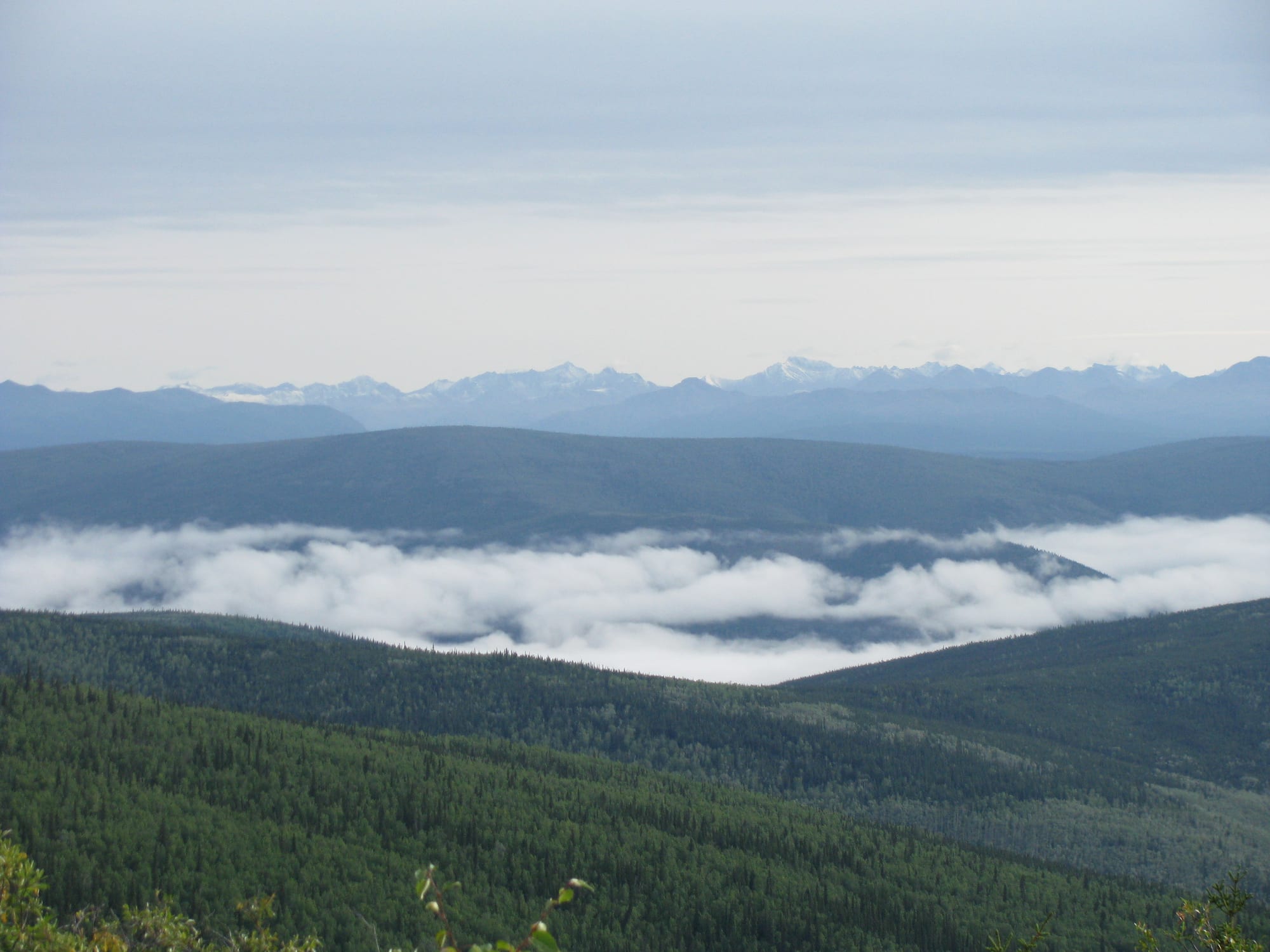
Context · Yukon Territory (Canada)
View of Ogilvie Mountains, Yukon, Canada.jpg · Wikimedia Commons · CC BY 2.0 · open original
The night in question
On the night of December 11, 1996, beginning around 8:00 p.m. local time, observers scattered along the North Klondike Highway in Yukon Territory (Canada) reported a huge, silent object in the sky. The first witness spotted it near Fox Lake, noticing a light illuminating what he perceived as a long, smooth surface; over the following hours, independent observations came in from Carmacks, Pelly Crossing, Mayo and other communities along the highway corridor. The investigator who documented the case identified 22 witnesses by name (6 at Fox Lake, 9 at Carmacks and 7 at Pelly Crossing, along 216 km of highway) and interviewed 19 of them between February and September 1999; the expanded version of his report, of June 2000, added witnesses for a total of 31.
The descriptions converge on striking features: a colossal object (some likened it to several times the size of a football stadium), with lights around its periphery, a total absence of sound, and slow movement. Several witnesses also described apparent structure: rows of lights they interpreted as windows at low altitude. The witnesses included a trapper, Don Trudeau, the only one to give his name, a brother and sister driving, four women coming out of a class in Pelly Crossing, four men in a pickup and a family who watched from their living-room window in Carmacks. Six of the nine groups first saw it from a vehicle, and all of those driving were heading north.
The civilian researcher Martin Jasek, an engineer, published his report in October 1999, updated in February 2000. By triangulating between witnesses looking at the same time from different places, he estimated the object at 0.88 to 1.8 km long. The times the witnesses gave run from about 7:00 to 10:00 p.m., but cluster around 8:30: a Fox Lake witness read 8:23 on the car clock, and the Carmacks family later reckoned they saw it around 7:00. The eight witnesses who estimated how long it lasted gave between 30 seconds and 5 to 10 minutes.
The dominant mundane explanation is robust and worth presenting head-on. In April 2012, Ted Molczan (one of the leading civilian experts in computing satellite orbits) checked the Space Track database and found a single decay that day: the second stage of the Tsiklon-2 rocket that had launched the Russian satellite Cosmos 2335 from Baikonur that same morning (designation 1996-069B), a 9.4 m, 3,700 kg body in a very low-perigee orbit. From the orbital elements he computed the final decay around 8:22–8:26 p.m. local time, with an uncertainty of 10 to 20 minutes, and a west-to-east track at about 90 km altitude and 200 to 400 km north of the witnesses, visible 11 to 35 degrees above the northern horizon for 1.4 to 2.2 minutes from Fox Lake, Carmacks, Pelly Crossing and Mayo. That matches what nearly all of them describe: lights moving left to right close to the northern horizon, silent, and going out one by one in the east. The Pelly Crossing witness who compared it with the Big Dipper drew the track almost where the calculation places it. Molczan noted that his estimate could be in error and invited alternative analyses; days later, Harro Zimmer propagated the orbit with his own perturbations program and confirmed that the final descent was in progress within sight of the witnesses between 8:25 and 8:27 p.m., dropping from about 83 to 68 km, and that the final break-up probably began during the sightings. Molczan explained the perception of a near, giant object: something 200 km away, 100 km long and moving at 7 km/s can seem 200 m away, 100 m long and moving at 7 m/s, because the angular velocity is the same. The durations the witnesses gave are two to five times longer than the computed pass, which he attributes to how unreliable such estimates are.
Why it matters
It is a case with a cartographic reconstruction based on 22 identified witnesses in three communities more than 200 km apart.
The explanation by re-entry of the Cosmos 2335 rocket body is not a weak skeptical conjecture: it comes from one of the leading civilian specialists in orbital mechanics, rests on the published orbital elements, and coincides in date, time, direction and elevation with the sighting. A re-entry phenomenon naturally explains the report's central features (enormous apparent size, silence, slowness, a row of lights) and also explains why the event was seen simultaneously from communities hundreds of kilometers apart: because it was occurring very high up, not at low altitude over the highway.
The tension left open is bounded: some witnesses described structural details (windows, a solid illuminated surface at low altitude) and two at Fox Lake said the light lit up the whole valley and they could see their shadows, features the original investigator considers hard to reconcile with a high-altitude re-entry. That discrepancy may be explained by later narrative reconstruction and witness suggestion, both well-documented phenomena, or it may point to a genuine residue. Yukon shows how a mundane astronautical event can generate, in good faith, a multi-witness 'mothership' report, and why calibration demands resisting the more dramatic reading when a verified physical explanation exists.
What's left on paper
Documented evidence
- 22 witnesses identified by Jasek at Fox Lake, Carmacks and Pelly Crossing (19 interviewed in 1999); 31 in the June 2000 version
- Jasek's triangulation: object 0.88 to 1.8 km long
- Witness times clustered around 8:30 p.m.; one witness read 8:23 on the car clock
- Molczan (2012): re-entry of 1996-069B estimated at 8:22–8:26 p.m., north of the witnesses and moving west to east, matching the direction and elevation described
Sources
- Jasek, M. — UFO Over the Klondike Highway (UFO*BC 2003)
- Rutkowski, C. — The Canadian UFO Report (2006) — Chapter on Yukon
- Jasek, M. — '22+ Witnesses Observe a UFO Larger than a Football Stadium', UFO*BC (Oct 1999, upd. Feb 2000) — Primary source: witness testimonies, drawings, times and triangulation
- Molczan, T. — 'Old Unknown Identified as a Re-entry', SeeSat-L (30 Apr 2012) — Calculation of the 1996-069B re-entry from the orbital elements and comparison with each witness
- Molczan, T. — 'RE: Old Unknown Identified as a Re-entry', SeeSat-L (2 May 2012), on Harro Zimmer's analysis — Zimmer's independent confirmation: final descent from 83 to 68 km between 8:25 and 8:27 p.m., within sight of the witnesses
- Sheaffer, R. — «Top Ten UFO Case: Yukon, Canada, 1996», Bad UFOs (abr 2012) — Secondary source: summarises Molczan's identification and Zimmer's confirmation
Related cases
Associated actors (1)