1993·RAF Cosford / RAF Shawbury, Shropshire
United Kingdom.Cosford Incident
On the night of 30–31 March 1993, a wave of sightings crossed the UK with dozens of witnesses. At RAF Cosford an RAF Police patrol saw two bright white lights giving off no beam; at RAF Shawbury a meteorological officer described a large object sweeping the field with a beam of light before speeding away. Nick Pope, of the MoD, rated it of 'considerable defence significance'. Much of the wave coincides with the re-entry of a Russian rocket's second stage; the Shawbury sighting, an hour and a half later, remained the disputed residue, and in 2005 its witness accepted it may have been a police helicopter.
Tier A · AcceptableWhat do they mean? →
Institutional evidence: several identified independent witnesses, or contemporary official documentation, without an instrumental record to corroborate them.
What it was
78%natural or human cause
Most likely explanation: reentry
See the split across the six explanations
Natural or human cause
No known cause
Read the full reasoning
The Shawbury sighting, an hour and a half later, is another: Clarke records that in 2005 it was attributed to a Dyfed-Powys police helicopter lighting up the A5 with its NiteSun, whereas in 1993 Nick Pope held that the decay did not explain the low-level sightings or the hum.Primary documents
File DEFE 24/2086: RAF Police report from Cosford and Sec(AS)2a minutes of 16 and 22 April 1993
Six pages from the British Ministry of Defence file DEFE 24/2086. It opens with an RAF Police corporal's report: on 31 March 1993, at 01:15, on patrol at RAF Cosford, he saw two circular cream-coloured lights fly silently south-east at about 1,000 feet for a minute; no base or airport he checked had aircraft airborne, and at 02:50 the Shawbury Met Office observer phoned to describe what he had seen. Next come the Sec(AS)2a minute of 16 April, which rejects a Russian rocket re-entry at 00:10 and recommends investigating an object of 'considerable defence significance' undetected by radar, and the 22 April minute to ACAS.
The National Archives (Reino Unido), DEFE 24/2086, págs. 57-58, 75-76 y 52-53 del PDF; copia digital en archive.org (BritishUFOFiles) · Open Government Licence v3.0 (Crown copyright, Ministry of Defence) · open original
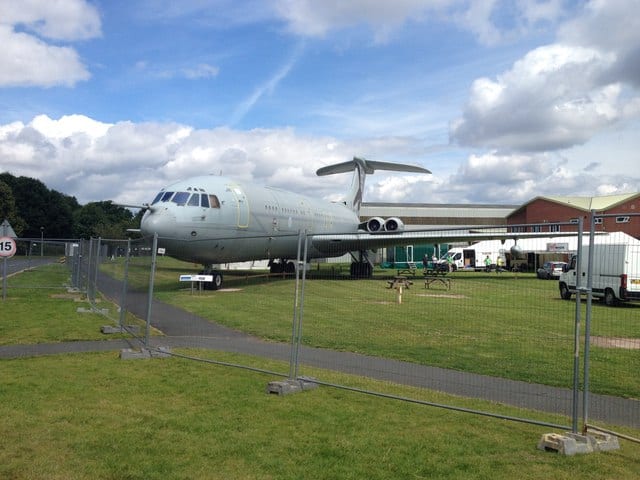
Context · RAF Cosford (Shropshire, England)
RAF Cosford - Vickers VC10 - geograph.org.uk - 5047934.jpg · Wikimedia Commons · CC BY-SA 2.0 · open original
The night in question
Between the night of 30 March and the early hours of 31 March 1993, the UK experienced a wave of sightings that spread across much of the country (from Devon and Cornwall in the southwest to the Midlands), with dozens of witnesses (about 70 in Great Britain according to David Clarke), among them police officers and military personnel; weeks later similar accounts arrived from Ireland, northern France and Spain. The core of the sightings, timed between 1:10 and 1:15 a.m., tallied remarkably: two bright white lights speeding towards the south-eastern horizon and leaving luminous trails; some saw a third light that gave the impression of a triangle, and a few reports from other times and places did not fit the pattern. At the RAF base in Cosford (Shropshire), an RAF Police patrol saw two bright white lights pass at 1:15 a.m., giving off no beam, with a slight red glow from the rear, and called nearby RAF Shawbury, where it was told no aircraft were flying; at 2:50 a.m. it was the Shawbury Met Office observer who called the patrol to report what he had seen, and the incident escalated within the British Ministry of Defence (MoD), which still kept an official channel open to receive and assess reports of aerial phenomena. Radar tapes were checked and showed no intruder.
The episode that gave the case weight occurred later at nearby RAF Shawbury: according to the Met Office log, at 01:40 GMT, that is, 2:40 a.m. local time. A Met Office observer (Wayne Elliott), a witness familiar with military air traffic, recounted seeing a large object projecting a narrow beam of light at the ground at about 400–500 feet, and estimated its size at somewhere between a C-130 Hercules transport plane and a Boeing 747 when it passed over his head at an estimated 4,000 feet. He described the object moving slowly while the beam swept the field beyond the perimeter fence 'as if it were looking for something', then accelerating away at high speed with a humming sound. In his 1996 account for the Met Office magazine he added that he had worked at military fast-jet and helicopter airfields and that the object was moving too quickly to be a helicopter, 'which seemed to be the obvious answer'. Because of its credible witness it was the most striking sighting of the whole wave, and the summary the MoD briefed to the Assistant Chief of the Air Staff (ACAS) on 22 April 1993 featured it.
The case landed on the desk of Nick Pope, then in charge of the MoD's UFO section (Sec(AS)2A). In an internal 'loose minute' he wrote that 'it seems that an unidentified object of unknown origin was operating in the UK Air Defence Region without being detected on radar; this would appear to be of considerable defence significance, and I recommend that we investigate further, within MOD or with the US authorities.' His section head suggested to ACAS that the sightings matched some characteristics of the rumoured 'Aurora' spyplane; the British Air Attaché in Washington drew a blank at the Pentagon, and Pope was told: 'I suggest you now drop this subject'. That sentence (and the official standing of the person who signed it) made Cosford the flagship case of Pope's time inside the British apparatus.
On the sceptical side, the civilian organisation BUFORA, with its consultant astronomer Gary Anthony, quickly identified the probable cause, and David Clarke later documented it from the MoD files (DEFE 24/2086 and DEFE 23/254): the second stage of the Tsyklon rocket that had put the Cosmos 2238 satellite into orbit on the afternoon of 30 March re-entered the atmosphere breaking into two or more pieces, and the simulation using US Space Command and NASA data places it over Ireland at 1:07 a.m. and crossing Devon and Cornwall between 1:10 and 1:15 a.m. The RAF Fylingdales tracking station first told Pope the decay occurred shortly after midnight, and later that it was at 2:20 a.m. 'with an error margin of an hour either way'; according to Clarke, the US Space Command and NASA space debris catalogue gives 1:15 a.m. local time, and Jonathan McDowell's GCAT catalogue dates it, with a question mark, to 23:45 UTC on 30 March (00:45 local time). On 7 May 1993 Pope objected to defence intelligence that the decay might explain the high-altitude sightings but not the low-level ones, the hum or Elliott's report; in March 1994, after receiving from the researcher Vicente-Juan Ballester Olmos the NASA and NORAD confirmation that the path of the three-country wave matched the rocket's orbit, he wrote that 'most of the UFO sightings that occurred on the night in question can be attributed to this event'. As for Shawbury, which the decay does not cover, an airman from the base told the Daily Mail in 2005 that the object was a Dyfed-Powys police helicopter following a stolen car down the A5 and lighting it up with its searchlight. Elliott told Clarke that same year that, after the warning from Cosford, he was primed to see a UFO, and that he was now convinced what he saw had been explained: 'the noise like a humming and the beam of light are very similar to what you would expect of a police helicopter'. The flight logs of the police helicopters of the time had already been destroyed, so it cannot be confirmed with certainty. Clarke records another possibility from the file itself: according to BUFORA astronomer Gary Anthony, point 9 of the MoD memo of 19 April 1993 on the radar tape replay shows an aircraft transponding at over 20,000 feet directly over Shawbury during Elliott's sighting, although Pope dismissed it as the explanation in 2006; the residue of the case is that sighting, with no instrumental backing to raise it above a single observer's testimony.
Why it matters
Cosford matters as the flagship case of Nick Pope's time inside the British official apparatus, and as a textbook example of how a wave decomposes under scrutiny. The bulk of the night's sightings has a solid prosaic explanation (the re-entry of debris from a Russian rocket, dated through space-debris catalogues of US Space Command and NASA) that fits the geography, the common direction of the lights and the timing. What remains is a single close-range sighting (Shawbury), an hour and a half later, whose witness accepted in 2005 that the hum and the beam fitted a police helicopter, with no radar record, photograph or sensor to back it.
The case's analytic value is twofold and pulls in opposite directions. First, it shows that an internal MoD memo speaking of 'considerable defence significance' is not the same as evidence of non-human technology: it is one official's reading of a single testimony, not an instrumental datum. Pope's sentence has circulated for decades as proof that 'the British government took a UFO seriously', when what it proves is that a bureaucratic channel logged and escalated a report, exactly what such a channel is meant to do. Second, it illustrates the asymmetry between the moment of sighting, when a case looks solid, and the later reconstruction, when known physics and the witness's own hedging erode it. Cosford illustrates, in sum, a pattern: apparent anomaly, mostly mundane explanation, and a small residue that does not meet the evidence bar. It serves as a counterweight to cases with multi-sensor backing.
What's left on paper
Documented evidence
- Wave of 30–31 March 1993 with dozens of witnesses (about 70 in Great Britain), including police and military personnel; core of sightings between 1:10 and 1:15 a.m.
- Close-range sighting at RAF Shawbury: large object with a beam of light sweeping the field (Met Office observer Wayne Elliott, 01:40 GMT = 2:40 a.m. local time)
- Nick Pope's 'loose minute' (MoD): object undetected by radar, of 'considerable defence significance'
- Majority prosaic explanation: re-entry of the second stage of the Tsyklon that launched Cosmos 2238 on 30 Mar 1993 (BUFORA; Clarke); in 1994 Pope accepted it explained most of the sightings
- Shawbury attributed in 2005 to a Dyfed-Powys police helicopter with a searchlight; Elliott accepted it as the explanation, although the flight logs no longer existed
Sources
- Nick Pope — 'Open Skies, Closed Minds' (1996) — Account by the MoD UFO desk officer on the case.
- Clarke, D. — 'Case Closed: 30th anniversary of the Cosford UFO flap' — Sceptical reconstruction with extracts from DEFE 24/2086, DEFE 23/254 and DEFE 24/1967 and the Shawbury weather log: rocket re-entry, Elliott's 2005 testimony.
- The National Archives (UK) — DEFE 24/2086, 'UFO reports of sightings, 30-31 March 1993' — Catalogue entry for the MoD file on the Cosford night.
- Jonathan McDowell — General Catalog of Artificial Space Objects (GCAT), satcat: 22586 (1993-018B, Tsiklon-2 stage 2) — Launched 30 Mar 1993 at 12:04 UTC; decay '1993 Mar 30 2345?' UTC.
Related cases
Associated actors (1)
.png?width=400)