1957·RAF West Freugh, Wigtownshire, Scotland
United Kingdom.West Freugh · RAF radar + Air Ministry silence
In April 1957, the Ministry of Supply Bombing Trials Unit radar at RAF West Freugh (Scotland) tracked an object for 36 minutes that held still at 50,000 ft, climbed to 70,000 ft and then accelerated to ~240 mph toward the Isle of Man. The internal intelligence report concluded they were "five reflecting objects of unidentified type and origin", while the notes for answering in Parliament suggested a possible private aircraft; base personnel were told not to talk about it. An institutional radar case with a documented parliamentary cover-up.
Tier S · SolidWhat do they mean? →
Strong evidence: a contemporary instrumental record (radar, sensor, film or photo of known provenance) that corroborates several independent witnesses.
What it was
66%no known cause
The evidence is not enough to decide between the explanations
See the split across the six explanations
No known cause
Natural or human cause
Context image (not a document from the case)
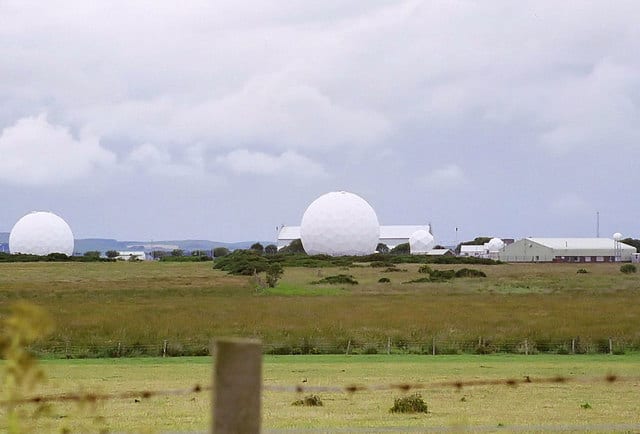
Context · RAF West Freugh (Scotland)
West Freugh Airfield - geograph.org.uk - 434249.jpg · Wikimedia Commons · CC BY-SA 2.0 · open original
The night in question
On April 4, 1957, while a test bombing exercise was being monitored over the Irish Sea, radar units of the Ministry of Supply Bombing Trials Unit, headquartered at RAF West Freugh (Wigtownshire, south-west Scotland), detected an unidentified echo. One of the stations (at Balscalloch, near Corsewall Point) did not receive the order to stand down when the exercise ended and kept tracking: it recorded a large, solid, almost stationary echo over the Irish Sea. Per the case reconstruction, the object held essentially still for about ten minutes at around 50,000 feet, 20-25 miles north of Stranraer; it then climbed to about 70,000 feet, turned south-east and accelerated to around 240 mph toward the Isle of Man. Altogether it was tracked by radar for about 36 minutes by three stations: Balscalloch; Ardwell, 14 miles south, which confirmed the echoes at the same range and height; and a third that at one point tracked four objects at 14,000 feet, in line astern 4,000 yards apart. The Air Ministry technical intelligence report (DDI Tech) of 30 April deduced that altogether five objects were detected by the three radars; that at least one rose to 70,000 feet while remaining appreciably stationary in azimuth and range; that all appeared capable of about 240 mph; and that they were very effective radar reflectors, "either of considerable size or else constructed to be especially good reflectors".
A few days later, civilian operators leaked the episode to the press; the Sunday Dispatch published it on April 7, 1957, and the case made headlines. According to the press of the time, radar stations across the country were alerted to look for the object; United Press, which specified that two radar screens on the west coast of Scotland had picked it up, quoted RAF officials suggesting a Soviet reconnaissance aircraft. An Air Ministry spokesman declined to give a detailed statement until experts had studied a full report, while the commanding officer of RAF West Freugh, Wing Commander Peter Whitworth, told the press: "I am not allowed to reveal its position, course and speed. It was no fluke or technical hitch"; in May, Air Ministry security asked him to instruct personnel that nothing occurring on the station was a proper subject for conversation in public.
Since the case was in the headlines, several Members of Parliament (among them Major Sir Patrick Wall, Conservative MP for Beverley) questioned the Air Ministry. The notes prepared for Minister George Ward to answer on 17 April said the object was tracked for 36 minutes, that no service or commercial aircraft was in the vicinity, that it could not have been a balloon "since it was moving against the wind", and suggested replying that the cause had not been established and that "it may well have been a private aircraft". An 11 April memo regretted that the Wigtownshire incident "fell into the hands of the press" and recommended not referring to two other, unpublicised cases as radar sightings. The file is part of the UK National Archives' records on aerial phenomena.
Why it matters
Military radar data with measured height and speed, performance exceeding the 1957 envelope, and an internal report concluding they were unidentified objects while Parliament was offered a private aircraft, alongside documented silence instructions.
This is not a naked-eye observer describing a light, but a military bombing-trials unit (trained personnel, calibrated equipment) tracking a radar return and recording quantitative parameters: position, height, heading, speed. That the tracking was carried out by more than one station lowers the probability of a local instrumental artifact (a propagation anomaly or a spurious echo on a single set). And the subsequent institutional chronology (leak to the press, RAF intelligence alert, Air Ministry evasions, parliamentary questioning with an answer more reassuring than the internal report, and a silence order to personnel) constitutes a textbook information-management file.
The file does not support the balloon hypothesis. The Air Ministry technical intelligence report, as quoted by the National Archives, concluded that the incident was due to "five reflecting objects of unidentified type and origin" (five, not one) and considered it "unlikely that they were conventional aircraft, meteorological balloons or charged clouds"; it added that even if balloons had been in the area they would not account for the sudden change of direction and the high-speed movement against the prevailing wind. The balloon appears only in what the ministry suggested off the record to the press days later, according to Patrick Gross: a balloon released from Aldergrove airfield, which, when journalists found it did not fit, was downgraded to a "possible" explanation. The case therefore stands as what it is: a military instrumental datum, officially unexplained, with no mundane explanation supported by its own sources, and a pattern of state silence relevant for its institutional value, not as evidence for an exotic hypothesis.
What's left on paper
Documented evidence
- Three Bombing Trials Unit radars (Balscalloch, Ardwell and a third station) tracked the echoes for about 36 minutes with height and speed measured.
- DDI (Tech) report of 30 Apr 1957: five objects, one rose to 70,000 ft almost stationary, all capable of about 240 mph; "unlikely" to be conventional aircraft, meteorological balloons or charged clouds.
- Notes for the minister (17 Apr 1957): it could not have been a balloon since it was moving against the wind; suggested answer, "it may well have been a private aircraft".
- Silence instruction to base personnel (May 1957); files AIR 20/9320 and AIR 20/9321 at the UK National Archives.
- Hypothesis attributed to Clarke and Roberts in their book, per Patrick Gross's summary (no page given): a U.S. U-2 spy plane, without documentary support.
Sources
- The National Archives (UK) — Unidentified Flying Objects (UFOs) research guide — Official National Archives guide: quotes the conclusion of the DDI (Tech) report (AIR 20/9321)
- RAF West Freugh incident, April 1957 (documentación ufológica) — Secondary source transcribing the Air Ministry documents (DDI Tech report, notes for the minister, 11 April memo) from Clarke and Roberts, and the 1957 press
- The National Archives (UK) — AIR 2/18564, 'UFO report: West Freugh 1957' — Catalogue entry for the Air Ministry file.
Related cases