1956·Suffolk, England
United Kingdom.Lakenheath-Bentwaters
Radars at two USAF bases in Suffolk tracked fast-moving targets for some five hours (13–14 August 1956), and an RAF Venom fighter reported that one got onto its tail. Blue Book closed the case as anomalous propagation; the Condon Report judged it its most puzzling radar-visual case.
Tier S · SolidWhat do they mean? →
Strong evidence: a contemporary instrumental record (radar, sensor, film or photo of known provenance) that corroborates several independent witnesses.
What it was
66%no known cause
The evidence is not enough to decide between the explanations
See the split across the six explanations
No known cause
Natural or human cause
Primary documents
Project Blue Book · record card, ATIC analysis and report IR-1-56 (extract, 4 pp.)
Four pages from the Project Blue Book file on the case. The record card (ATIC Form 329) sets the dates of 13 and 14 August 1956, about five hours of radar, ground and air observation, and the conclusion 'Anam. Propagation'; its comment says that, according to report IR-1-56, the observations 'cannot be considered as concurrent'. The AFOIN-4E1 analysis of 31 August, signed by Colonel Gordon C. Hoffman, attributes the targets to weather conditions and asks for scope photographs and temperature-inversion data. The last two pages are from report IR-1-56 of the 81st Fighter Bomber Wing: the three tracks on the Bentwaters GCA radar and the object watched through binoculars from the tower for an hour.
Project Blue Book, expediente «1956-08-7069309-Bentwaters-Lakenheath-England» (NARA, copia en archive.org), págs. 1, 27, 34 y 40 · Public domain · US Government work · open original
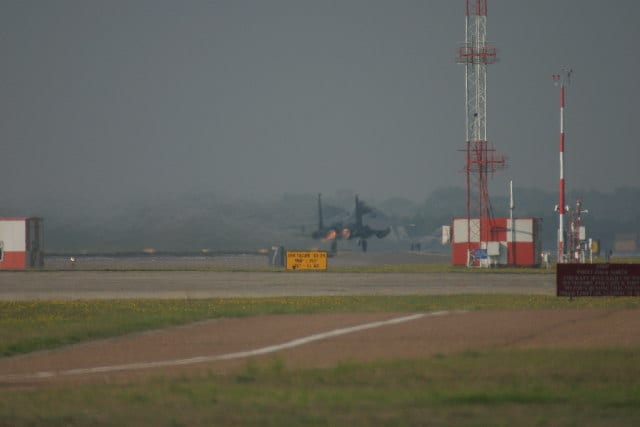
Context · RAF Lakenheath (England), base of the radar-visual incident
Lakenheath Military airfield - geograph.org.uk - 53241.jpg · Wikimedia Commons · CC BY-SA 2.0 · open original
The night in question
The episode spanned some five hours on the night of 13–14 August 1956 in eastern England (Suffolk). The Project Blue Book record card sets out two phases: Bentwaters, between 21:20 and 22:20 local time on 13 August, and Lakenheath, between 00:10 and 03:30 GMT on the 14th. Both were RAF stations operated by the USAF. Contacts were logged by the Bentwaters GCA approach radar (AN/MPN-11A) and, at Lakenheath, by three sets (TS-1D, CPS-5 and CPN-4) belonging to the radar air traffic control center and the GCA unit; there were also ground observers, tower personnel and aircrews in flight.
According to intelligence report IR-1-56, between 21:50 and 21:55Z the Bentwaters GCA tracked 12 to 15 targets that moved from about 8 miles southwest toward the northeast and appeared to merge into a single large echo. At 22:55Z another target crossed the scope from east to west at a calculated 2,000 to 4,000 mph, vanished two miles short of the station and reappeared three miles beyond it. The tower reported a bright light passing at great speed, and the pilot of a C-47 at 4,000 feet saw a light streak beneath his aircraft. Two American T-33s searched for about 45 minutes and found nothing; their pilots reported only a bright star that, in their view, could be mistaken for a UFO, and ATIC's analysis matched an amber object watched through binoculars for an hour with the position of Mars, which was making its closest approach to Earth that summer; an ephemeris calculation confirms it: Mars was rising in the east-southeast at magnitude −2.4 and stood about 6° above the horizon at 21:30Z.
Alerted by Bentwaters, Lakenheath logged a stationary target (despite the MTI filter, which should have removed motionless echoes) that then moved in straight legs of 8 to 20 miles at 400–600 mph, with no apparent acceleration phase, and stopped for several minutes before the next jump. Ground observers described round white lights. They noted an unusual number of shooting stars that night, but said the lights left no trails.
The RAF sent up a de Havilland Venom night fighter; the telex does not name its base, which later research places at Waterbeach. According to the message in the file, the pilot saw a bright white light and lost it; vectored to another target, he reported it on his radar and that he was 'locking on', then that he had lost it. The control center then reported that the target had begun a tail chase of the fighter; the pilot acknowledged, tried to circle to get behind it, said he could not shake it, and described the echo as the 'clearest target I have ever seen on radar'. He returned low on fuel; a second Venom made no contact and returned with a malfunction. The 1956 message lists the fighter's radar among the manners of observation ('Air-electronic was A-1 airborne radar equipment in… jet aircraft. Type of aircraft, Venom'); only the Blue Book record card leaves that box unticked. What has not survived is any recording from that radar: the lock-on is known from what the pilot and the controllers reported. All targets disappeared at about 03:30Z, almost exactly as scattered cloud arrived.
Blue Book closed the case as anomalous propagation ('Anam. Propagation'). ATIC's comment on the card warns that the messages gave the impression of simultaneous radar, ground and air observations, but that according to the detailed report they 'cannot be considered as concurrent'. That reading clashes with the rest of the file: in 1956 Hynek and the astronomer Fred Whipple pointed out that the statement that the radars picked up the objects later than the ground observers contradicted other portions of the report indicating that, at least at certain times, visual and radar sightings were simultaneous, an objection the Condon Report (1968) repeated; and the officer who drafted the 1956 message had written that 'three radar sets picked up the targets simultaneously'. An ATIC analysis attributed the echoes that appeared and disappeared to weather conditions favourable to anomalous propagation, and read the end of the episode the same way: the 'disappearance of all the targets in question at about the same time' was, in ATIC's view, typical of conditions changing rapidly from favourable for anomalous propagation to normal, which fitted the arrival of the cloud. J. Allen Hynek, the Air Force consultant, partly disagreed: in a memorandum of 17 October 1956 he ruled out the Perseids, because the witnesses told meteors apart from the lights, and regretted that the report lacked basic data such as exact simultaneity or weather conditions, warning that it could become 'a source of embarrassment' to the Air Force if it reached the public.
Twelve years later the case reached the University of Colorado project through an unsolicited letter from the Lakenheath watch supervisor, written from memory; the investigators checked it against the Blue Book file and found it matched on the essentials. The Condon Report's write-up of the case, Case 2, concluded that, although conventional explanations could not be ruled out, 'the probability that at least one genuine UFO was involved appears to be fairly high'. In the radar analysis chapter, physicist Gordon Thayer judged the probability of anomalous propagation small and called it 'the most puzzling and unusual case in the radar-visual files', while noting a detail consistent with it (the first echo vanishing as it overflew the Bentwaters radar) and conceding that the tail chase, taken alone, could look like a ghost image.
Why it matters
Its file brings together radars at two USAF stations, ground observers, aircrews and an RAF interception attempt, all in a single file. Its interest lies in the fact that two official bodies reached opposite conclusions from the same papers: Blue Book filed it as anomalous propagation, and the University of Colorado, in the report used to close Blue Book, presented it as its most puzzling radar-visual case. Atmospheric physicist James E. McDonald listed it in December 1969, before the American Association for the Advancement of Science, among the cases the Condon Report itself conceded to be unexplained, and devoted an analysis to it in Flying Saucer Review in 1970.
Calibration requires separating the phases. At Bentwaters the file offers plausible explanations: the echo jumping over the station is characteristic of anomalous propagation, and the light watched for an hour matches Mars. The core of the case is Lakenheath, and there two limits weigh: ATIC concluded that the radar, ground and air observations were not concurrent, although Hynek and Whipple (1956) and the Condon Report (1968) noted that this contradicts other portions of the report indicating simultaneous radar and visual sightings at certain times, and the officer who drafted the 1956 message wrote that three radar sets picked up the targets simultaneously; and the most detailed version of the chase comes from a letter written from memory twelve years later, although the 1956 message confirms its main features. Against that, Lakenheath control reported little traffic and few spurious echoes, continuous and easily tracked targets, and a target that stopped following the fighter and halted, something a ghost echo explains poorly. No single explanation covers every element, and none of them rests on preserved instrumental data: there are no scope photographs or temperature soundings from that night. It remains an unresolved residue, not proof of anomalous technology.
What's left on paper
Documented evidence
- Project Blue Book record card: 13–14 August 1956, some five hours, conclusion 'Anam. Propagation'; ATIC warns that the radar, ground and air observations 'cannot be considered as concurrent'
- Bentwaters, AN/MPN-11A GCA: 12 to 15 targets between 21:50 and 21:55Z and one at 2,000–4,000 mph at 22:55Z; bright light seen by the tower and by the pilot of a C-47
- Lakenheath: three radars (TS-1D, CPS-5, CPN-4) tracked targets that stopped and started at 400–600 mph, intermittently, between 00:10 and 03:30Z
- RAF Venom: the pilot reported a brief lock-on and a target on his tail that he could not shake; the 1956 message lists the Venom's A-1 radar among the manners of observation, though the card leaves it unticked
- Partial explanations within the file itself: Mars for the amber light at Bentwaters, and a fruitless 45-minute search by two T-33s
Show 2 more items
- Hynek memorandum (17 October 1956): rules out the Perseids and criticises the report's lack of data
- Condon Report, Case 2: 'the probability that at least one genuine UFO was involved appears to be fairly high'; Thayer calls it 'the most puzzling and unusual case in the radar-visual files'
Sources
- Project Blue Book — file '13-14 August 56, Bentwaters-Lakenheath, England' (copy on archive.org) — Primary source: record card with the 'Anam. Propagation' conclusion, the Bentwaters and Lakenheath messages, report IR-1-56, ATIC's analysis and Hynek's 17 October 1956 memorandum. The British catalogue holds no UFO file for Lakenheath 1956.
- Condon Report — Case 2 (1968) — Primary source: the Lakenheath watch supervisor's letter, excerpts from the Blue Book message and the project's conclusion ('fairly high').
- Condon Report — Section III, Chapter 5: Optical and Radar Analyses of Field Cases (Thayer) — Primary source: Thayer's analysis of anomalous propagation at Lakenheath and his assessment of it as the most puzzling radar-visual case in the files.
- McDonald, J. E. — «UFOs over Lakenheath in 1956», Flying Saucer Review 16(2), 1970 — Secondary analysis by an advocate of the case.
- McDonald, J. E. — 'Science in Default' (AAAS symposium, 1969) — Lists Lakenheath among the cases the Condon Report conceded to be unexplained.
Related cases
Associated actors (1)
