1952·Washington, D.C.
United States.Washington Flap
On the weekends of 19 and 26 July 1952, radar controllers at Washington National Airport tracked unidentified returns over the capital, some near lights seen by airline pilots, and the USAF sent F-94 fighters that found nothing conclusive. The episode triggered the largest Air Force press conference since the war. The analyses by ATIC (1952) and the Condon Report (1968) attributed the returns to anomalous propagation from temperature inversions and the lights to stars and meteors, although Ruppelt wrote in 1956 that both episodes were still carried as unknowns.
Tier S · SolidWhat do they mean? →
Strong evidence: a contemporary instrumental record (radar, sensor, film or photo of known provenance) that corroborates several independent witnesses.
What it was
66%natural or human cause
Most likely explanation: optical
See the split across the six explanations
Natural or human cause
No known cause
Primary documents
State Dept SECRET memo (Jul 28, 1952) — Nitze asks about the saucers; Samford's IAC assessment
U.S. Department of State (PURSUE Release 01) · Public domain · US Government work · open original
The night in question
The summer of 1952 was the peak of a nationwide sighting wave in the United States: Project Blue Book logged a record number of reports that year, concentrated in July. The Washington series, known in the press as 'The Big Flap' or the 'Invasion of Washington', occurred in that context.
On the night of 19-20 July 1952, around 23:40, the duty operator on the radar of the Air Route Traffic Control (ARTC) centre at Washington National Airport saw seven slow returns appear east and a little south of Andrews AFB that matched no flight; he called senior controller Harry G. Barnes, and a technician confirmed the set was working properly. The returns moved at 100-130 miles an hour with sudden bursts and, according to the account Ruppelt recorded, crossed the prohibited areas over the White House and the Capitol. The airport tower confirmed targets on its radar; Andrews approach control, by contrast, at first reported seeing nothing, and Ruppelt later noted that, although the radars' coverage overlapped, only once did all three pick up the same target at the same time. Capital Airlines pilots saw lights in positions matching returns: one, Captain S. C. Pierman, told investigators he may have seen as many as seven objects between Washington and Martinsburg, at speeds he would not attempt to estimate, and another reported a light that followed him to within four miles of the runway.
The Air Force was slow to respond: the first F-94 arrived from New Castle (Delaware) around daybreak, when the returns were gone, and found nothing. The following weekend, 26-27 July, the pattern repeated with up to twelve simultaneous returns on the ARTC radar, which Andrews approach control confirmed by telephone, while the airport tower positively identified only one. This time Major Dewey Fournet and Lieutenant Holcomb of USAF intelligence were in the radar room; Holcomb checked with the weather station, which gave a slight inversion of about 1°C, and judged that the strong returns at that moment were not due to it, while he attributed to the inversion the weak, unstable returns that continued until the early hours. The first pair of F-94s was vectored onto the targets with 'generally negative results': according to the controllers, it flew through 'a batch of radar returns' without spotting anything, although one pilot saw four lights and then a single light that 'went out'. A B-25 vectored for more than an hour remarked that each vector took it over a busy highway or intersection. Lieutenant William Patterson told the press he chased several bright lights without being able to close on them and lost sight of the last one at about two miles.
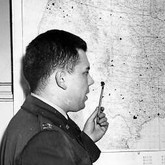
Public pressure was such that on 29 July 1952 Major General John Samford, USAF Director of Intelligence, held the press conference Ruppelt describes as the largest and longest the Air Force had held since World War II. Captain Roy James, Blue Book's radar specialist, handled the questions on the returns, and the press took temperature inversion to be the official explanation. Internally, the analysis James signed on 29 August conceded that the reports did not allow a positive and final explanation, but pointed to features typical of anomalous propagation in the controllers' descriptions: returns that were 'sporadic', 'intermittent', dropped in and out and had a 'creeping appearance'. ATIC's conclusion, sent to Fournet on 22 September, attributed the returns and lights of 26 July to mirage effects from a double temperature inversion, the lights also to distorted stars and meteors, and extended the same cause to 19-20 July. Ruppelt wrote in 1956 that, even so, both episodes were still carried as unknowns. President Truman's air aide, General Landry, called intelligence at the President's request, and Ruppelt told him the returns could have been caused by weather but that there was no proof.
The official explanation was, and remains, disputed. Astronomer Donald Menzel endorsed it; atmospheric physicist James E. McDonald rejected it years later, arguing that the inversions of those nights were too weak to produce such well-defined returns. The Condon Report (1968) reviewed the Silver Hill sounding profiles and reached the opposite conclusion: conditions on both nights were conducive to anomalous propagation, the returns were most likely its product, and the lights, with one or two possible exceptions, were meteors and scintillating stars; it added that the tracks from National, Andrews and Bolling were generally not correlated with each other or with the visual reports. It drew on a CAA study (Borden and Vickers, 1953) that in August 1952 observed very similar tracks tied to the onset of an inversion. The witnesses moved too: the Andrews tower operators who had seen an 'orange sphere' over the radio range later said it had been a star, although Ruppelt (1956, ch. 12) noted that, according to astronomical charts, there were no exceptionally bright stars where the object was seen, and that he had heard from a good source that the tower men had been 'persuaded' a bit; the F-94 pilot who had told the press and Ruppelt himself about trying to intercept some lights later stated in an official report that all he saw was 'a ground light reflecting off a layer of haze'; and an airline pilot told Ruppelt that the return he was asked to locate over the Potomac turned out to be an excursion steamboat. The episode, together with the 1952 report volume, was among the cases examined by the CIA's Robertson Panel in January 1953, the first scientific committee convened by intelligence to evaluate the phenomenon.
A primary document declassified by PURSUE illuminates the top-level reaction in Washington. A SECRET memorandum of July 28, 1952 (on the eve of the famous press conference by Major General John Samford, the USAF's intelligence director) records that Paul Nitze, head of the State Department's Policy Planning Staff, asked 'what the Air Force thought about the flying saucers'; Samford himself had delivered an assessment at the Intelligence Advisory Committee (IAC), and the memo's author recommends circulating its gist at the morning meeting. The attached note summarises that assessment: the matter 'is still a complete enigma', 'credible observers are reporting the incredible', and the radar observation may have elements of 'electronic fluke' but is sufficiently tied in with pilot observation that it cannot be attributed entirely to this; according to the author, Samford implied that the possibility of their being man-made or controlled, friend or foe, was remote. The document, embedded in this case's viewer, shows that the tracks over the capital escalated within days to strategic planning and the intelligence leadership: they were treated as a matter requiring a coordinated official position.
The sixth PURSUE release adds what happened next, inside the directorate of intelligence, in the two months after the press conference. DOW-UAP-D105, the Air Force's 'flying discs' file for September–December 1952, preserves three unsolicited technical letters addressed to General Samford, all proposing a mechanism for the search-radar returns at Washington National Airport. They are signed by an engineer at CBS Laboratories in New York, an associate professor of electrical engineering at the University of Wisconsin and the director of the Glare Research Institute; the first two converge, independently, on the same idea: that a radar beam might be ionising the air and creating the target another radar then detects.
John M. Hollywood's, from CBS Laboratories, is worth reading in full for how it is built. He proposes that a high-power, narrow-beam fire-control radar might, 'under unusual atmospheric conditions, create enough ionization along points on the beam in the upper atmosphere to allow the return of an appreciable echo to the search radar system from such points', with apparent motion 'quite haphazard, following whatever the fire control radar operator does in directing the beam'. And he then demolishes his own hypothesis on three counts: the power required is 'orders of magnitude greater' than a normal radar puts out; the echoes would come from ionospheric heights and 'therefore could not appear at ranges of a few miles from the search radar, as reported'; and it seems unlikely a coincident visual effect of any conspicuous magnitude would be produced. He offers it anyway, with a concrete experiment: have a powerful fire-control radar sweep out simple patterns and see whether they can be detected on the search radar, 'preferably at a time when flying saucer echoes are being observed'. The second, Professor John C. Weber, proposes his own bench test: a glass sphere of air at atmospheric pressure exposed to radiation of known wavelength and power density, the pressure lowered until ionisation occurs, with a separate radar watching whether the change is detectable.
What makes those letters more than amateur correspondence is the internal memorandum that accompanies them, signed by Major Dewey Fournet on 12 September 1952. Fournet records that Weber's and Hollywood's proposals 'coincide rather closely with the experiments of Mr. Scott of the Engineer Research and Development Lab at Fort Belvoir as well as with the ideas of Dr. Possony', and that for that reason 'their letters have been reviewed very carefully' and 'copies are being maintained here for further study'. The originals go to ATIC; the replies are signed by Samford himself and in the first person, and the memo expressly recommends that he sign them 'because of the professional status of the three correspondents'. It closes with an administrative line that also says something: the subject matter 'is not considered suitable for inclusion in the Daily Staff Digest'.
That memo reveals the internal state of the directorate. In September 1952, while the public position was the one set out at the press conference, inside the directorate there was an open line of work on radar-induced ionisation, with experiments already running at Fort Belvoir and a proponent of its own in-house, and the letters from outside were routed into it rather than filed. It is worth marking what the file does not establish too: no document in this release says the experiment was ever run against the Washington returns, nor what came of Scott's work. The memo is a routing note and reports no result.
And the ionisation hypothesis cannot explain the Washington returns, for a reason contained in the very letter that proposes it: the decisive objection to it is written by Hollywood himself. If the echoes came from ionospheric heights, they could not appear a few miles from the search radar, which is exactly where they appeared. The mundane candidate this file already discusses is the temperature inversion, a different mechanism that at least operates at the ranges reported and the one ATIC and the Condon Report adopted, against McDonald, who judged those inversions too weak to produce the returns. What ionisation adds is history: that of an Air Force which in September 1952 was still looking for a physical mechanism, and answered over the director of intelligence's own signature anyone who offered it one.
Why it matters
It prompted the Air Force's longest press conference since World War II and was among the cases examined by the Robertson Panel. It brings together returns on more than one radar over the capital, airline pilots who saw lights where radar showed targets, interceptors sent on two weekends, an inquiry that reached the White House and a paper trail written at the time.
Its weight must be read with the file on the table. ATIC's internal analysis and the Condon Report attribute the returns to anomalous propagation and the lights to stars and meteors, and the file itself supports that reading: the tracks from the different radars almost never coincided, the fighters saw nothing or only lights that went out, several witnesses retracted, and at least one return turned out to be a boat. What keeps the debate alive is that the CAA controllers, veterans at their job, and the intelligence officers present on 26 July judged some returns solid, that the measured inversion was weak, and that Ruppelt recorded the cases as still unknown. The case is also historically seminal: it inaugurated the pattern of a meteorological explanation announced under media pressure before the investigation was finished, while the 28 July memo shows the director of intelligence privately calling it 'a complete enigma'; and, via the Robertson Panel, it led to the deliberate policy of reducing the phenomenon's public visibility, which shaped the U.S. institutional posture for the following two decades.
What's left on paper
Minutes of Maj. Gen. John Samford's press conference, USAF — July 29 1952, the Pentagon. The largest DoD press conference since World War II.
United States Air Force · Public domain · US Government work
Documented evidence
- CAA account from the Washington National ARTC (19-20 Jul 1952): seven returns at 100-130 mph near Andrews; Andrews approach control reported seeing nothing
- Intelligence report on 26-27 Jul 1952: up to 12 returns on the ARTC scope; F-94s vectored with 'generally negative results'; inversion of about 1°C per Lieutenant Holcomb
- Press conference, Maj. Gen. John Samford, USAF (July 29, 1952); State Department memo (28 Jul 1952): to Samford the matter 'is still a complete enigma'
- Analysis by Captain Roy James (29 Aug 1952) and ATIC conclusion (22 Sep 1952): anomalous propagation from a double inversion, extended to both nights
- Condon Report (1968): returns most likely anomalous propagation, lights meteors and stars, radar tracks generally not correlated
Show 3 more items
- DOW-UAP-D105, the Air Force's 'flying discs' file for Sep–Dec 1952 (PURSUE Release 06): three unsolicited technical letters to General Samford proposing mechanisms for the search-radar returns at Washington National Airport; Memorandum by Major Dewey Fournet (AFOIN-2A2), 12 Sep 1952: the proposals 'coincide rather closely with the experiments of Mr. Scott of the Engineer Research and Development Lab at Fort Belvoir as well as with the ideas of Dr. Possony', and were therefore 'reviewed very carefully'; The same memo: the originals go to ATIC, the replies are signed by Samford in person 'because of the professional status of the three correspondents', and the subject 'is not considered suitable for inclusion in the Daily Staff Digest'
- John M. Hollywood, engineer at CBS Laboratories: a narrow-beam fire-control radar might 'create enough ionization along points on the beam in the upper atmosphere to allow the return of an appreciable echo to the search radar system'; Hollywood himself refutes his hypothesis on three counts, among them that the echoes would come from ionospheric heights and 'therefore could not appear at ranges of a few miles from the search radar, as reported'; The experiment Hollywood proposes: have a powerful fire-control radar sweep out simple patterns and see whether they are detected on the search radar, 'preferably at a time when flying saucer echoes are being observed'
- Prof. John C. Weber (electrical engineering, University of Wisconsin), 2 Sep 1952: proposes a bench test with a glass sphere, lowering the pressure until the air ionises, with a separate radar watching whether the change is detectable
Sources
- NARA — Project Blue Book, guide to the Air Force UFO records — Page of the archive holding the original files.
- Robertson Panel report (CIA, January 1953), archive.org mirror — The Washington case (19 Jul 1952) is among those examined in detail.
- Ruppelt, Edward J. — The Report on Unidentified Flying Objects (1956), text on archive.org — Account by the head of Blue Book, who followed the case from the Pentagon.
- Blue Book file on Washington (July 1952), obtained under FOIA by Clifford Stone, archive.org mirror — Primary source: CAA account, intelligence reports, Pierman interview, James's analysis (29 Aug 1952) and ATIC's conclusion (22 Sep 1952).
- Condon Report (1968), Section III, ch. 5 'Optical and Radar Analyses of Field Cases' (Washington, 19-20 and 26-27 Jul 1952) — Analysis of the Silver Hill soundings and the radar tracks.
- McDonald, J.E. — Statement on Unidentified Flying Objects, AAAS (1968)
- Department of War — DOW-UAP-D105, 'US Air Force Flying Discs File, September–December 1952' (PURSUE Release 06, 18 Sep 2026) — 170 pages of directorate-of-intelligence correspondence. Source of the three technical letters to Samford and of Fournet's memorandum of 12 Sep 1952. Not embedded for storage-budget reasons (44.4 MB; see rule E38).
Referenced by 1 case
Related cases
Associated actors (3)