Case No. 180·United States
2011·Department of Homeland Security · Washington D.C.
United States.Kona Blue · DHS prospective SAP (UAP retrieval)
Prospective Special Access Program (PSAP) proposed to DHS around 2011, derived from the DIA's AAWSAP/AATIP and led by Dr. Jim Lacatski. It proposed to study UFO technology, interview witnesses and hold recovered materials — but was terminated on February 10, 2012 without being approved, unfunded and never receiving any material. Declassified by DHS in 2023 and officially documented by AARO.
Year
2011
Tier
A
Probability
62%
Category
Document
Institutional evidence: multiple verifiable witnesses or official documentation. Three independent axes: the «tier» measures the strength of the evidence; the «probability» estimates how genuinely unexplained the case is —a natural phenomenon can remain unexplained, so it does not equal «non-prosaic»—; and the partition of explanations (below) says what it most plausibly was. So a well-documented case can have a possible hoax as its most plausible cause, and a Tier B is not, for that reason, a hoax.
Primary documents · viewer
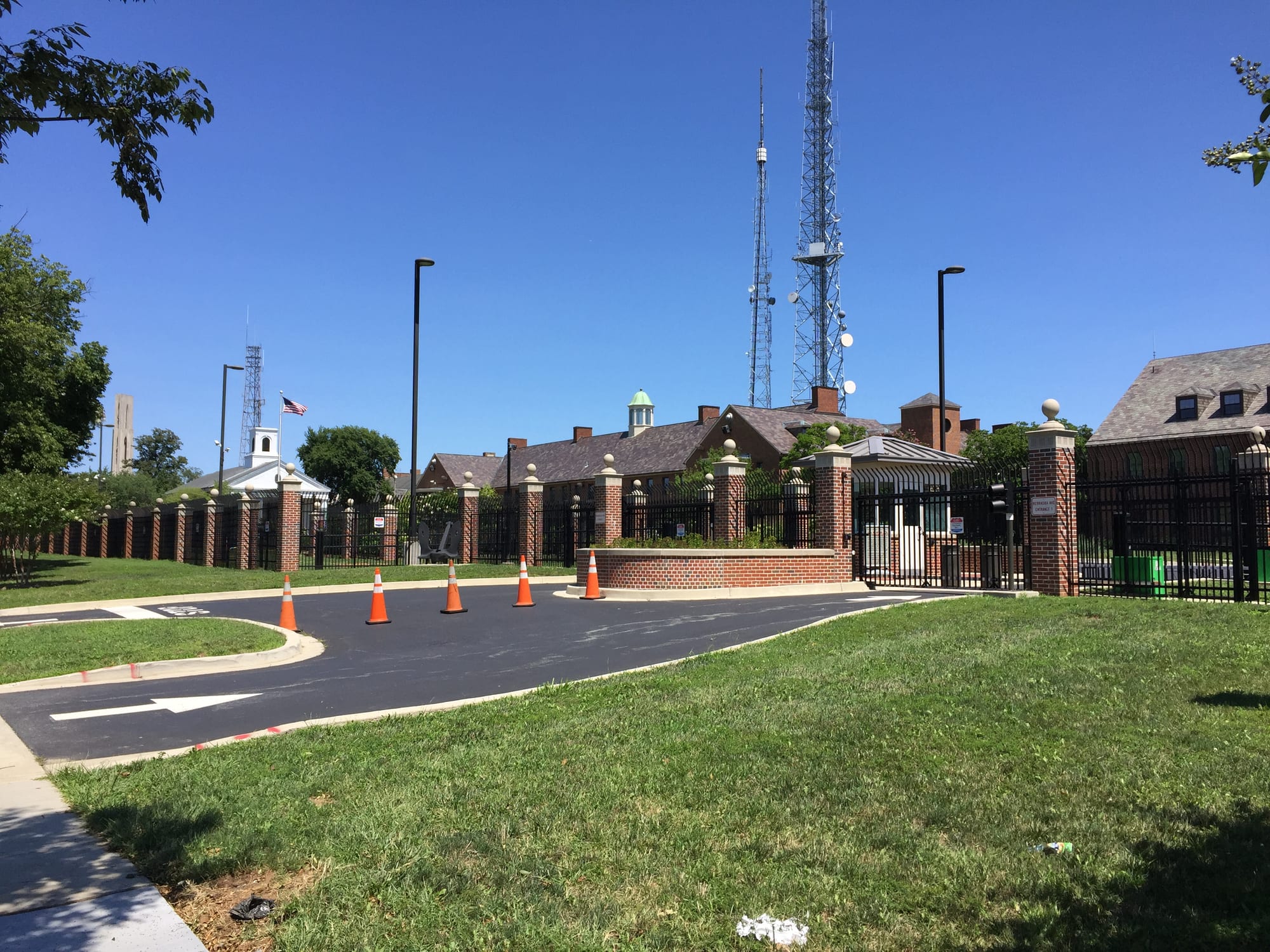
Context · the Nebraska Avenue Complex (DHS), Washington D.C.
Nebraska Avenue Complex 2017a.jpg · Wikimedia Commons · CC BY-SA 4.0 · open original
Part 01
The file in question
Kona Blue was a Prospective Special Access Program (PSAP) proposed to Department of Homeland Security (DHS) leadership around 2011. It was not an improvised effort: it arose as a direct continuation of the Advanced Aerospace Weapon System Application Program (AAWSAP) and its better-known component, the Advanced Aerospace Threat Identification Program (AATIP), managed by the Defense Intelligence Agency (DIA) between 2008-2009 and 2012 with funds allocated through congressional earmarks (driven, in the public account, by Senator Harry Reid). When the DIA funding ran out, its architects sought a new institutional home for the research line. The central driver was Dr. James (Jim) Lacatski, a DIA rocket scientist and intelligence analyst who had been the official manager of AAWSAP; colleagues from the same team joined him. The proposal contemplated studying aerospace technology of unknown origin, interviewing witnesses, investigating physical and psychological effects of encounters, and included heterodox lines inherited from AAWSAP —consciousness and remote viewing—; and, the most significant point for the corpus, it contemplated holding and analyzing recovered materials.
According to the documentation, the proponents went so far as to brief the DHS Deputy Under Secretary for Science and Technology, Dr. Tara O'Toole, on what AAWSAP had learned and the supposed benefits of Kona Blue. Despite an initial interest, the program never overcame internal opposition: it was never approved as a SAP, never received funding or material, and was terminated by DHS leadership on February 10, 2012 for lack of adequate justification. AARO itself stresses in its report that no data or material of any kind was transferred to, or collected by, DHS under Kona Blue.
The file resurfaced more than a decade later. DHS unexpectedly declassified the program's documents, which circulated publicly in early 2024, and the All-domain Anomaly Resolution Office (AARO) —the Department of Defense office created in 2022 to investigate unidentified anomalous phenomena— published an official report titled 'History and Origin of KONA BLUE' on its aaro.mil portal. The file's value is strictly documentary, not probative: it confirms by official paper that a team from the U.S. intelligence apparatus architected a formal program whose written mandate included holding recovered craft or materials —without the declassification, in itself, proving such material existed or that the program ever received it—. AARO in fact presents it as an example of a proposal that did not prosper, part of its effort to document the origin of the recovery narratives it has investigated.
Part 02
Why this case moved the needle
It is a hard documentary datum on the recovery-program hypothesis: the U.S. government drafted and formally proposed a Special Access Program whose mandate included holding materials recovered from craft of unknown origin. That the program was never funded nor received material is exactly what AARO itself stresses — and so the weight is institutional intent, not hardware confirmation. The distinction is central to a calibrated reading: there is a categorical difference between 'a group inside the state wanted to set up a material-custody program' (what the document proves) and 'the state holds recovered material' (what the document does not prove). The case is routinely cited both ways —by proponents of the recovery hypothesis as a sign that the apparatus expected to have something to study, and by skeptics as proof that such programs are born, go unfunded and die with nothing to show—; both readings fit on the paper.
It matters, too, because it connects the AAWSAP/AATIP/Skinwalker ecosystem (present in the corpus) with its attempted continuation at DHS, showing the institutional genealogy of the research line across several agencies. And because the declassification puts it on verifiable official paper —DHS documents plus a named AARO report— rather than resting on anonymous testimony, which is the field's lowest evidentiary standard. Tier A for that documentary solidity, not for evidential strength about the nature of the phenomenon: the file is strong as a document and weak as proof of hardware, and the case's calibration reflects exactly that asymmetry.
Part 03
What's left on paper
Documented evidence
- Kona Blue documents declassified by DHS (February 2023)
- Official AARO report: 'History and Origin of KONA BLUE' (aaro.mil)
- Origin in AAWSAP/AATIP (DIA, 2009-2012, congressional earmarks); driven by Dr. Jim Lacatski
- Proposed mandate: study of technology of unknown origin, custody of recovered materials, effects on witnesses
- Terminated February 10, 2012, without approval, unfunded and never receiving any material (per the official documentation)
Sources
- AARO — 'History and Origin of KONA BLUE' (informe oficial) — Official AARO primary document.
- The Black Vault — 'DoD Releases KONA BLUE Documents' — Archive of the declassified documents.
- NewsNation — 'What was the Kona Blue program, and does it mean UFOs exist?'
Patterns it exhibits (2)
Location
Department of Homeland Security · Washington D.C. · 38.89°, -77.04°
Related cases