Case No. 179·Reino Unido · IAA/SETI (global)
Developing2026·Univ. of Manchester · IAA SETI Permanent Committee (global ratification)
Reino Unido · IAA/SETI (global).SETI Post-Detection Protocol · IAA 2026 update
The IAA SETI Committee ratified in 2026 the first major revision since ~2010 of the 'post-detection protocols': how to verify and announce a detection of extraterrestrial intelligence. The analytically relevant point is the boundary it draws — it explicitly states it does NOT apply to UAP in Earth's atmosphere, in the same year the disclosure wave prompted the update.
Year
2026
Tier
B
Probability
80%
Category
Document
Limited evidence: single-witness, local or without primary verification. Three independent axes: the «tier» measures the strength of the evidence; the «probability» estimates how genuinely unexplained the case is —a natural phenomenon can remain unexplained, so it does not equal «non-prosaic»—; and the partition of explanations (below) says what it most plausibly was. So a well-documented case can have a possible hoax as its most plausible cause, and a Tier B is not, for that reason, a hoax.
Primary documents · viewer
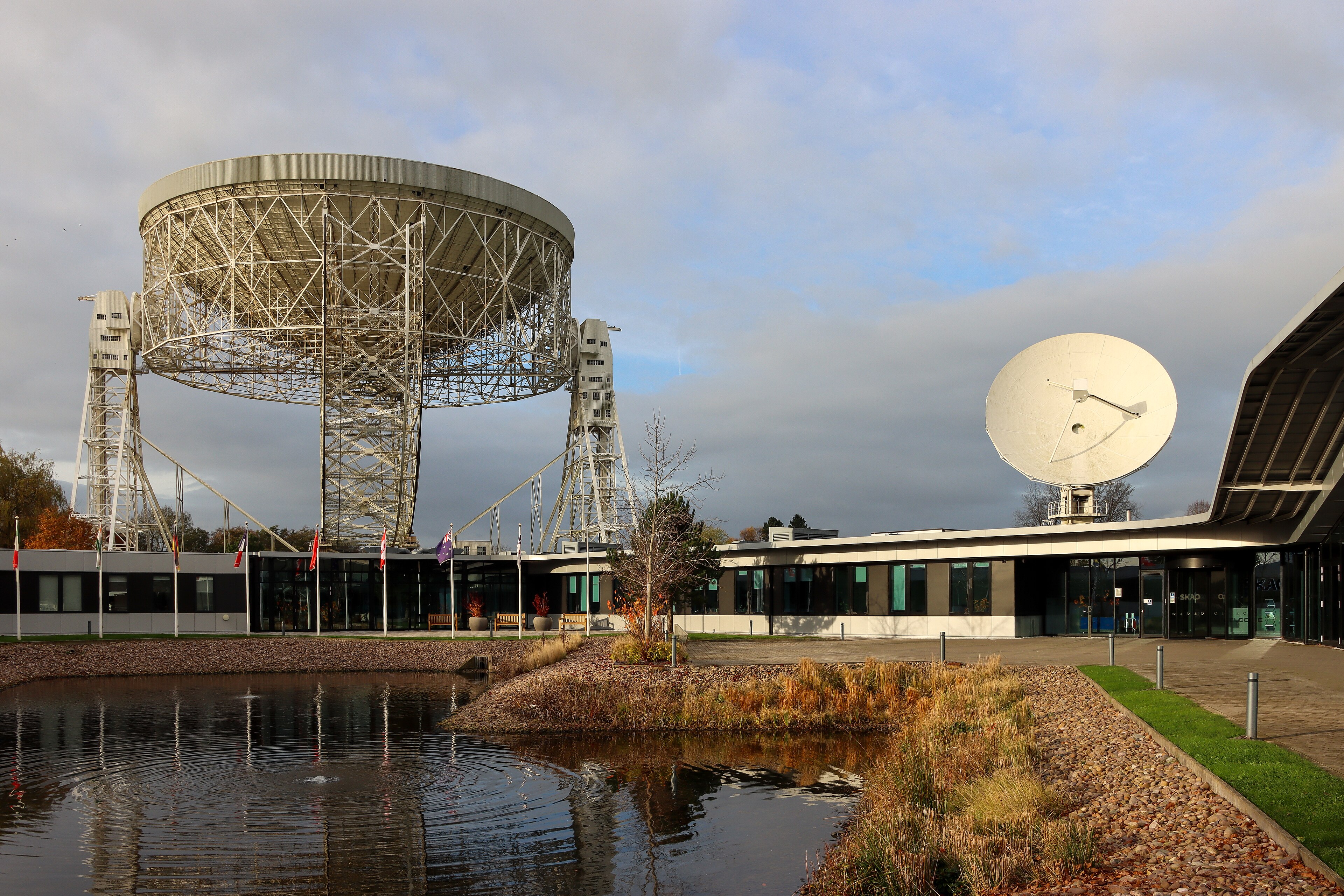
Context · Jodrell Bank Observatory (University of Manchester)
At Jodrell Bank Observatory 2024 005.jpg · Wikimedia Commons · CC BY-SA 4.0 · open original
Part 01
The file in question
The SETI Permanent Committee of the International Academy of Astronautics (IAA), in a global effort chaired by astrophysicist Michael Garrett (Sir Bernard Lovell Chair of Astrophysics, University of Manchester) and co-authored with specialists such as Kathryn Denning, Laurence Tennen and Chris Oliver, announced on June 5, 2026 a comprehensive update to the 'Declaration of Principles Concerning Activities Following the Detection of Extraterrestrial Intelligence' — the post-detection protocols, without a major revision in more than fifteen years. The process was multi-year, informed by historical precedent, evolving scientific practice and extensive community consultation; the version is formally finalized at the International Astronautical Congress and its technical draft circulated as a preprint (arXiv 2510.14506).
The update broadens scope to the full range of technosignatures: narrow-band radio signals, laser emission, infrared excess associated with large-scale energy use (Dyson-type megastructures), anomalies in astronomical measurements, and evidence of physical artifacts. It introduces independent multi-instrument verification requirements before any public announcement —no team may publicize a detection without cross-confirmation by separate institutions and telescopes—, and keeps the rule that no reply should be sent to a signal without coordinated international consultation through the United Nations. The major novelty for 2026 is that the protocol assumes a media environment transformed by social media, artificial intelligence and the 24-hour news cycle: it incorporates guidance on social-media dissemination, the handling of data leaks, the risk of AI-generated deepfakes capable of simulating a 'detection' during the verification window, and —notably— the protection of researchers from harassment, doxxing and professional retaliation that a real or rumored detection could unleash. It also creates a permanent Post-Detection Sub-Committee to keep the framework alive between revisions.
The document draws an explicit boundary: it declares it applies to the astronomical search for extraterrestrial intelligence and NOT to Unidentified Anomalous Phenomena observed in Earth's atmosphere. That exclusion is deliberate and arrives precisely as the very context that motivated the revision —a media and political landscape changed by the disclosure wave and the UAP congressional hearings— was pushing the topic to the center of public conversation. Put another way: the cultural pressure of UAP is part of what made updating the protocol necessary, and the protocol used the update to delimit clearly that its domain is the deep sky, not terrestrial airspace.
Part 02
Why this case moved the needle
It is not a sighting case — it brings no evidence of the phenomenon. Its value to the corpus is as a datum of institutional behavior: the scientific establishment (IAA/SETI), pushed by the 2026 disclosure wave, formalizes and modernizes its contact channel and, in the same gesture, reasserts the legitimacy boundary between 'respectable' astronomical SETI (technosignatures light-years away) and 'out-of-domain' atmospheric UAP. It is, in terms of the sociology of science, boundary-work: the operation by which a discipline defines what counts as legitimate science by drawing a line against what it deems contaminating. While figures such as Grusch take testimony of 'sentient plasmoid life' to the Capitol and AARO releases images of 'plasma-like' orbs, academia delimits its jurisdiction so as not to be caught in the UAP file, associated in the public imagination with pseudoscience.
There is, however, a methodological resonance that makes that boundary more porous than SETI would like. The standard the 2026 protocol raises to a norm —independent multi-instrument verification, cross-confirmation by separate institutions, a ban on announcing without replication— is exactly the one the corpus uses to qualify a case as Tier S. The yardstick by which SETI would measure an extraterrestrial radio signal is the one that, applied honestly, would validate the best UAP cases SETI refuses to look at. The exclusion, then, is not methodological but jurisdictional and reputational: UAP is not ruled out because it cannot meet the standard, but because examining it threatens the legitimacy astronomical SETI has cultivated for decades. That the trigger for the update is, in part, the UAP wave itself sharpens the irony: the phenomenon academia works to keep outside is one of the reasons it had to put its house in order. Tier B because its evidential weight on the nature of the phenomenon is nil; it enters as governance context —how institutional science would treat a contact and where it decides not to look—, not as evidence. Its high probability (80) is not a judgment about UAP, but about the documentary solidity of the institutional fact itself, grounded in a preprint and in verifiable public statements.
Part 03
What's left on paper
Documented evidence
- Update ratified by the IAA SETI Permanent Committee (2026), first major revision since ~2010; chaired by Michael Garrett (Univ. of Manchester)
- Scope broadened to all technosignatures: narrow-band radio, laser, IR excess (megastructures), astronomical anomalies, physical artifacts
- Mandatory independent multi-instrument verification before any public announcement
- Rule retained: no reply to a signal without coordinated international consultation via the UN
- New for 2026: protocols against deepfakes/AI, leaks, social media; researcher protection; permanent Post-Detection Sub-Committee
- Explicit exclusion: the document does NOT apply to UAP observed in Earth's atmosphere
- Formal finalization at the August 2026 IAC; technical preprint arXiv 2510.14506
Sources
- SETI Post-Detection Protocols — preprint técnico (arXiv 2510.14506) — Draft of the 2026 update.
- The Conversation — 'Alien first contact: how the new rules differ from science fiction'
- SETI Institute — 'Beyond Disclosure Day: The Real-World Protocols'
- Astronomy.com — 'The real disclosure day: the protocols for announcing extraterrestrial intelligence'
Patterns it exhibits (2)
Location
Univ. of Manchester · IAA SETI Permanent Committee (global ratification) · 53.48°, -2.24°
Related cases
same country · 1 pattern
Lakenheath-Bentwaters
1956 · Tier S · 80%
same country · 1 pattern
West Freugh · RAF radar + Air Ministry silence
1957 · Tier A · 55%
same country · 1 pattern
Project Condign · UK MoD UAP study
2000 · Tier A · 60%
same country · 1 pattern
Flying Saucer Working Party · first official MoD study (UK)
1950 · Tier A · 55%