1957·Mississippi–Louisiana–Texas–Oklahoma
United States.RB-47 ECM Encounter
In the early hours of 17 July 1957, a USAF RB-47H electronic reconnaissance aircraft picked up on one of its ELINT receivers an S-band radar signal whose bearings, according to the wing report, matched several times a light the pilots could see; between Louisiana and Texas the Duncanville ground radar tracked it for a few minutes. Air Defense Command carried it as unknown and Blue Book closed it as an airliner; the Condon Report, lacking the file, deemed it unidentified, and Philip Klass attributed the signals to ground radars.
Tier S · SolidWhat do they mean? →
Strong evidence: a contemporary instrumental record (radar, sensor, film or photo of known provenance) that corroborates several independent witnesses.
What it was
52%natural or human cause
Most likely explanation: airplane
See the split across the six explanations
Natural or human cause
No known cause
Primary documents
Blue Book file on the RB-47 (July 1957): record card, 55th Wing message, Air Defense Command letters, ATIC analysis and CAA letter, 9 pp.
Extract of the Blue Book file. The record card checks "Was Aircraft", "identified as American Airlines flight 655", and summarizes that the object was picked up by the B-47's radar but not by ground radar. The message from the 55th Wing intelligence officer gives the timeline from 10:10Z to 11:40Z: the 2995-3000 MHz signal, the "Utah" contacts near Fort Worth and the statement that the electronic bearings coincided with the visual observations "numerous times". Air Defense Command asks on 15 August for Chase's data sheet and on 17 October carries the sighting as unknown; ATIC's 30 October analysis finds the signals have the characteristics of a CPS-6B ground radar. The CAA letter concerns a different incident, near El Paso.
Proyecto Blue Book (NARA), vía archive.org · Public domain · US Government work · open original
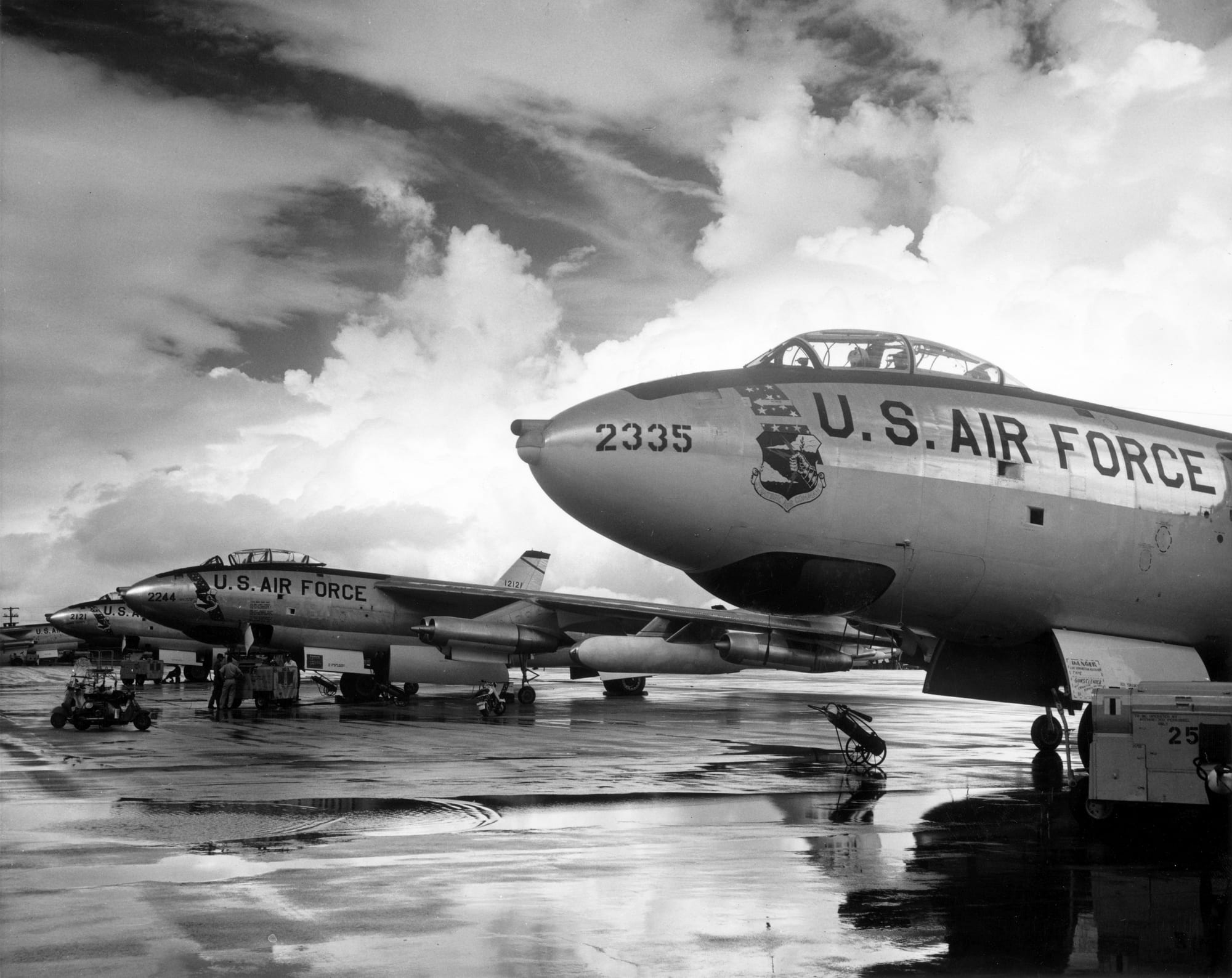
Context · a Boeing RB-47, the aircraft type of the 1957 ECM encounter
Strategic Air Command B-47 Stratojets - 020903-o-9999r-001.jpg · Wikimedia Commons · Public domain · open original
The night in question
On 17 July 1957, an RB-47H of the 55th Strategic Reconnaissance Wing (the electronic reconnaissance variant of the B-47 Stratojet) left Forbes AFB, Kansas, on a mission combining gunnery practice over the Gulf of Mexico, celestial navigation and an ELINT exercise on the way back over the southern United States. The crew of six officers was commanded by Major Lewis D. Chase: copilot James H. McCoid, navigator Thomas H. Hanley and three electronic warfare operators (John J. Provenzano, Frank B. McClure and Walter A. Tuchscherer) running the ELINT receivers in the rear of the aircraft, designed to detect and measure radar emissions.
The report written by the wing intelligence officer after debriefing the crew places the first event 'approximately at Meridian', Mississippi: the No. 2 monitor operator, McClure, picked up a signal at 2995-3000 MHz, with a 2-microsecond pulse and 600 pulses per second, moving up his bearing scope, something a fixed ground station does not do with the aircraft in straight flight, and he abandoned it. McClure recalled years later that it happened while crossing the coast near Gulfport. At 10:10 Z, now heading west, the pilot saw 'a very intense white light with light blue tint' cross in front of the aircraft from 11 to 2:30 o'clock and vanish; the copilot also saw it. McClure retuned to S-band and found the signal at 10:30 Z; at 10:39 Chase saw a huge light about 5,000 feet below, and at 10:40 the monitor showed two signals while the pilots saw two red lights. Chase got permission to leave the flight plan, asked the Duncanville (Texas) air defense radar, call sign 'Utah', for help, and accelerated to Mach 0.83 while the light pulled ahead.
The wing report records the key phase near Dallas-Fort Worth. Utah confirmed an echo about 10 nautical miles northwest of Fort Worth; around 10:50 Z the light appeared to stop, the aircraft overshot it, and Utah and the No. 2 monitor lost it at the same time; as the aircraft turned, the signal, the ground echo and the light reappeared. At 10:52 the aircraft closed to about 5 nautical miles, the light appeared to drop to about 15,000 feet and was lost visually and from the ground radar. At 10:57 the monitor had a signal but Utah had no contact; at 10:58 the pilots saw the light again, and around 11:02 they headed home for lack of fuel, with the signal behind the aircraft until it faded, at 11:40, abeam Oklahoma City. The wing concluded it had 'no doubt' that the electronic bearings coincided with the visual observations 'numerous times'. By contrast, according to Klass, Duncanville's own telex, sent four hours later, reported 'negative contact with object', and the Blue Book record card states that the ground radar did not see it.
The fate of the file explains much of the legend. Air Defense Command wrote on 17 October 1957 that it could offer no explanation and was carrying the case as unknown; an air intelligence office replied in October that it knew of no airborne S-band equipment with those characteristics. Blue Book closed it as an aircraft: the card says 'identified as American Airlines flight 655', but the Civil Aeronautics Administration letter it relies on concerns a different incident, near El Paso, whose object turned out to be flight 966. In June 1967, Chase described the encounter at a Condon Committee conference in Boulder; the committee did not find the file, dated the case to September and cataloged it as Case 5 of the Condon Report, with the phenomenon 'unidentified'. James E. McDonald interviewed all six crew members, presented it at the 1969 AAAS symposium, later located the file with the correct date and published his analysis in 1971. That same year Philip Klass, working from the same documents, concluded that the signals came from CPS-6B and FPS-10 ground radars at Biloxi and Duncanville, that the first light was a meteor and that the Utah echo may have been American Airlines flight 966 approaching Dallas; Chase and McClure accepted his explanation in writing.
Why it matters
Its analytical value lies in the architecture of the evidence: a passive onboard receiver, an active ground radar and the pilots' eyes coincided, according to the wing report, in several appearances and disappearances. If that correlation is real, no single source of error explains it. But the file shows the triangulation has weaker points than usually told: in the wing message only the No. 2 monitor records the signal (the No. 3 monitor was recording interphone and command-position conversations), although Provenzano, on the No. 1 monitor, told McDonald about a decade later (AAAS, 1969) that he also got a signal from the same bearing; the ground radar held the echo for only a few minutes and its own telex denied it; and the report's times were jotted down hastily on scraps of paper. The correlation rests on a second-hand report written by the wing intelligence officer.
The case also shows how the institutional version and its critics can fail at the same time. Blue Book closed it with a letter about another incident; the Condon Committee assessed it without the file, with the wrong date and from ten-year-old recollections, so its 'unidentified' weighs less than it seems. McDonald recovered the original documents, and with them Klass proposed a detailed prosaic explanation that the two key crew members accepted. That explanation does not close everything either: the match of the bearings with Duncanville is not perfect, the signal moved up the scope in a way Klass attributes to an unproven malfunction, and the wing held that signal and light coincided many times. What survives is a notable but disputed case, not a demonstrated anomaly.
What's left on paper
Documented evidence
- Report by the 55th Wing intelligence officer (message to SAC, 1957): timeline of ELINT signals, sightings and 'Utah' radar contacts
- Air Defense Command letter (15 Aug 1957): no explanation, the case is carried as unknown
- Blue Book record card: 'identified as American Airlines flight 655', based on a CAA letter about another incident
- Condon Report, Case 5 (1968): phenomenon unidentified, assessed without the file and with the wrong date
- Philip Klass's analysis (1971), filed in the case folder: signals from CPS-6B/FPS-10 ground radars, with comments by Chase and McClure
Sources
- Project Blue Book — 'Forbes AFB, Kansas / Oklahoma City / Ft Worth' file, 17 Jul 1957 (archive.org) — Primary source: record card, Air Defense Command letter of 15 August 1957, 55th Wing message, CAA letter of 8 November 1957 and Klass's 1971 analysis.
- Condon Committee — Scientific Study of UFOs (1968), Case 5 — Primary source: Roy Craig's investigation from 1967 interviews; he found no records and left the phenomenon unidentified.
- Thayer, G. D. — 'Optical and Radar Analyses of Field Cases', Condon Report, section III, ch. 5 — Propagation analysis of Case 5: mirage and anomalous-echo hypotheses that Thayer judged possible but not highly probable.
- McDonald, J. E. — Science in Default (AAAS, 1969) — Reconstruction from interviews with all six crew members, before the file was found.
- McDonald, J. E. — FSR Vol 16 No 3 (1970) — Secondary source: version published in Flying Saucer Review.
Related cases
same object · same country · same period
Kirtland AFB · controllers and Blue Book
1957 · Tier A
same object · same country · same period
Kinross Incident · F-89 lost over Lake Superior
1953 · Tier S
same object · same country · same period
Mariana film · Great Falls, Montana
1950 · Tier A
same object · same country · same period
USS Gyatt · the Puerto Rico radar contact and the classified Mach 3 jet
1964 · Tier S
Associated actors (1)
