1957·Kirtland AFB, Albuquerque, New Mexico
United States.Kirtland AFB · controllers and Blue Book
On November 4, 1957, between 22:45 and 23:05, amid the wave following Levelland, two Civil Aeronautics Administration controllers in the Kirtland Air Force Base tower (Albuquerque), R. M. Kaser and E. G.
Read the rest of the summary
Brink, watched through binoculars a dark object with no wings or tail, elongated vertically and with a white light at its base, that crossed the field at low altitude, stopped near a restricted area and climbed fast into the overcast; the approach radar tracked it. The Air Force attributed it to a confused light aircraft and the Condon Report accepted that without interviewing the witnesses, which James McDonald criticized in 1969.
Tier A · AcceptableWhat do they mean? →
Institutional evidence: several identified independent witnesses, or contemporary official documentation, without an instrumental record to corroborate them.
What it was
56%natural or human cause
Most likely explanation: airplane
See the split across the six explanations
Natural or human cause
No known cause
Primary documents
Project Blue Book index · sightings of 1–4 November 1957
Page of the Project Blue Book case index (unredacted copy) listing the sightings of 1–4 November 1957. The last entry for the 4th is this case: 'Kirtland AFB, New Mexico', observers 'Brink, Greer, Kaser (RADAR)', evaluation 'Aircraft'. A handwritten note beside the location reads 'case missing': the file was not in its folder when the archive was microfilmed, which is why it is absent from the digitized case files. The same page lists a second military report at Kirtland that day (observer Moreno), evaluated as a meteor.
Project Blue Book Indexes, 1947-1969 · índice de 1957, p. 16 (NARA, espejo en archive.org) · Public domain (US Government work) · open original
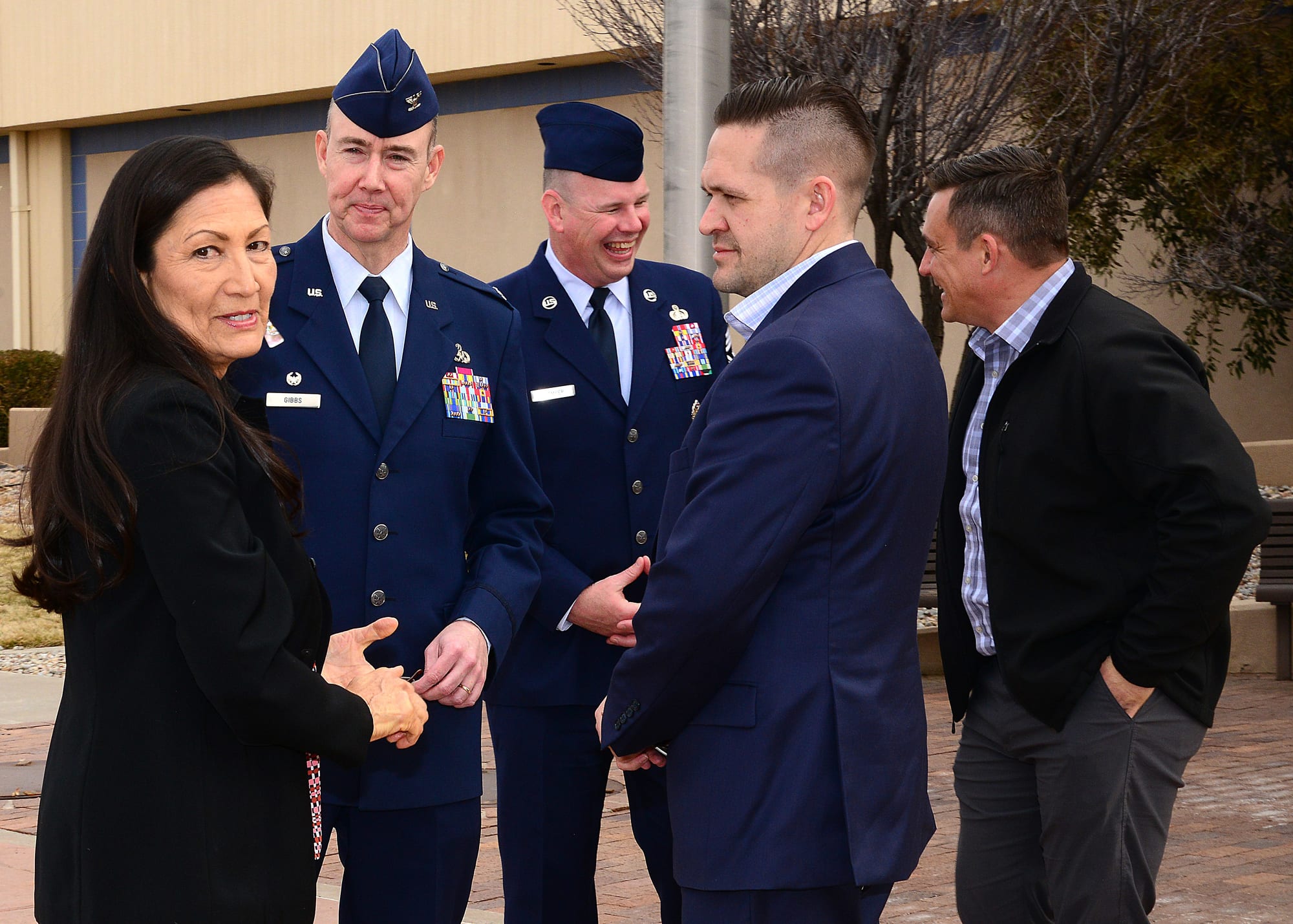
Context · Kirtland Air Force Base (New Mexico)
Deb Haaland visits Kirtland Air Force Base, Albuquerque, New Mexico (2019-02-05) 03.jpg · Wikimedia Commons · Public domain · open original
The night in question
On the night of November 4, 1957, the region was in the most intense phase of the sighting wave that had erupted two days earlier in Levelland, Texas. Between 22:45 and 23:05 local time, in the Civil Aeronautics Administration (CAA) control tower at Kirtland Air Force Base, on the southeastern edge of Albuquerque (New Mexico), two on-duty controllers, R. M. Kaser and E. G. Brink, who had 23 years of tower work between them, saw a light crossing the airfield. The Condon Report summarizes that night's weather: scattered clouds with high overcast, good visibility, thunderstorms and rain showers in the vicinity and light rain over the field.
The two written versions of the episode do not agree on every detail. According to the Condon Report summary, the observers saw "an unidentified dark object with a white light underneath," about the "shape of an automobile on end," that crossed the field at about 1,500 ft and circled as if to land on the E-W runway, reversed direction at low altitude while out of sight behind some buildings, climbed suddenly to 200-300 ft on a 120-degree heading and disappeared into the overcast in a steep climb. According to the Blue Book file, as physicist James McDonald quoted it in 1969, and according to McDonald's interviews with both controllers, the object came down in a steep dive at the east end of Runway 26, crossed runways and taxiways a few tens of feet above the ground, and through 7x binoculars they established that it had no wings, tail or fuselage, was elongated vertically, some 15 to 20 ft tall, and carried a single white light at its base. It stopped over a B-58 service pad next to Area D, a restricted area south of the runway, about 3,000 ft from the tower, for somewhere between about 20 seconds and more than a minute, then went back to the east edge of the field and climbed at a rate the witnesses compared with a supersonic aircraft; the file renders that estimate as 45,000 ft per minute.
When the object entered the clouds, the controllers called the radar approach control unit (RAPCON). The Condon Report says the operator described the blip as a "perfectly normal aircraft return" and that the track showed nothing beyond the capabilities of the more powerful private aircraft of the time. Kaser remembered something else: that the CPN-18 radar followed the target south at high speed, saw it orbit for several minutes near the Albuquerque radio range station and come back north to take up a position behind an Air Force C-46 leaving Kirtland, moving off the scope with it; the November 6 teletype, according to McDonald, gives no speed.
Captain Patrick O. Shere, from Ent AFB, interviewed the controllers on November 8. The 34th Air Division message to Air Defense Command and ATIC closed with the line "Sighting and descriptions conform to no known criteria for identification of UFOs," and the November 13 follow-up report rated both witnesses "completely competent and reliable." Blue Book filed it as 'Possible Aircraft', based, according to McDonald, solely on a closing comment by Captain Shere, who gave as reasons that the witnesses were reliable and had seen something they could not identify and that a competent operator had tracked it on radar. According to the Condon Report, the Air Force attributed it to "a small, powerful private aircraft, flying without flight plan," that became confused, attempted a landing at the wrong airport and broke off when it saw a brightly lit restricted area. University of Colorado physicist Gordon Thayer, author of that section of the report, concluded there was no reason to doubt that analysis.
One contextual element gives the case a security reading: Kirtland adjoined Manzano Base, one of the principal US nuclear weapons storage sites during the Cold War, and the object stopped next to a restricted area of the airfield itself. That opens hypotheses competing with the strayed light aircraft, such as an experimental platform of one's own or a reconnaissance attempt, but the documents consulted support neither.
Why it matters
Kirtland 1957 matters mainly for what it reveals about the investigative process. The witnesses were professional air-traffic controllers on duty, in a tower built to see all traffic on the airfield, and the Air Force itself rated them competent and reliable in 1957. Even so, the case was filed as a light aircraft, and the Condon Report accepted that conclusion without locating the two controllers: when McDonald found them in 1969, neither had heard of the Colorado project or of the official explanation, and both told him the object looked like no aircraft. McDonald also pointed out that a light aircraft turning around a few feet off the ground, at night and in rain, hidden by buildings from a control tower, was an implausible hypothesis, and he confirmed with the Albuquerque FAA office that Area D had only a chain-link fence and a few scattered one-story metal buildings.
The light-aircraft explanation rests on a concrete datum that should not be left out: according to the Condon Report, the radar operator described the blip as a normal aircraft return and the track exceeded nothing a powerful light aircraft of the time could do. Against that stand the controllers' description, made through binoculars and repeated consistently in 1957 and in 1969, and Kaser's recollection of the radar tracking, which cannot be checked because the 1957 operator had died by the time McDonald investigated. The controllers could have erred despite their experience, and a 15-to-20-foot object with no wings or tail is not something the official explanation addresses.
Kirtland anchors the category 'institutional witness vs. administrative explanation' and adds to the pattern of sightings near catastrophic-risk infrastructure, here the Manzano nuclear storage. It offers no evidence of a non-human origin; it raises the recurring question of how much of the official explanation rests on an analysis and how much on the absence of one.
What's left on paper
Documented evidence
- Testimony of CAA controllers R. M. Kaser and E. G. Brink in the Kirtland AFB tower (November 4, 1957, 22:45-23:05), interviewed by Captain Patrick O. Shere on November 8
- 34th Air Division message: "Sighting and descriptions conform to no known criteria for identification of UFOs"; November 13 report: witnesses "completely competent and reliable"
- Blip on the RAPCON CPN-18 radar; per the Condon Report, the operator described it as a "perfectly normal aircraft return"
- Project Blue Book conclusion: private light aircraft without flight plan, accepted by the Condon Report (section III, ch. 5, case 19-X)
- James E. McDonald, 'Science in Default' (AAAS, 1969): interviews with Kaser and Brink, who were never contacted by the Condon project
- Documented context: Kirtland AFB's adjacency to the Manzano nuclear storage
Sources
- Scientific Study of Unidentified Flying Objects (Informe Condon), University of Colorado (1968) — Primary source: section III, chapter 5 (G. Thayer), case 19-X, with the description of the event and the Air Force conclusion.
- Project Blue Book Archive — expedientes noviembre 1957
- Hynek, J.A. — The UFO Experience: A Scientific Inquiry (1972)
- James E. McDonald, «Science in Default: Twenty-Two Years of Inadequate UFO Investigations» (AAAS, 1969), caso 4 — Quotes the Blue Book file (November 6 teletype, Captain Shere's interview, November 13 report) and records the interviews with Kaser and Brink.
Related cases
same object · same country · same period
RB-47 ECM Encounter
1957 · Tier S
same object · same country · same period
Kinross Incident · F-89 lost over Lake Superior
1953 · Tier S
same object · same country · same period
Mariana film · Great Falls, Montana
1950 · Tier A
same object · same country · same period
USS Gyatt · the Puerto Rico radar contact and the classified Mach 3 jet
1964 · Tier S