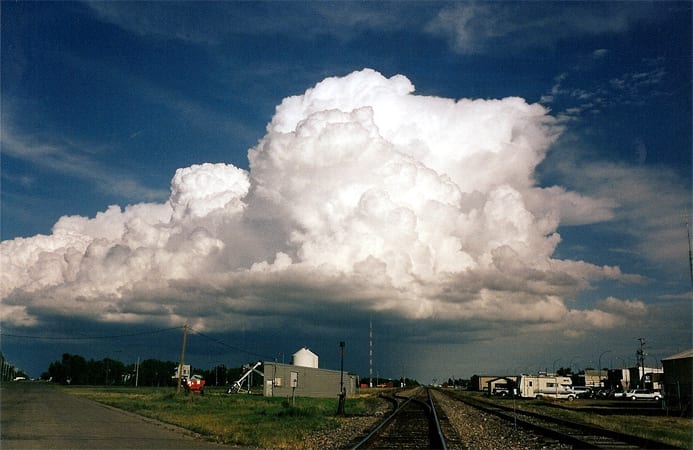
Caso Nº 267Case No. 267·CanadáCanada
1974·campo de colza cerca de Langenburg, Saskatchewanrapeseed field near Langenburg, Saskatchewan
CanadáCanada.Anillos de Langenburg · investigación RCMPLangenburg Rings · RCMP investigation
El 1 de septiembre de 1974, el agricultor Edwin Fuhr cosechaba colza cerca de Langenburg (Saskatchewan, Canadá) cuando reportó cinco objetos metálicos con forma de cuenco invertido girando a poca altura sobre el campo. Tras unos minutos ascendieron juntos, lanzaron una ráfaga que aplastó el pasto y se alejaron. Dejaron cinco anillos de vegetación arremolinada en sentido horario. La Real Policía Montada del Canadá (RCMP), por el agente Ron Morier, investigó el sitio, fotografió los anillos y consideró a Fuhr un testigo creíble sin móvil de fraude. El caso entró en el catálogo de trazas físicas de Ted Phillips (CUFOS) como uno de los mejor documentados del rubro.On September 1, 1974, farmer Edwin Fuhr was harvesting rapeseed near Langenburg (Saskatchewan, Canada) when he reported five metallic, inverted-bowl-shaped objects spinning low over the field. After a few minutes they rose together, released a gust that flattened the grass, and departed. They left five rings of clockwise-swirled vegetation. The Royal Canadian Mounted Police (RCMP), through Constable Ron Morier, investigated the site, photographed the rings, and considered Fuhr a credible witness with no fraud motive. The case entered Ted Phillips's (CUFOS) physical-trace catalog as one of the best-documented of its kind.
AñoYear
1974
TierTier
A
ProbabilidadProbability
48%
CategoríaCategory
IncidenteIncident
Evidencia institucional: múltiples testigos verificables o documentación oficial. Tres ejes independientes: el «tier» mide la fuerza de la evidencia; la «probabilidad» estima cuán genuinamente inexplicado está el caso —un fenómeno natural puede seguir sin explicación, así que no equivale a «no-prosaico»—; y la partición de explicaciones (abajo) dice qué fue más plausiblemente. Por eso un caso bien documentado puede tener como causa más plausible un posible fraude, y un Tier B no es, por eso, un fraude.Institutional evidence: multiple verifiable witnesses or official documentation. Three independent axes: the «tier» measures the strength of the evidence; the «probability» estimates how genuinely unexplained the case is —a natural phenomenon can remain unexplained, so it does not equal «non-prosaic»—; and the partition of explanations (below) says what it most plausibly was. So a well-documented case can have a possible hoax as its most plausible cause, and a Tier B is not, for that reason, a hoax.
Documentos primarios · visorPrimary documents · viewer

Contexto · Langenburg (Saskatchewan, Canadá)Context · Langenburg (Saskatchewan, Canada)
Langenburg Saskatchewan crossing.jpg · Wikimedia Commons · CC BY-SA 3.0 · abrir originalopen original
Parte 01Part 01
La noche en cuestiónThe night in question
La mañana del 1 de septiembre de 1974, Edwin Fuhr, un agricultor de 36 años, cosechaba colza con su segadora en la granja familiar cerca de Langenburg, una pequeña localidad del este de Saskatchewan, Canadá. Hacia media mañana, al acercarse a una hondonada pastosa del campo, vio lo que tomó por un objeto metálico apoyado entre la hierba alta. Detuvo la máquina y se aproximó a pie unos pocos metros, pensando que alguien había dejado un tanque o equipo abandonado. A unos cuatro o cinco metros notó que el objeto —un domo metálico gris con forma de cuenco invertido, de poco más de un metro y medio de diámetro— no estaba apoyado: flotaba a unos treinta centímetros del suelo y giraba sobre su eje. Asustado, retrocedió hacia la segadora y entonces advirtió que no era uno solo: había cinco objetos idénticos dispuestos en arco, todos girando en el mismo sentido, suspendidos sobre el pasto.
“ que habría arremolinado la vegetación, y los llamados ”
Fuhr permaneció paralizado junto a la máquina, sin atreverse a moverse, observándolos durante varios minutos. Los domos giraban en su lugar sin emitir un sonido reconocible salvo una vibración o zumbido tenue; la hierba bajo cada uno se mecía en remolino. Tras un rato, los cinco objetos ascendieron de golpe en formación, escalonadamente, hasta unos quince metros de altura. Al elevarse produjeron una ráfaga descendente de aire que aplastó el pasto a su alrededor y, según Fuhr, hizo que su segadora se sacudiera; un vapor gris salió de la base de los objetos. Luego se alejaron juntos hacia arriba a gran velocidad y desaparecieron entre las nubes bajas. Fuhr quedó tan conmocionado que tardó en reaccionar; volvió a la casa y, esa tarde, su familia y luego la policía fueron al sitio.
En la hondonada quedaron cinco anillos de pasto aplanado y arremolinado en sentido horario, de algo más de tres metros de diámetro cada uno, dispuestos aproximadamente en el patrón en que Fuhr había visto los objetos. La Real Policía Montada del Canadá (RCMP) acudió: el agente Ron Morier inspeccionó el terreno, fotografió los anillos y entrevistó a Fuhr. Morier declaró públicamente que el pasto estaba aplastado y girado, no cortado ni quemado, que no había huellas de maquinaria, animales ni personas que entraran o salieran del patrón, y que Fuhr —un hombre reservado, sin interés en publicidad— estaba genuinamente asustado y le pareció completamente sincero. La RCMP no encontró indicios de montaje ni explicación obvia, y registró el incidente sin atribuirlo a fraude. En los días siguientes aparecieron uno o dos anillos adicionales en el mismo campo, lo que aumentó el desconcierto local.
El caso fue documentado por investigadores civiles serios. Ted Phillips, asociado del Center for UFO Studies (CUFOS) de J. Allen Hynek y compilador del catálogo más extenso de casos con trazas físicas, incorporó Langenburg a su archivo y lo consideró uno de los mejor atestiguados por evidencia de superficie. El ufólogo canadiense Chris Rutkowski también lo investigó y conservó documentación. Las explicaciones prosaicas propuestas fueron dos: un torbellino o 'dust devil' que habría arremolinado la vegetación, y los llamados 'anillos de hadas' (fairy rings), patrones circulares producidos por hongos del suelo que alteran el crecimiento del pasto. Ninguna de las dos da cuenta cómoda de los cinco patrones simultáneos, de la rotación uniforme ni del relato visual de Fuhr, pero tampoco pueden descartarse: los anillos fúngicos son reales y comunes en praderas, y un testigo único bajo estrés puede sobre-interpretar un fenómeno atmosférico breve.
On the morning of September 1, 1974, Edwin Fuhr, a 36-year-old farmer, was harvesting rapeseed with his swather on the family farm near Langenburg, a small town in eastern Saskatchewan, Canada. Around mid-morning, approaching a grassy hollow in the field, he saw what he took for a metal object sitting in the tall grass. He stopped the machine and walked a few meters closer, thinking someone had left a tank or piece of equipment. At about four or five meters he realized the object —a grey metallic dome shaped like an inverted bowl, a little over a meter and a half across— was not resting on anything: it floated about thirty centimeters above the ground and spun on its axis. Frightened, he backed toward the swather and then noticed it was not alone: there were five identical objects arranged in an arc, all spinning the same way, hovering over the grass.
Fuhr stood frozen by the machine, not daring to move, watching them for several minutes. The domes spun in place with no recognizable sound beyond a faint vibration or hum; the grass beneath each swayed in a swirl. After a while, the five objects rose abruptly in a staggered formation to about fifteen meters. As they lifted they produced a downward gust of air that flattened the surrounding grass and, according to Fuhr, made his swather shudder; grey vapor issued from the base of the objects. They then moved off together upward at high speed and vanished into the low clouds. Fuhr was so shaken it took him a while to react; he returned to the house, and that afternoon his family and then the police went to the site.
In the hollow remained five rings of flattened, clockwise-swirled grass, each a little over three meters across, arranged roughly in the pattern in which Fuhr had seen the objects. The Royal Canadian Mounted Police (RCMP) responded: Constable Ron Morier inspected the ground, photographed the rings, and interviewed Fuhr. Morier stated publicly that the grass was flattened and swirled, not cut or burned, that there were no tracks of machinery, animals, or people entering or leaving the pattern, and that Fuhr —a reserved man with no interest in publicity— was genuinely frightened and struck him as entirely sincere. The RCMP found no sign of staging and no obvious explanation, and logged the incident without attributing it to a hoax. In the following days one or two additional rings appeared in the same field, deepening local bafflement.
The case was documented by serious civilian investigators. Ted Phillips, an associate of J. Allen Hynek's Center for UFO Studies (CUFOS) and compiler of the most extensive catalog of physical-trace cases, added Langenburg to his archive and regarded it as one of the best attested by surface evidence. Canadian ufologist Chris Rutkowski also investigated it and preserved documentation. Two prosaic explanations were proposed: a whirlwind or dust devil that would have swirled the vegetation, and so-called fairy rings, circular patterns produced by soil fungi that alter grass growth. Neither comfortably accounts for the five simultaneous patterns, the uniform rotation, or Fuhr's visual account, but neither can be ruled out: fungal rings are real and common in grasslands, and a lone witness under stress can over-interpret a brief atmospheric phenomenon.
Parte 02Part 02
Por qué este caso movió la agujaWhy this case moved the needle
Langenburg pertenece a la clase de casos cuyo valor analítico no descansa en la espectacularidad del relato sino en la convergencia entre un testigo único pero sin móvil y evidencia física registrada por una autoridad independiente en el lugar. Su fortaleza es que la Real Policía Montada del Canadá documentó las trazas de forma contemporánea, descartó in situ las explicaciones triviales más obvias (maquinaria, pisadas, fraude visible) y avaló la credibilidad del testigo; su límite es que sigue siendo un solo observador, sin radar, fotografía del objeto ni segundo testigo del fenómeno en vuelo. Esa asimetría —evidencia de superficie buena, evidencia del objeto nula— es exactamente la que el corpus busca calibrar sin inflar.
La lectura honesta deja el caso abierto hacia lo mundano. Los anillos de hongos y los torbellinos son fenómenos reales y frecuentes en las praderas de Saskatchewan, y la aparición de anillos adicionales en días posteriores es compatible tanto con un proceso natural en curso como con imitación. Por eso la masa mundana domina el reparto. Lo que impide cerrarlo del todo es el residuo: cinco patrones simultáneos con rotación uniforme y un relato visual coherente de un testigo que la policía consideró sincero no encajan sin fricción en ninguna de las dos explicaciones prosaicas.
Para la metodología, Langenburg funciona como caso testigo de la categoría 'traza física con investigación policial': muestra cómo una autoridad no científica puede preservar evidencia útil, y por qué incluso una buena traza de superficie no basta para mover la probabilidad lejos de lo mundano cuando falta corroboración instrumental del objeto. Es un ancla de calibración, no un caso que empuje la aguja hacia lo no humano.
Langenburg belongs to the class of cases whose analytical value rests not on a dramatic account but on the convergence of a single witness with no motive and physical evidence recorded on-site by an independent authority. Its strength is that the Royal Canadian Mounted Police documented the traces contemporaneously, ruled out the most obvious trivial explanations on-site (machinery, footprints, visible fraud), and vouched for the witness's credibility; its limit is that it remains a single observer, with no radar, photograph of the object, or second witness to the phenomenon in flight. That asymmetry —good surface evidence, no object evidence— is precisely what the corpus seeks to calibrate without inflating.
The honest reading leaves the case open toward the mundane. Fungal rings and whirlwinds are real and frequent phenomena on the Saskatchewan prairie, and the appearance of additional rings on later days is compatible with both an ongoing natural process and imitation. That is why the mundane mass dominates the allocation. What prevents closing it entirely is the residue: five simultaneous patterns with uniform rotation and a coherent visual account from a witness the police judged sincere do not fit without friction into either prosaic explanation.
For methodology, Langenburg serves as a test case of the 'physical trace with police investigation' category: it shows how a non-scientific authority can preserve useful evidence, and why even a good surface trace is not enough to move probability away from the mundane when instrumental corroboration of the object is missing. It is a calibration anchor, not a case that pushes the needle toward the non-human.
Parte 03Part 03
Lo que queda en papelWhat's left on paper
Evidencia documentadaDocumented evidence
- Testimonio de Edwin Fuhr, agricultor, recogido por la RCMP (1 septiembre 1974)Testimony of Edwin Fuhr, farmer, recorded by the RCMP (September 1, 1974)
- Declaraciones públicas del agente Ron Morier (RCMP) confirmando los anillos y la ausencia de huellasPublic statements by Constable Ron Morier (RCMP) confirming the rings and the absence of tracks
- Cinco anillos de pasto arremolinado en sentido horario, fotografiados en el sitioFive rings of clockwise-swirled grass, photographed on-site
- Ficha del caso en el catálogo de trazas físicas de Ted Phillips (CUFOS)Case entry in Ted Phillips's (CUFOS) physical-trace catalog
- Documentación del ufólogo canadiense Chris RutkowskiDocumentation by Canadian ufologist Chris Rutkowski
FuentesSources
- Rutkowski, Chris — A World of UFOs (2008), capítulo sobre casos canadienses
- Phillips, Ted — Physical Traces Associated with UFO Sightings (CUFOS, 1975)
- Regina Leader-Post — cobertura del caso Langenburg (septiembre 1974)
- Ukrainian Canadian / National Post — retrospectivas del caso Fuhr
Patrones que exhibe (2)Patterns it exhibits (2)
UbicaciónLocation
campo de colza cerca de Langenburg, Saskatchewanrapeseed field near Langenburg, Saskatchewan · 50.85°, -101.70°
Distribución de explicacionesDistribution of explanations
Este caso se clasifica entre las hipótesis del modelo: la barra reparte el 100% según cuánto pesa cada explicación (la incertidumbre se reparte entre las hipótesis que el caso apoya). Sumadas en todo el corpus producen la partición comparable. Es una pregunta distinta de la Probabilidad de arriba: aquella estima qué tan probable es que el caso sea un fenómeno genuinamente no explicado; esta reparte cuál sería la explicación.This case is classified among the model's hypotheses: the bar splits 100% by how much each explanation weighs (the uncertainty is spread across the hypotheses the case supports). Summed across the corpus they produce the comparable partition. It is a different question from the Probability above: that one estimates how likely the case is a genuinely unexplained phenomenon; this one splits which the explanation would be.
Hipótesis modalModal hypothesis: Fenómeno naturalNatural phenomenon 60% · suma 100%sums to 100%
Juicio analítico estructurado, no frecuencia calibrada. Clasificación forzada: la masa que la evidencia no permite asignar se reparte entre las hipótesis que el caso sí apoya.Structured analytical judgment, not a calibrated frequency. Forced classification: the mass the evidence cannot assign is spread across the hypotheses the case does support.
Casos relacionadosRelated cases
2 patrones2 patterns
Skinwalker Ranch · AAWSAP y experimentos de campoSkinwalker Ranch · AAWSAP and field experiments
2008 · Tier A · 60%
2 patrones2 patterns
Socorro (Zamora)Socorro (Zamora)
1964 · Tier S · 75%
2 patrones2 patterns
Dalnegorsk · Altura 611Dalnegorsk · Height 611
1986 · Tier A · 58%
2 patrones2 patterns
Ghost Rockets · FörsvarsstabenGhost Rockets · Försvarsstaben
1946 · Tier S · 58%