1957·RAF Manston, Kent, over East Anglia
United Kingdom.RAF Manston · the order to fire (Milton Torres)
According to the account he wrote in 1988, on the night of 20 May 1957 USAF Lieutenant Milton Torres scrambled from RAF Manston (Kent) in an F-86D and was ordered to fire a salvo of 24 rockets at an echo ground control was tracking over East Anglia.
Read the rest of the summary
Inside cloud and never seeing it, he locked it on his radar at 15 miles (24 km), a return 'with the proportions of a flying aircraft carrier'; the echo pulled away, broke lock and left his 30-mile scale. The next day a civilian ordered him to stay silent. No contemporary military record is known: Manston's were held by the USAF and there is no sign they were checked; the account reached the MoD in 1988 and was published in 2008.
Tier B · IndicativeWhat do they mean? →
Limited evidence: a single witness, testimony gathered years later, or an account without contemporary primary documentation.
What it was
53%natural or human cause
Most likely explanation: classified human technology
See the split across the six explanations
Natural or human cause
No known cause
Primary documents
File DEFE 24/1931: Sec(AS)2a memoranda of 22 July and 18 November 1988 on the 1957 incident
Three pages from the Ministry of Defence file DEFE 24/1931. Two handwritten Sec(AS)2a memoranda of 22 July 1988 forward an account of 'an unusual incident from 1957' and ask the Air Historical Branch to check whether it holds any record of it, 'either a UFO or RAF experimentation'. The handover memorandum of 18 November records the Daily Express's query about two USAF jets from Manston armed and ordered to fire on 20 May 1957; a handwritten note records that the Air Historical Branch confirmed Manston was under USAF control from December 1956 to May 1958, that its sortie records are held by the USAF, and that nothing is held by the PRO or the AHB.
The National Archives (Reino Unido), DEFE 24/1931, págs. 255-256 y 65 del PDF; copia digital en archive.org (BritishUFOFiles) · Open Government Licence v3.0 (Crown copyright, Ministry of Defence) · open original
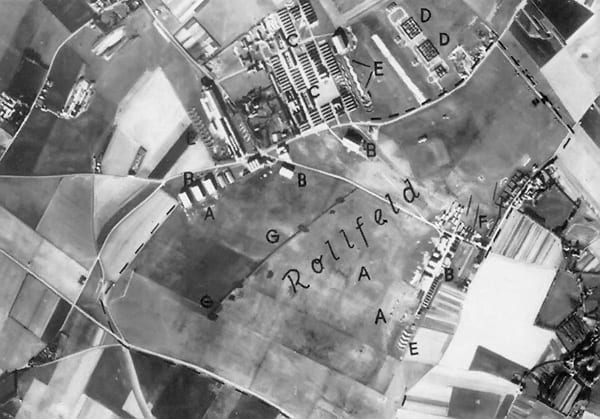
Context · RAF Manston (Kent, England), base of the interceptor ordered to fire
Luftwaffe Photograph Of RAF Manston 1939.jpg · Wikimedia Commons · Public domain · open original
Solicitor's letter to the Ministry of Defence (20 July 1988) and Milton Torres's typed account, in DEFE 24/1931
Pages 259 to 262 of file DEFE 24/1931 in the archive.org copy. The solicitor's letter, dated 20 July 1988 and headed 'Radar Blip', forwards a former American pilot's account and asks whether a 'bogus' blip caused by weather or an 'electronic warfare' experiment would explain the episode, and whether the technology to create such radar illusions existed in 1957. The pilot's typed account describes the scramble of two F-86Ds on alert at Manston on 20 May 1957 and the chase of a return that, he says, left his 30-mile range. They are private documents filed by the ministry, not Crown works.
The National Archives (Reino Unido), DEFE 24/1931; copia digital en archive.org (BritishUFOFiles) · view source
The night in question
In May 1957, East Anglia was one of the most militarized skies on the planet: an extraordinary density of USAF and RAF bases, early-warning radars and fighters on alert against the Soviet bomber threat. Everything known about the episode comes from the typed account of Milton Torres, a pilot of the USAF's 514th Fighter Interceptor Squadron. According to that text, two F-86D Sabres were that night on five-minute alert at the end of the runway at RAF Manston, Kent, in instrument weather. Ground control intercept (GCI) told him it had for some time been tracking an echo orbiting East Anglia with very little movement, that it had been motionless for long intervals and that, after the usual checks with the other control agencies, it was regarded as unidentified.
Vectored by GCI, Torres (then a 25-year-old lieutenant) climbed in afterburner to about 32,000 feet and flew inside cloud with no visual reference: 'I'm in the soup and it's impossible to see anything', he answered when asked for observations. He was ordered to fire a full salvo of his 24 Mighty Mouse rockets, asked for authentication and received it. He found the echo where he was told, 30 degrees to port at 15 miles (24 km), and described it as a return that was 'burning a hole in the radar', similar to a B-52's, with 'the proportions of a flying aircraft carrier'; he locked it within seconds, at the system's maximum range. About ten seconds before firing, the overtake indicator swung from about 800 knots closing to 200 knots opening, the largest negative value the equipment displayed; the echo pulled away, broke lock and left his 30-mile scale, and GCI told him it had lost it too, within two sweeps. Torres wrote that the real speed could not be measured, but that his impression was that the object was traveling at '2 digit mach numbers'. He returned to Manston without firing and without having seen anything by eye.
The next day, according to Torres, a civilian who looked like 'a well dressed IBM salesman' questioned him in the squadron operations area, told him the matter was highly classified and threatened him with a national security breach if he spoke of it, even to his commander. Torres stayed silent for about thirty years. In May 1988 the two pilots met at a veterans' reunion at Manston; Torres then wrote his account, and a British solicitor looking into the case sent it to the Ministry of Defence on 20 July 1988, asking whether it had been a bogus blip caused by the weather or an electronic-warfare experiment. The MoD acknowledged it and checked with the Air Historical Branch, which replied that Manston was under USAF control from December 1956 to May 1958, that its sortie records were held by the USAF and not the RAF, and that it held nothing; the file lists USAF contacts but records no reply from them. Torres's wingman, Dave Roberson, sent his own account with significant differences: he recalled an unarmed training flight, a landing at RAF Bentwaters to load rockets and several unknowns extending as far as Scotland; he did not recall any warning to keep silent, though he said that did not surprise him and that he had no reason to doubt Torres's account. On the essentials, however, he confirmed it: 'we did chase UFO's that evening'. The controller told him the unknowns 'were changing speed and altitude quite frequently', and the low bogey he himself was vectored onto 'either accelerated or descended and the controller lost him'. The correspondence became public in the MoD's UFO file release at the National Archives in October 2008, and Torres then confirmed his identity to the press.
Why it matters
In Torres's account, command orders fire: a full salvo of rockets at an unidentified echo over East Anglia. If the order was given as he remembers it, it measures how seriously air control took that contact. But the order exists only in one pilot's memory, written thirty-one years later; his wingman does not mention it, and no contemporary record (from GCI, the RAF or the USAF) confirms it. The same holds for the hypersonic departure: Torres's equipment could only show 200 knots opening, and the 'two-digit Mach' is his inference, not a measurement. An echo that pulls away from an interceptor flying above Mach 0.9 and vanishes from ground radar within two sweeps is still notable, but it is not the measured acceleration sometimes attributed to it.
What the case does show is how the Cold War could turn an ambiguous echo into an order to fire, and how the silence imposed on a pilot makes such an episode surface decades later and without paperwork. Its limits are these: the contact was radar-only, with no visual acquisition, inside cloud; the two witnesses disagree on basic facts, such as whether they launched from alert or on a training flight; and the only documentary trace is the 1988 correspondence. Even so, Roberson's letter independently corroborates the core of the episode: that night they chased unknowns the controller saw changing speed and altitude, and one slipped away from him too. The only named prosaic hypothesis remains open: an electronic-warfare exercise generating false targets on radars. In 1988 a researcher asked the Ministry of Defence whether it had been such an experiment, and the Ministry found no reference to the incident; historian David Clarke noted in 2008 that the CIA once had a program intended to create phantom signals on radar. Torres considered the second possible, though not probable.
What's left on paper
Documented evidence
- Typed account by Milton Torres (1988), in UK National Archives file DEFE 24/1931
- Solicitor's letter to the MoD (20 Jul 1988) raising a weather-caused bogus blip or an electronic-warfare experiment
- F-86D radar lock at 15 miles on a return 'with the proportions of a flying aircraft carrier', with no visual contact
- Echo's departure at 200 knots opening (the maximum displayed) and loss from ground radar within two sweeps, per Torres
- Letter from the wingman, Dave Roberson (DEFE 24/1931, pp. 66-67): confirms the chase ('we did chase UFO's that evening') and targets changing speed and altitude, but differs on the training flight and does not recall a silence warning, which he says does not surprise him
- No contemporary record: neither the MoD nor the USAF found documentation of the incident
Sources
- The National Archives (UK), DEFE 24/1931 — MoD UFO correspondence, 1988 (copy on archive.org) — Primary source: Torres's typed account, the solicitor's letter of 20 July 1988 with the two hypotheses, and MoD acknowledgements (pp. 254-262 of the PDF), and Dave Roberson's letter (pp. 66-67). The case continues in DEFE 24/1942.
- Satter, R. G. (AP) — 'U.S. pilot was ordered to shoot down UFO', NBC News, 20 Oct 2008 — Report on the 2008 release: no British or US military record, the second pilot's diverging account and Torres's statements.
- History of Manston Airfield — «USAF F-86D from Manston ordered to fire on UFO» — Secondary source: transcribes the Torres and Roberson accounts as they appear in the MoD files.
- Hansard — House of Commons, 'Unidentified Flying Objects' (15 May 1957) — The Air Secretary's official figures on unidentified objects: 5 so far in 1957 and 6 in 1956. Open Parliament Licence.
Related cases