1952·North Sea / RAF Topcliffe, Yorkshire
United Kingdom.Operation Mainbrace · NATO Fleet Wave
During Operation Mainbrace (September 1952), NATO's large naval exercise in the North Sea, several military sightings occurred with different outcomes. Blue Book closed as a balloon the silver sphere photographed from USS Franklin D. Roosevelt on 20 September, after the Navy reported that the carrier itself had launched a weather balloon with a radar reflector shortly before. The disc that five Shackleton aircrew saw follow a Meteor over RAF Topcliffe on 19 September remained unexplained. Other episodes, such as the Willemoes near Bornholm, rest only on the press and later accounts.
Tier A · AcceptableWhat do they mean? →
Institutional evidence: several identified independent witnesses, or contemporary official documentation, without an instrumental record to corroborate them.
What it was
60%natural or human cause
Most likely explanation: balloon
See the split across the six explanations
Natural or human cause
No known cause
Primary documents
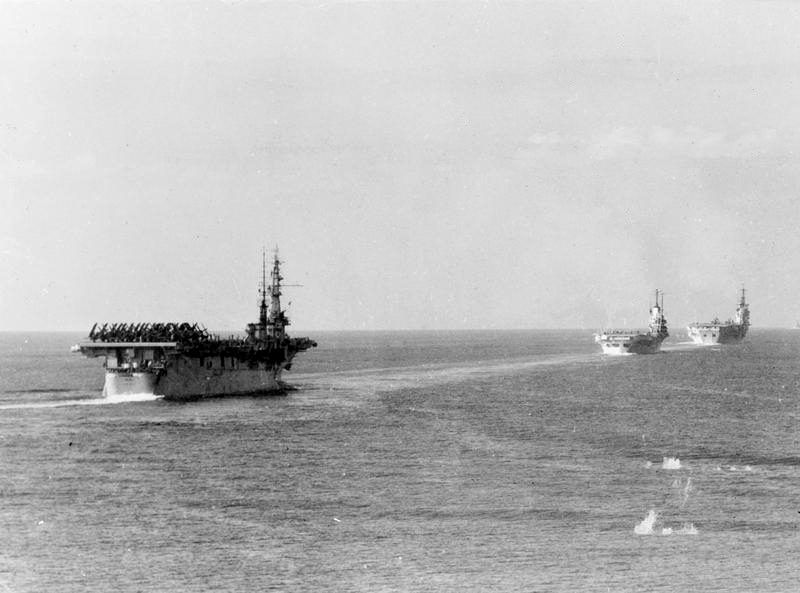
Operation Mainbrace · the allied fleet in the North Sea, September 1952 (IWM A32288)
Imperial War Museum (A32288) vía Wikimedia Commons · Public domain · open original
Denmark · declassified Air Force UFO files
In February 2009 the Royal Danish Air Force declassified the UFO files it had gathered over some three decades and handed the civilian association SUFOI 329 pages of reports from 1978–2002, with the official justification that there was nothing secret in them. The archive records on the order of 15,000 sightings, of which more than 200 were left unresolved; most were explained as aircraft, weather phenomena and similar confusions. Among the older files is the report of a luminous triangular object north of Bornholm during NATO's Mainbrace exercise in September 1952. The archive's value lies in its institutional transparency, not in any proof of anomaly.
The night in question
Operation Mainbrace was NATO's largest naval exercise since World War II: from September 14 to 25, 1952, some 200 ships from nine nations (including the carriers USS Franklin D. Roosevelt and HMS Eagle), nearly a thousand aircraft and about 80,000 personnel operated between the North Sea and the Baltic approaches, rehearsing the defense of northern Europe under Soviet watch. Over that theater saturated with sensors and trained observers, in less than two weeks, a series of sightings accumulated that reached the press and British and American intelligence records.
On 13 September, according to the press and later compilations (the original report has not been located) the crew of the Danish torpedo boat Willemoes, north of Bornholm, reported a bluish triangular object moving very fast toward the southeast. Six days later, on 19 September, there was a sighting at RAF Topcliffe (Yorkshire). In his report to the station commander, preserved at the UK National Archives (AIR 16/1199), Flight Lieutenant John Kilburn of 269 Squadron said he was on the airfield with four other Shackleton aircrew watching a Meteor fighter descend, at about 5,000 feet, when one of them saw a silver, circular object between 10,000 and 20,000 feet and some five miles astern of the aircraft. They first took it for a parachute or an engine cowling; the object descended swinging 'similar to a falling sycamore leaf', appeared to follow the Meteor as it turned towards Dishforth, stopped, rotated on its own axis and accelerated towards the west before turning onto a south-easterly heading and disappearing, all within 15 to 20 seconds. The press carried it within days, distorted: an INS wire spoke of ten officers and men aboard a bomber.
On 20 September, aboard USS Franklin D. Roosevelt, photographer Wallace Litwin, sent by Metropolitan Sunday Newspapers to cover the exercise, saw a round object some 500 to 1,000 feet above the stern shortly after four in the afternoon and took three colour transparencies as it rose and moved away. According to his letter, he was with a helicopter pilot, Lt. 'SEE' (the surname is partly redacted), who 'saw it too, at the same time as I was photographing it'; that pilot left no statement of his own in the file. His letter, reproduced in the Blue Book file, holds that it was not the ship's weather balloon, which according to the aerologist had been launched at 15:30 and lost in the clouds in about 50 seconds. Major Dewey Fournet of USAF Intelligence received the transparencies on 2 October, had enlarged copies made for Blue Book and returned the originals. The Navy Second Fleet's reply of 6 November states that no official investigation had been made until the USAF asked, that a 1,500-gram aerological balloon with a radar reflector was launched from the Roosevelt shortly before the pictures were taken, and that this balloon, about 8 feet in diameter at sea level and expanding with altitude, 'is believed to be the object sighted'; no other ship in the formation released balloons that afternoon. The Blue Book card carries the conclusion 'Balloon'. Ruppelt gave another version in his 1956 book: that naval intelligence found no one had launched a balloon and that the photos were excellent; the primary file does not support it.
Ruppelt added two more episodes: on 21 September, six RAF pilots in a Meteor formation over the North Sea reportedly saw a bright spherical object coming from the fleet that later seemed to follow one of them; and he placed the Topcliffe case 'on the third consecutive day', with a Meteor scrambled to intercept, details that do not match Kilburn's report. He also wrote that an RAF intelligence officer in the Pentagon told him these sightings led the RAF to 'officially recognize' the phenomenon. No primary record of the Meteor pursuit has been located. A USAF telex to the allied naval command in Oslo obtained only a reply, from the US naval attaché in Norway, that there was no official knowledge of the cited incidents, although the Norwegian air force was then investigating two official and numerous vague reports of cigar-shaped objects over southern Norway.
Why it matters
Mainbrace brought together multiple sightings by military observers during an operation where identifying everything that flies was doctrine. Reading the primary file forces its pieces apart. The one usually presented as the central evidence, the Franklin D. Roosevelt photo series, was neither lost nor left unevaluated: the transparencies went through USAF Intelligence, were copied for Blue Book, and the case was closed as a balloon, with the Navy identifying an aerological launch from the same carrier shortly before the pictures. Litwin's contrary testimony about the balloon's timing is part of the case and deserves recording, but the official conclusion was not an open mystery.
What remains is Topcliffe: a signed, contemporaneous report by five aircrew of a flying unit, with a coherent 15-to-20-second description that they themselves began by taking for a parachute or an aircraft part. No known British file resolved it; a balloon or a reflective object at high altitude could account for the swinging descent, but the final acceleration does not fit easily. The rest of the wave (the Willemoes, the Meteors of 21 September) depends on the press of the time and on Ruppelt's book, which in this episode departs from the record in several details. The institutional consequence is documented: the sightings made headlines, unsettled the Air Ministry and, according to historian David Clarke, who worked with those files, helped lead the ministry from 1953 to collect UFO reports on a permanent basis, even though the Flying Saucer Working Party had recommended in 1951 that no further investigation be made.
What's left on paper
Documented evidence
- Report by Flight Lieutenant John Kilburn (269 Squadron) on RAF Topcliffe, 19 Sep 1952 (AIR 16/1199): five Shackleton aircrew see a silver, circular object swing down behind a Meteor, rotate and accelerate away; total duration 15 to 20 seconds
- Blue Book file on USS Franklin D. Roosevelt (20 Sep 1952): letter from photographer Wallace Litwin and three colour transparencies copied by the USAF and returned to their author
- Second Fleet telex (6 Nov 1952): aerological balloon with radar reflector launched from the Roosevelt shortly before the pictures, 'believed to be the object sighted'; Blue Book card: 'Balloon'
- Telex from Oslo: no official knowledge of the cited incidents; the Norwegian air force was investigating reports of cigar-shaped objects in the same period
- Willemoes (13 Sep) and pursuit by six Meteors (21 Sep): only in the press and in Ruppelt's book (1956), with no primary record located
Sources
- Project Blue Book — file 'At sea on USS Franklin D. Roosevelt', 20 Sep 1952 (NARA), archive.org mirror — Primary source: card ('Balloon'), Litwin's letter, USAF memo on the transparencies and telexes from the Second Fleet and Oslo.
- The National Archives (UK) — AIR 16/1199, 'Flying saucers: occurrence reports by service personnel at Topcliffe station' (Sep 1952) — Catalogue entry for the report by Kilburn and the Topcliffe personnel.
- David Clarke — 'The Topcliffe Incident' (Sign Historical Group), with the transcript of Kilburn's report (AIR 16/1199) — Secondary: transcript of the primary document and Air Ministry context.
- Edward J. Ruppelt — The Report on Unidentified Flying Objects (1956), text on archive.org — Account by the head of Blue Book, written years later; it differs from the file on the Roosevelt case and on the Topcliffe date.
- Wikipedia — Operation Mainbrace — Secondary: context of the exercise.
- Danish Defence — the Air Force's UFO archive published in 2009 — The official page with the archive's four scanned PDFs (329 pp.).
Related cases
same object · same period
Fort Monmouth · the case that revived Grudge
1951 · Tier A
same explanation · same country · same period
Farnborough · test pilot Hubbard's discs
1950 · Tier B
same object · same period
Gorman Dogfight · F-51 vs. maneuvering light (Fargo)
1948 · Tier A
same object · same period
Roswell
1947 · Tier A