1959·Redmond, Oregon
United States.Redmond, Oregon · police, FAA and six F-102s
Before dawn on September 24, 1959, police officer Robert Dickerson and FAA specialist Laverne Wertz watched a very bright light over Redmond, Oregon, for more than an hour, low in the northeast, hovering around one point though it seemed to move rapidly toward and away from them.
Read the rest of the summary
At the same time the Keno radar held a return in the area, and six F-102s, an F-89, a helicopter and a light plane carrying a Geiger counter were sent out, finding nothing. The operators attributed that return, which never moved, to an antenna on a mountain. In June 1960 the Air Force concluded the light was the refraction of Venus and Regulus, very low in the east.
Tier A · AcceptableWhat do they mean? →
Institutional evidence: several identified independent witnesses, or contemporary official documentation, without an instrumental record to corroborate them.
What it was
69%natural or human cause
Most likely explanation: planet or star
See the split across the six explanations
Natural or human cause
No known cause
Primary documents
Blue Book file on Redmond (September 1959): record card, 24 September teletype, Redmond and Seattle FAA logs, 827th squadron teletype and ATIC conclusions, 13 pp.
The record card checks "probably astronomical (Venus)" and comments that refraction of Venus and Regulus was possible. The teletype of the morning of 24 September describes a white light "such as landing light" changing to orangish, four protruding lights, and a falling light that hovered at 800 feet and rose to 3,000. The extracts of the Redmond and Seattle FAA logs record Officer Dickerson's report, the "tongues" of light, the mushroom shape and the Klamath Falls radar returns at altitudes from 6,000 to over 50,000 feet. The March 1960 teletype details the fighter scrambles, and ATIC's June 1960 summaries attribute the light to refraction of Venus and the return to a gap-filler antenna or the terrain.
Proyecto Blue Book (NARA), vía archive.org · Public domain · US Government work · open original
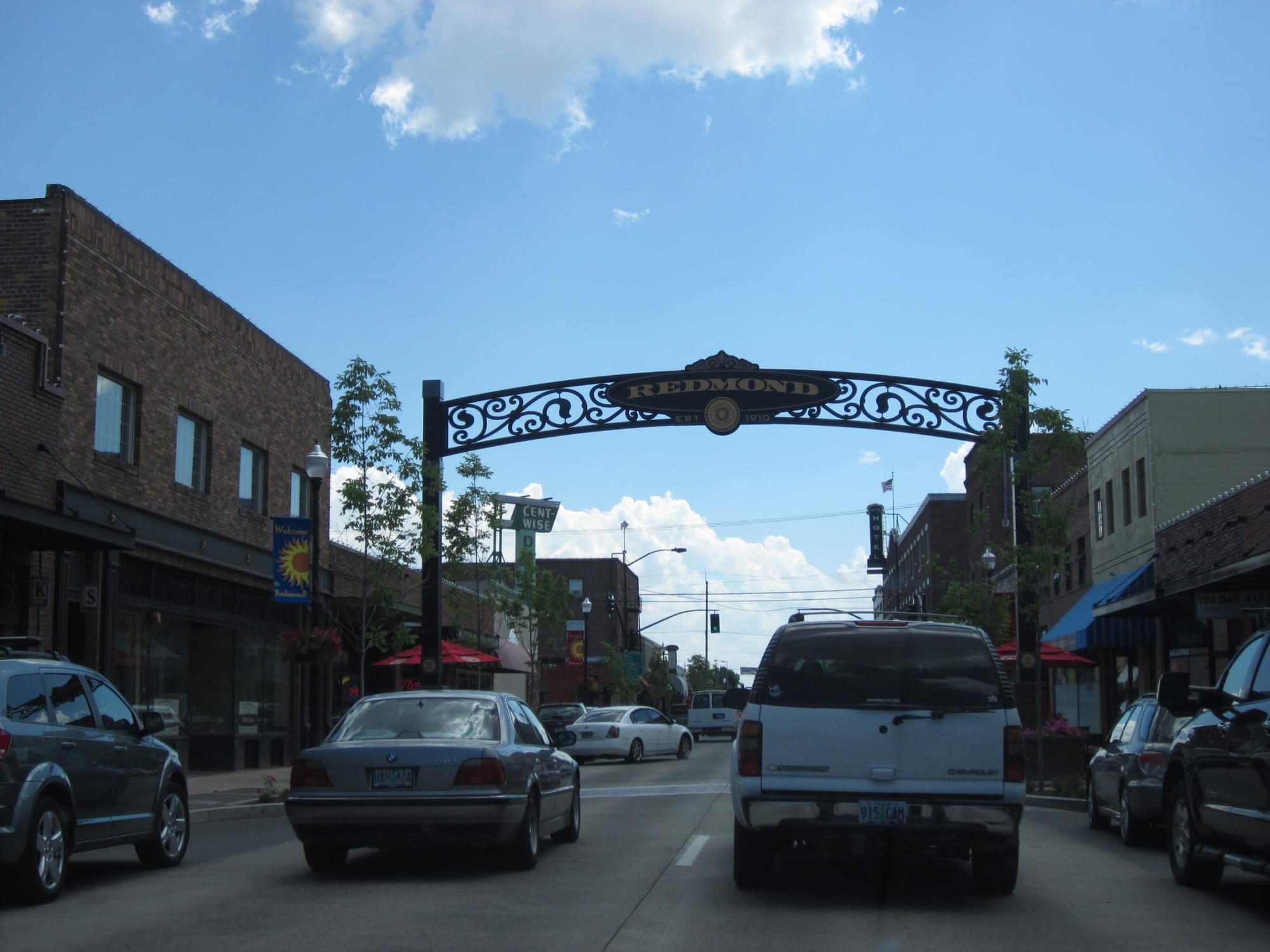
Context · Redmond (Oregon), where police, FAA and six F-102s tracked the object
Redmond, Oregon, Business Hwy 97.jpg · Wikimedia Commons · CC BY-SA 2.0 · open original
The night in question
Before dawn on September 24, 1959, Redmond city police officer Robert Dickerson saw a bright light over Redmond, in central Oregon. The log of the FAA communications station at the airport, signed by its chief L. E. Davis, records at 12:59 UTC that Dickerson reported a strange bright light "descending rapidly north of the station," that at several hundred feet "it stopped and hovered for several minutes," and that as he drove toward it on the Prineville highway the light turned orange and moved very rapidly to the northeast, relocating about 10 miles northeast at an estimated 3,000 feet. The military teletype sent to Hamilton Air Force Base that same morning summarizes it as a white light "such as landing light" changing to orangish, four protruding lights (red, green, yellow and white), and a falling light that hovered at 800 feet and then rose to 3,000. Dickerson went to the FAA station, and flight service specialist Laverne Wertz watched the object with him. In later telephone interviews with the Air Force, both described it as an extremely bright light, very low on the northeastern horizon, that seemed to move erratically around one point and rapidly toward and away from them, for more than an hour; according to ATIC's own summary, at the end of that time Wertz said the object "appeared to zoom straight up at great speed." No other visual witness could be found.
Wertz alerted the Seattle Air Route Traffic Control Center, which asked the 827th Aircraft Control and Warning Squadron, with its radar at Keno near Klamath Falls, whether it had a target in the area; the operator said yes. According to Wertz's log, the object projected "long tongues of red, yellow and green light" that extended and retracted; when a high-speed aircraft approached from the southeast it took the shape of a mushroom, showed a flame from its lower side, rose and disappeared above a cloud layer estimated at 14,000 feet, and reappeared about 20 miles south of Redmond. Seattle reported a radar return about 25 miles south of the town at "various altitudes from 6,000 to 52,000 feet," and at 15:20 UTC noted that the Klamath Falls site was still painting an object "hovering" about 30 miles south. The squadron's classified logs, summarized in a March 1960 teletype, detail the response: two F-102s took off from Portland at 13:00 UTC to identify the target, which was given track number JB129; two more at 14:52; one at 16:08; another at 17:18, by then inside an air defense exercise that had begun at 17:00; an F-89 at 18:24; an H-19 helicopter at 19:49; and a civilian Tri-Pacer left Redmond with a Geiger counter aboard. That makes six F-102s in all, in four waves spread over five hours, not at once. None made visual or airborne-radar contact, the light plane found no radiation, and at 21:55 the 25th Air Division ordered the track scrubbed. A B-47 flying in the area reported a negative sighting.
Three radar directors, on duty from 15:00 UTC, stated that the JB129 return did not move during that period; the senior director on duty when the object was first reported, Captain Gordon R. Toland, had been transferred to Iceland and was not interviewed, so the statement does not cover the early hours, between 13:00 and 15:00 UTC. The directors added that it sat very close to a gap-filler radar antenna on a mountain at the 8,010-foot level, South Paulina Peak, about 40 miles south of Redmond, and that after September 24 they had several times seen non-moving returns in the same spot; the interceptors passed through the position between 12,000 and 40,000 feet and found nothing. The 25th Air Division's communications staff did not believe the antenna was responsible, but rather "a mountain peak which is normally out of range." The official explanation did change, though not in the order usually told. ATIC first carried the case as "insufficient data." In January 1960, Major Lawrence Tacker, the Pentagon spokesman, wrote to NICAP that the object "was probably a balloon" and that the file showed no radar tracking. NICAP answered with the FAA logs, which did mention radar, and wrote to the Secretary of the Air Force and to President Eisenhower; in April 1960 ATIC still carried the case as "insufficient evidence." In June 1960, after interviewing Dickerson, Wertz and Major Creasman of the Keno squadron by telephone, ATIC concluded that the light was probably the refraction of Venus and the star Regulus, and that the radar return was a fixed target unrelated to the sighting. That is the conclusion on the case card: "probably astronomical, Venus." The file contains no 1963 verdict.
Why it matters
Redmond shows how a case inflates when records that the documentation itself keeps apart are merged into one. The usual account combines the low descent the officer saw, a two-hour radar track climbing and descending nearly 15 km, and a simultaneous scramble of six fighters. The Blue Book file separates them. The visual sighting has two witnesses, Dickerson and Wertz, and both described it to the Air Force as a very bright light, low in the northeast, that for more than an hour stayed around one point though it seemed to move rapidly toward and away from them. The radar return was, according to the directors on duty from 15:00 UTC, a fixed target next to a mountain, which the operators saw again on later days; nobody gave a statement covering the first hours. The altitude figures come from the Seattle log, which relayed them second-hand, and the fighters took off in four waves over five hours, some of them inside an exercise. The military response was large, but it was aimed at a radar return, not at the light the officer saw. The astronomy supports the identification: at 12:00 UTC Venus, at magnitude −4.4, had risen about half an hour earlier and stood about 5 degrees high, almost due east, with Regulus close by; by 12:59 it was about 16 degrees up. The witnesses spoke of the northeast, a difference of some 20 to 40 degrees that is easy to make without a compass. The card says both bodies were "just below horizon," which is not accurate: they had already risen, which strengthens the explanation rather than weakening it. But there is a tension the identification does not resolve: over the next hour and a half Venus climbed from about 5 to about 21 degrees, while the witnesses described a light that stayed very low on the horizon.
A residue remains. The FAA log records things Venus does not explain well: a light that descends fast and stops, the shift to the northeast, the mushroom shape with a flame when an aircraft approached, and the disappearance into clouds. Those entries were written at the time, but they come from the same two witnesses, who later told the Air Force something more compatible with a celestial body. The time in the FAA log (12:59 UTC) also does not match the teletype and the card (12:00 UTC). Add to that ATIC's own summary, in which Wertz saw the object zoom straight up at the end. The radar return has a prosaic explanation supplied by the operators themselves, though not a unanimous one: the antenna for the directors, a mountain peak for the communications staff. The file also documents the relationship between NICAP and the Air Force: the spokesman first offered an explanation, "a balloon," without having seen the FAA logs, and that mistake fed the idea of a cover-up for decades. But the file shows an investigation that, however slow, did interview the witnesses and the radar operators, not a concealment. Redmond thus shows how a probable astronomical confusion and a fixed return, added together by the press and by NICAP, came to be presented as a radar-visual case.
What's left on paper
Documented evidence
- Redmond FAA station log (L. E. Davis): at 12:59 UTC Dickerson reports a light descending to the north, stopping "at several hundred feet" and moving northeast; colored tongues of light, a mushroom shape and disappearance above clouds at about 14,000 ft
- September 24 teletype to Hamilton AFB: white light changing to orangish, four protruding lights, hovering at 800 ft and then at 3,000; two witnesses, Dickerson and specialist Laverne Wertz
- Seattle log: radar return about 25 miles south of Redmond, at altitudes of 6,000 to 52,000 ft per the height finder
- 827th squadron logs (Keno): track JB129; six F-102s in four waves between 13:00 and 17:18 UTC, an F-89, an H-19 helicopter and a light plane with a Geiger counter, all without result; track scrubbed at 21:55
- Statement by three radar directors on duty from 15:00 UTC: the JB129 return did not move, sat next to an antenna on South Paulina Peak, and reappeared in the same place on later days; the senior director at the start, Captain Toland, transferred to Iceland, was not interviewed, and the 25th Air Division's communications staff blamed "a mountain peak which is normally out of range"
Show 2 more items
- Successive verdicts: "insufficient data"; "probably a balloon" (Major Tacker, January 1960); refraction of Venus and Regulus (ATIC, June 1960), which is the card's conclusion
- Position check: at 12:00 UTC Venus (magnitude −4.4) stood about 5° high, almost due east, and about 16° by 12:59
Sources
- Project Blue Book — file "24 Sep 59, Redmond, Oregon" (card: refraction of Venus and Regulus), NARA, archive.org mirror — Primary source. 56 pages: card, September 24 teletype, Redmond and Seattle FAA logs, 827th squadron teletype with the scrambles and the radar directors' statement, NICAP correspondence and the June 1960 ATIC memo
- OCR text of the Redmond Blue Book file (archive.org) — Automatic transcription of the same file; useful for searching, but with reading errors
- NICAP — Redmond 1959 case directory — Secondary source: NICAP compilation; NICAP circulated the FAA logs and argued the object was a device under intelligent control
Related cases
same object · same country · same period
Edwards AFB · The 1965 Tapes
1965 · Tier A
same object · same country · same period
Ellsworth AFB · Blue Book's 'best report'
1953 · Tier S
same object · same country · same period
Minot AFB B-52
1968 · Tier S
same object · same country
Great Airship Wave · U.S.
1896 · Tier B