2008·San Juan hamlet, near Pucallpa (Ucayali)
Peru.Pucallpa · San Juan (light-beam lights)
In April 2008, residents of the San Juan hamlet near Pucallpa (Peruvian Amazon, Ucayali) reported 'lights' that flew over the area at night and shot beams of light at people, causing terror.
Read the rest of the summary
According to a ufology-outreach reconstruction, the Peruvian Air Force's OIFAA received the report through Commander Julio César Chamorro, though other sources place Chamorro's departure from the office years earlier; the civilian inquiry was carried out by three Communication Sciences students from the University of Lima. It is a low-documentation case (mostly testimonial and secondary) that echoes, on a smaller scale, the Colares pattern.
Tier B · IndicativeWhat do they mean? →
Limited evidence: a single witness, testimony gathered years later, or an account without contemporary primary documentation.
What it was
63%natural or human cause
Most likely an ordinary cause that no one has identified
See the split across the six explanations
Natural or human cause
No known cause
Read the full reasoning
The absence of a published analysis is not evidence against an ordinary cause: in its FY2024 report AARO stated that 'all 174 cases have been finalized as resolved to prosaic objects including balloons, birds, UAS, satellites, and aircraft'. The same report adds that 'many other cases remain unresolved', so the figure is the rate among resolved cases, not among all cases.Context image (not a document from the case)
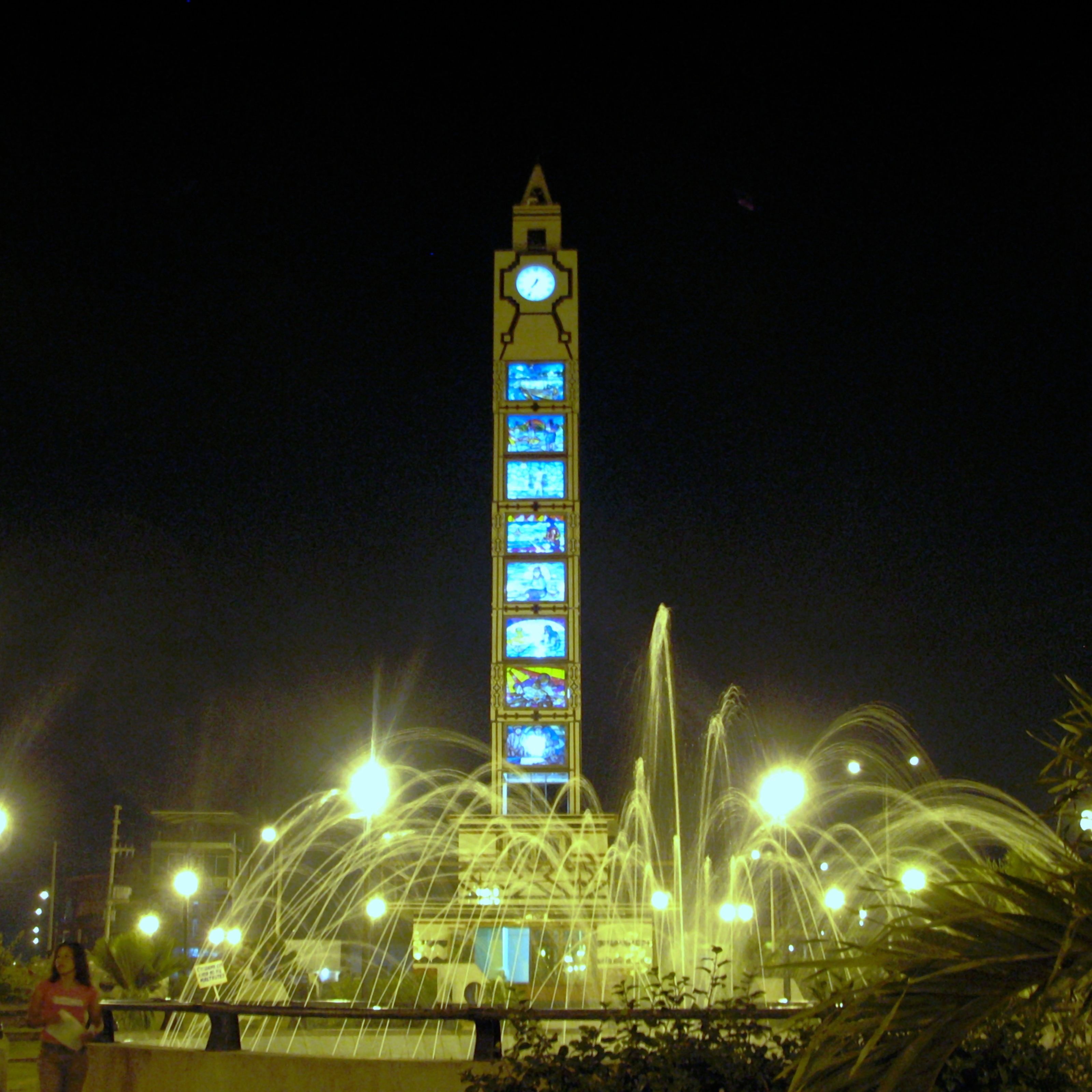
Context · Pucallpa (Ucayali, Peru)
Pucallpa Plaza San Martín Fountain by Night.jpg · Wikimedia Commons · CC BY-SA 3.0 · open original
The night in question
In April 2008, in the San Juan hamlet on the outskirts of Pucallpa (Ucayali department, in the Peruvian Amazon), residents reported that for several nights 'lights' flew over the area and projected beams of light directed at people. The account (gathered by media and local ufology) describes a frightened population that associated the lights with a recurring nightly aggression and experienced the episode as a collective harassment. That feature (lights that are not merely observed but seem to 'attack' people with directed beams) is what leads to comparing the case, on a smaller scale, with the Brazilian Colares episode (1977), where residents of Colares island reported burns and physical effects attributed to nighttime light beams. The comparison is one of phenomenological pattern, not of magnitude or evidential backing: Colares produced a military file (Operation Prato) with photographs and drawings; Pucallpa does not reach that level of documentation.
According to the reconstruction published by the site Exploración OVNI (which takes it from tudiscovery.com), the Peruvian Air Force's OIFAA (Office for the Investigation of Anomalous Aerial Phenomena) received the complaint through Commander Julio César Chamorro and already had personnel in the region; the same text mentions a document bearing an official seal that asked the commanding general of the FAP's IV Territorial Air Region for support in investigating, but neither reproduces nor dates it. That account clashes with other sources (see ↗): El Comercio's historical archive says Chamorro left the office after about two years in charge, beginning in 2001, and the state news agency Andina wrote in 2013 that the unit had been shut for five years. The FAP's official role in Pucallpa therefore remains unconfirmed; what is documented is Chamorro's personal link to the inquiry. The civilian component of the investigation was provided by three Communication Sciences students from the University of Lima (Teresa Lucía Chamorro, the commander's daughter; Martha Wong and Luciana Masías), who took the case as a project for the 'Fundamentals of Information' course, with the support of Chamorro and the office. The students traveled to the area, gathered residents' testimonies and assembled material they would later describe as an experience that transformed their understanding of the phenomenon.
The material gathered was presented publicly at a ufology congress in Lima, where the case was publicized as 'the Pucallpa UFO'. Unlike Chulucanas (2001) or La Joya (1980), the available documentation is comparatively weak: residents' testimonies, local press coverage and outreach work, without an equivalent open, verifiable technical file: no radar, no independent photographic analysis, no robust chain of custody for the material. It is also worth recalling that the Amazonian context introduces plausible prosaic explanations for 'frightening nighttime lights': from meteorological and bioluminescent phenomena to collective suggestion in isolated communities, none of which can be either confirmed or ruled out with the available evidence. It is therefore usually described as an open case, pending a more rigorous analysis.
Why it matters
Pucallpa matters for the institutional angle and the contrast, not for the strength of its evidence. Its central value is showing an official office (the Peruvian Air Force's OIFAA, per an outreach account that has not been confirmed) receiving and channeling an Amazonian scare about 'attacking lights', exactly the kind of folk report that in most countries would have left no state record at all. It is, alongside Chulucanas (2001), the other face of the Peruvian experiment of maintaining a permanent military window for the anomalous: an unusual institutional decision in the region, which stands as a datum about state behavior, regardless of what actually happened in San Juan.
But the quality of the evidence is low. The inquiry was not a technical air-force investigation but a university coursework project supported by the office, based on residents' testimonies and secondary documentation, with no radar, no instrumental analysis and no verifiable file. The family closeness between the office's commander and one of the investigators (his daughter) adds, moreover, a note of caution about the inquiry's independence. And the Amazonian setting offers several prosaic explanations for frightening nighttime lights, none confirmable but all more economical than an exotic hypothesis.
It calls for caution: it is an institutional record of a folk-Amazonian phenomenon, not a sensor case. It marks the lower threshold of the admissible: it shows where the limit of acceptable evidence lies. The comparison with Colares is one of phenomenological pattern ('lights that assault a community'), not of evidentiary strength: Colares left a military file with photographic material; Pucallpa, a well-intentioned but technically poor documented scare.
What's left on paper
Documented evidence
- Testimonies from residents of the San Juan hamlet (Pucallpa, Ucayali), April 2008: nightly 'lights' shooting beams at people
- Report received by the FAP's OIFAA via Commander Julio César Chamorro, per a secondary source; clashes with the El Comercio and Andina chronology
- Civilian investigation by three Communication Sciences students (University of Lima), supported by the office
- Later dissemination at a ufology congress in Lima ('the Pucallpa UFO'); open case, with no verifiable technical file
Sources
- Exploración OVNI — 'OVNI en Pucallpa, Perú' (2012) — Reconstruction of the case and the role of OIFAA / Commander Chamorro.
- International Coalition for Extraterrestrial Research — Julio Chamorro (Perú) — Profile of the FAP commander and OIFAA director.
- El Comercio (Perú), archivo histórico — cronología de la OIFAA (12 ago 2023) — Chamorro left the office after about two years in charge; the files were stolen in 2004.
- AARO — Fiscal Year 2024 Consolidated Annual Report on UAP (Nov 14, 2024)
Related cases
Associated actors (1)