1965·Mexico City (Ángel de la Independencia) · nationwide wave
Mexico.The Great Mexican UFO Wave (1965)
Throughout 1965 Mexico experienced a massive wave of UFO sightings, fueled by an intense press campaign (1,000+ articles) and a collective expectation of extraterrestrial contact. Its climax was social, not aerial: on 1 October 1965, around 20,000 people gathered at the Ángel de la Independencia awaiting a 'parade' of interplanetary craft announced in the press. Nothing appeared. It is a case study of how a wave is manufactured by media and expectation, with a public prediction that failed in front of thousands.
Tier B · IndicativeWhat do they mean? →
Limited evidence: a single witness, testimony gathered years later, or an account without contemporary primary documentation.
What it was
84%natural or human cause
Most likely explanation: collective contagion
See the split across the six explanations
Natural or human cause
No known cause
Primary documents
Airgram A-11 from the U.S. Consulate in Mexicali, "Political Report for August 1965" (14 September 1965): summary page, 1 p.
First page, the only one released, of the monthly political report that the Consulate in Mexicali (Baja California) sent to the Department of State, copied to the Embassy in Mexico City and the Tijuana consulate; it is signed by Arthur W. Feldman. It is an unclassified five-page document, and its ten-point summary lists, between the aftermath of the elections, the municipal market and the cotton harvest, an item titled "Flying Saucers in Mexicali", marked with an arrow. The text of that item is not in the released copy. It shows that in August 1965 the Baja California sightings earned a place in the consulate's political report.
Departamento de Estado de EE. UU. (publicado por la NSA en su colección sobre ovnis; espejo de archive.org) · Public domain · US Government work · open original
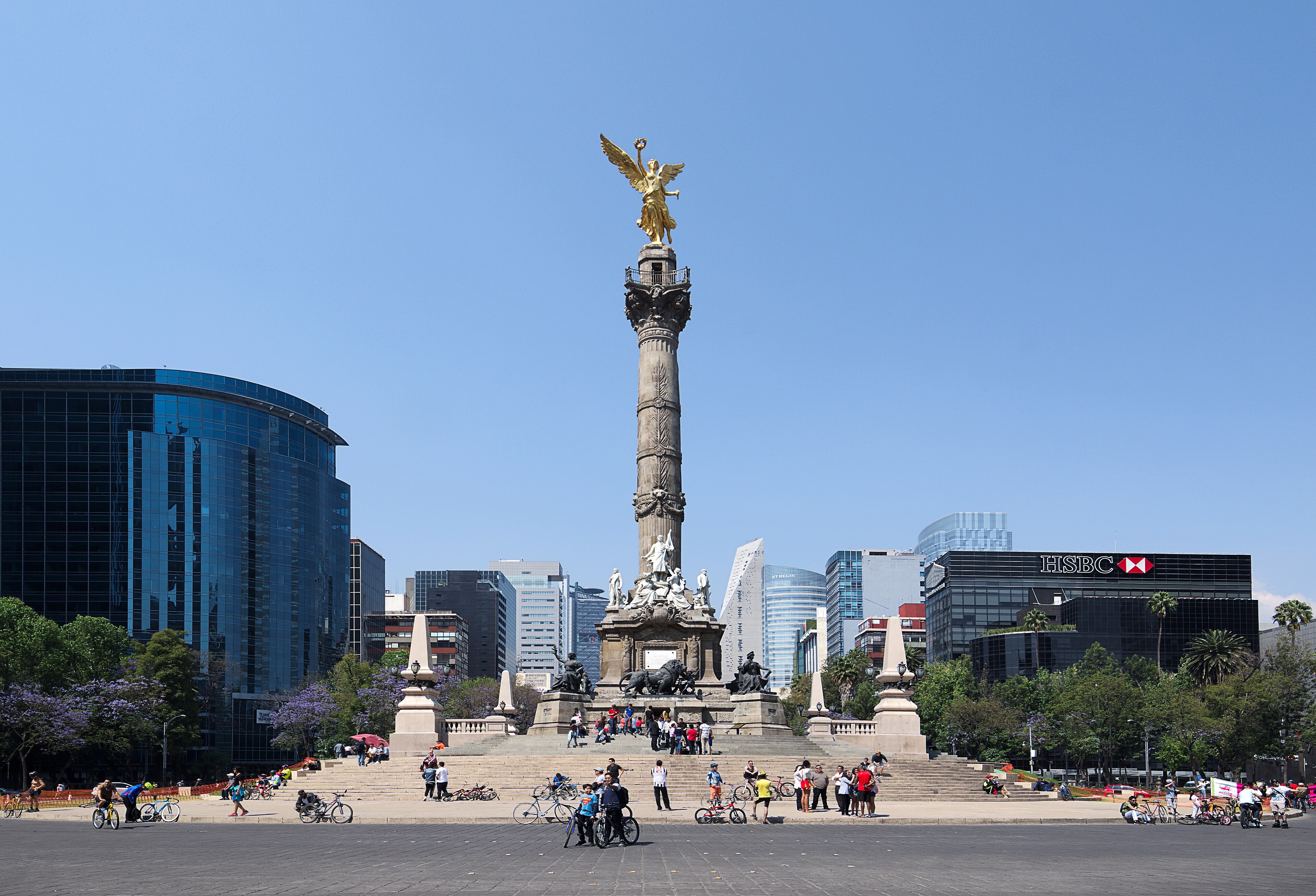
Context · the Angel of Independence, Mexico City
Angel de la independencia170409.jpg · Wikimedia Commons · CC BY-SA 4.0 · open original
The night in question
1965 was a year of intense UFO activity across much of the world, and Mexico was no exception. From July, reports of lights and objects in the sky surged in states such as Guerrero, Sonora, Oaxaca, Aguascalientes, Baja California, Veracruz, Guanajuato, Hidalgo and Morelos. September was the peak month, with dozens of reports (about 46 documented), and the national press accompanied the phenomenon with more than a thousand articles of varying length, planting in public opinion the idea of an imminent extraterrestrial visit, or even an invasion. Journalist Laura Castellanos would come to describe 1965 as the year of Mexico's 'galactic dread' ("pavor galáctico"): an emotional climate in which the expectation of contact became, for broad sectors, an everyday possibility.
The episode that defines the wave was not a sighting but a crowd, and it had a traceable origin. A painter named Clemente González Infante claimed to have been contacted by beings from Venus, who had supposedly announced that a large number of flying saucers (thousands, according to the most widespread version) would parade over Mexico City on 1 October 1965 to give 'signs of power and peace', traveling across the sky from the Villa de Guadalupe to the Ángel de la Independencia. The announcement, amplified by the press and broadcast even on television (the well-known host Paco Malgesto discussed it on the program 'El Club del Hogar'), turned a marginal contactee prophecy into a mass public appointment.
That day, a crowd that chroniclers estimated at around 20,000 people gathered on Paseo de la Reforma, in front of the Ángel de la Independencia, to await the 'parade of the UFOs'; El Universal's reconstruction speaks instead of 'hundreds of citizens, especially young people', at the Basilica of Guadalupe and at the Ángel. People watched the sky for hours. No craft appeared. As the day wore on and disappointment grew, the gathering turned to disorder and, according to the accounts, police intervention was needed to restore order and disperse the crowd. González Infante and another of the announcement's promoters dropped out of public view after the fiasco. The episode is remembered as the point that marked the end of Mexico's 1960s UFO craze.
In hindsight, the 1965 wave is understood above all as a social and media phenomenon: a mix of genuine sightings (most with prosaic explanations), contactee lore, and a press campaign that fed on itself until it produced a collective expectation. Journalist Laura Castellanos reconstructed the episode with exhaustive newspaper-archive research in her book 'Ovnis: historia y pasiones de los avistamientos en México' (2009), which is today the documentary reference for the case.
Why it matters
The Great Wave of 1965 matters as a disciplined counter-example: a case that documents the mechanism that manufactures a wave. Its central episode (the 1 October gathering) offers something ufology almost never produces: a falsifiable, public and precise prediction. A contactee announced a concrete event, with date, time and trajectory, the press and television spread it, and 20,000 people showed up to verify it. The sky stayed empty. Rarely is a claim about extraterrestrial presence subjected to so clean a test and failing it so unequivocally, in broad daylight and before tens of thousands of witnesses.
That outcome helps calibrate skepticism. Including 1965 asserts nothing about non-human technology; on the contrary, it rigorously documents how a mix of prosaic sightings, contactee lore, media amplification (more than a thousand press articles) and collective expectation can generate an entire national wave with no need for a single anomalous phenomenon. The causal chain is traceable from beginning to end (from González Infante's prophecy to the fiasco in front of the Ángel) and constitutes a model case study of the sociology of UFO belief. The wave's own hemerographic trail (over a thousand press items) is the kind of record that Mexican researchers such as Alfonso Salazar Mendoza compiled into archives spanning more than 2,000 press-documented cases since 1890.
For a site that insists on separating real anomaly from over-interpretation, this episode is first-rate pedagogical material and a deliberate skeptical anchor: a reminder that the strength of a collective conviction, and even the number of witnesses, says nothing about the reality of the awaited object. The documentation is excellent, but what it documents is precisely the absence of the phenomenon.
What's left on paper
Documented evidence
- Sustained rise in reports from July 1965 across multiple states; September as the peak month (~46 reports)
- Press campaign of 1,000+ articles over the year, which amplified the expectation of contact
- The 1 October 1965 gathering: ~20,000 people at the Ángel de la Independencia awaiting a 'parade' of craft that did not appear
- Newspaper-archive reconstruction by Laura Castellanos, 'Ovnis: historia y pasiones de los avistamientos en México' (2009)
Sources
- Castellanos, L. — 'Ovnis: historia y pasiones de los avistamientos en México' (Grijalbo, 2009) — Exhaustive newspaper-archive research; documentary reference for the case.
- El Universal — 'La oleada OVNI que invadió a México en los 50 y 60' (Mochilazo en el tiempo)
Related cases
Associated actors (1)