1992·Popocatépetl
Mexico.Popocatépetl
Since 1992, the thermal and visible cameras with which CENAPRED monitors the Popocatépetl volcano have recorded between 50 and 200 events of objects emerging from or overflying the crater, automatically archived by a system not designed to detect UAP. It is continuous, selection-bias-free instrumentation over active geological infrastructure.
Tier A · AcceptableWhat do they mean? →
Institutional evidence: several identified independent witnesses, or contemporary official documentation, without an instrumental record to corroborate them.
What it was
73%natural or human cause
Most likely an ordinary cause that no one has identified
See the split across the six explanations
Natural or human cause
No known cause
Read the full reasoning
The absence of a published analysis is not evidence against an ordinary cause: AARO's 2024 report finalized 'all 174 cases' as 'resolved to prosaic objects including balloons, birds, UAS, satellites, and aircraft', though 'many other cases remain unresolved'.Primary documents
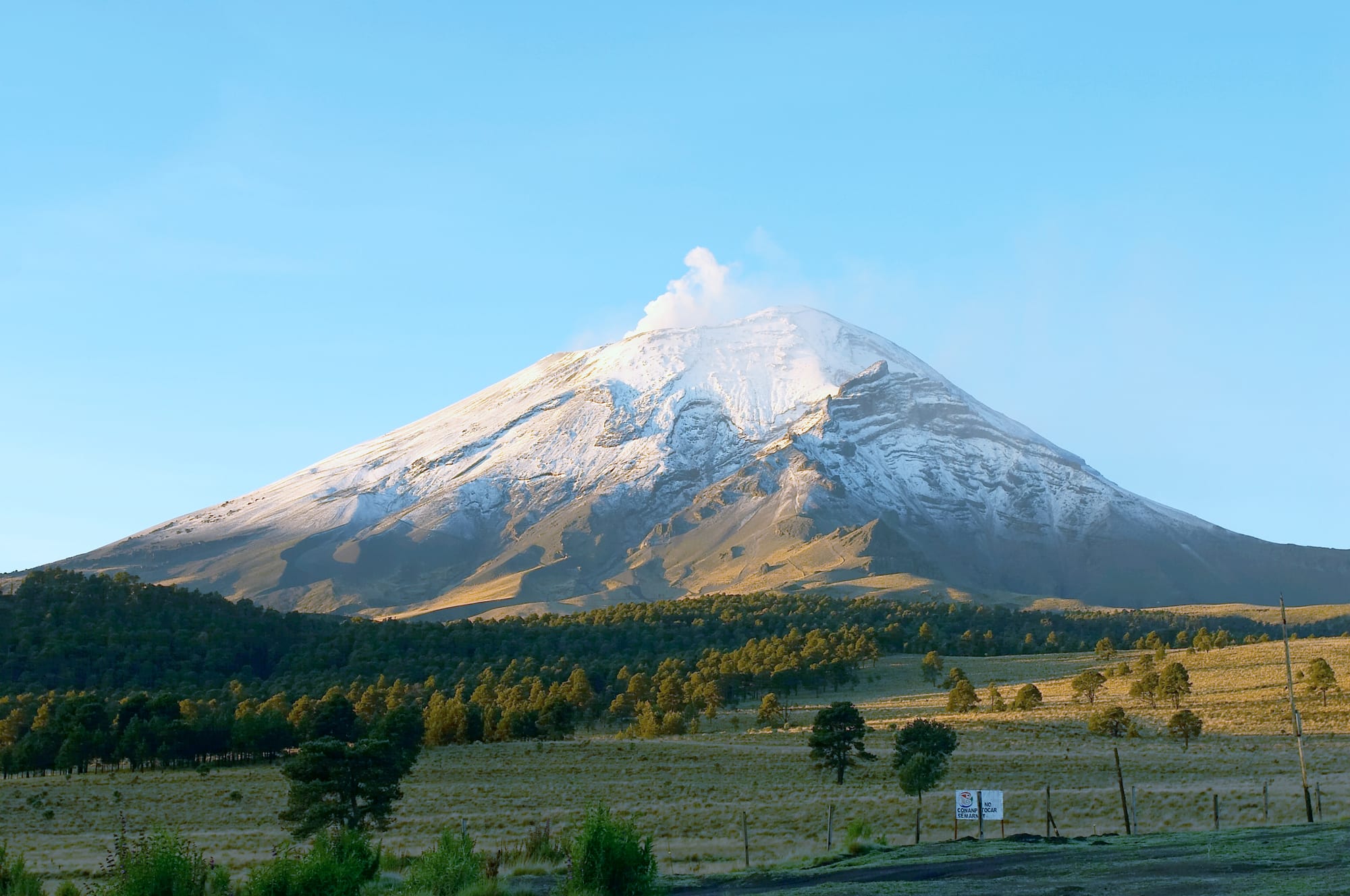
Context · the Popocatépetl volcano (Mexico), a recurring sighting hotspot
Mexico-Popocatepetl.jpg · Wikimedia Commons · CC BY-SA 3.0 · open original
Azteca Puebla, "UFOs or satellites? Luminous objects caught over the Popocatépetl volcano before dawn" (12 July 2026)
Report on the video recorded before dawn on 11 July 2026 by one of the monitoring cameras at the Altzomoni station, from which the volcano is watched: a line of points of light that, because of the perspective, seems to rise from near the crater. It says the lights were a train of Starlink satellites, still lined up after launch and lit by the Sun, and recalls that the volcano cameras have at other times caught meteors, aircraft, drones, birds and insects that can seem to behave unusually. It quotes no statement from CENAPRED. Copyrighted article: it is linked.
Azteca Puebla (TV Azteca) · view source
The night in question
The Popocatépetl volcano (5,426 m, about 70 km southeast of Mexico City) is one of the most heavily watched geological structures in the world: because it sits next to a megalopolis of more than twenty million people, the Centro Nacional de Prevención de Desastres (CENAPRED) has monitored it continuously since 1992 with thermal and visible-spectrum cameras broadcasting day and night. Over those three-plus decades of recording, by the various counts, between 50 and 200 events have been logged in which disc-shaped, cylindrical, or linear objects appear emerging from the crater, flying over the summit, or apparently descending toward it.
The methodologically decisive feature is that these videos are auto-archived by a volcano-monitoring system that was not designed to detect UAP: its mission is to watch fumaroles, ash columns and eruptive activity. That means the camera does not 'hunt' for flying objects, does not selectively aim or crop what it records according to an observer's expectations, which reduces two classic biases of UAP casuistry: selection (looking only where one already expects to see something) and intentional manipulation. Among the most cited episodes are July 28, 1998 (a cylindrical object, estimated around 100 m long, descending almost vertically toward the fumarole) and October 25, 2012 (an elongated object that appeared to enter the crater, recorded at 8:44 p.m. and broadcast by Televisa, which astronomer Margarita Rosado thought could be a video defect), plus numerous minor events during periods of intense volcanic activity.
This file claimed that AARO had catalogued one of these events as anomalous under the designation PR053. That is false: DOW-UAP-PR053 is an October 2022 clip that AARO assesses as likely derived from an infrared sensor in the U.S. Central Command area, unrelated to the volcano, and no AARO file on Popocatépetl has been found. On 11 July 2026, according to Azteca Puebla, a row of lights caught by one of the monitoring cameras at the Altzomoni station, from which the volcano is watched, was a train of Starlink satellites (the report does not mention CENAPRED), and the outlet notes that the cameras have caught meteors, aircraft, drones, birds and insects that can seem to behave unusually on video; Nación321 noted that CENAPRED had given no official explanation.
Against all this, the mundane explanations are several and plausible for much of the events. Many of the 'objects' caught by these cameras correspond to meteors and bolides, to birds or insects near the lens that appear out of focus and enormous, to satellites or solar-reflection glints under dusk or dawn conditions, and to artifacts of the CCD cameras themselves (shutter effects, smear, scan lines) that produce spurious cylindrical or linear shapes. The cameras' cadence and wide field of view mean that, statistically, they capture a great many trivial transits. The events are not anomalous one by one; the case is valuable for a continuous, institutional, selection-bias-free instrumental record on which to apply rigorous analysis, and some events still have no published explanation.
Why it matters
Its value lies not in any single video (almost all have a mundane explanation) but in the nature of the record: continuous institutional instrumentation, not designed to detect UAP, operating over the same geological infrastructure for more than three decades. That architecture attacks at the root two chronic weaknesses of UAP casuistry. It eliminates selection bias, because the camera records everything that crosses its field without a believer deciding to aim it; and it reduces the incentive to manipulate, because CENAPRED's mission is volcanology, not ufology, and it gains nothing by inflating sightings. In Bayesian terms, the case is attractive not for the strength of any one event but because it offers a long, homogeneous, clean-provenance dataset on which the comparison baseline (how many trivial transits occur per hour) can be established empirically.
The hypothesis of a correlation between anomalous phenomena and geological activity (also raised at Hessdalen regarding geomagnetic anomalies) is exactly the kind of conjecture such a corpus allows to be investigated methodically: with time series, not anecdotes. The individual evidence is not conclusive; what is exceptional is the quality and continuity of the record.
What's left on paper
Documented evidence
- Continuous CENAPRED cameras since 1992: self-generated corpus
- Cataloged events: July 28 1998, October 25 2012, multiple events 2012-2024
- July 2026: a row of lights over the volcano, recorded by a monitoring camera at the Altzomoni station, identified as a train of Starlink satellites (Azteca Puebla)
- No CENAPRED incentive to manipulate (its mission is volcanology, not UAP)
Sources
- CENAPRED — Monitoreo Volcánico Popocatépetl
- Maussan, J. — Compilación Popocatépetl UFO archive — Sustained press coverage
- Marcianitos Verdes, «El ovni del Popocatépetl» (oct 2012) — The 25 October 2012 video broadcast by Televisa and astronomer Margarita Rosado's opinion (pixel overexposure).
- Azteca Puebla, «¿Qué son los objetos luminosos captados en el volcán Popocatépetl?» (12 jul 2026) — Identifies a 11 July 2026 row of lights as a train of Starlink satellites.
- AARO — Fiscal Year 2024 Consolidated Annual Report on UAP (Nov 14, 2024)
Related cases