1991·Discovery orbit (STS-48) · mission launched from Cape Canaveral
Earth Orbit.STS-48 NASA
A camera aboard shuttle Discovery captured a luminous point that turned about 90 degrees and accelerated after a flash; NASA attributed it to ice particles, while Carlotto's independent analysis computed ~14,000 mph in under a second, incompatible with that explanation.
Tier A · AcceptableWhat do they mean? →
Institutional evidence: several identified independent witnesses, or contemporary official documentation, without an instrumental record to corroborate them.
What it was
58%natural or human cause
Most likely explanation: space object
See the split across the six explanations
Natural or human cause
No known cause
Primary documents
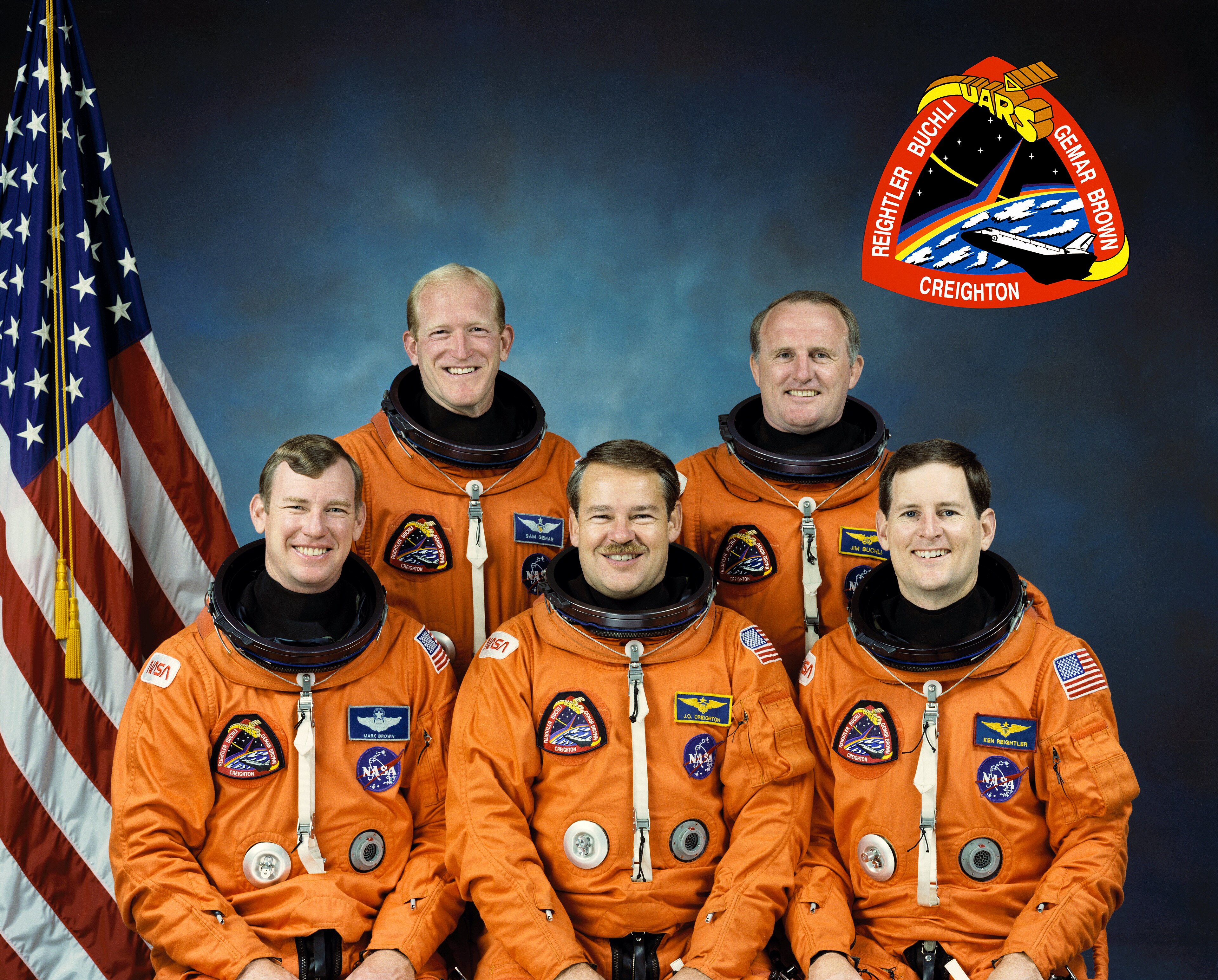
The STS-48 Space Shuttle Discovery mission, whose in-orbit video sparked the case
STS-48 crew.jpg · Wikimedia Commons · Public domain · open original
The night in question
On September 15, 1991, around 20:30-20:45 GMT, during the STS-48 mission of the Discovery shuttle in Earth orbit, a shuttle video camera pointed at the planet's nighttime horizon captured several luminous points drifting slowly against the terrestrial background. At a specific instant in the video, a flash erupted near the lower edge of the frame and, simultaneously, one of the points abruptly changed direction (a turn near 90 degrees) and sped off, accelerating toward space. Other points appeared to react similarly after the flash.
NASA's explanation, publicly defended by mission-control engineer and skeptical writer James Oberg, is that the trails are ice particles, frost or debris shed from the shuttle itself, sunlit, and that the abrupt trajectory change coincides with the firing of an attitude-control (Reaction Control System, RCS) thruster: the flash would be the thruster jet and the particles' acceleration the pressure wave pushing them. Oberg stresses that visually identical phenomena have been recorded on virtually every shuttle mission and require no exotic explanation.
The analysis by Dr. Mark Carlotto (an image-processing analyst with defense-systems experience), published in the Journal of Scientific Exploration in 1995, disputed this reading. Carlotto modeled the trajectories in the image plane and argued that the main object appeared to stop for about half a second before accelerating, a behavior he considered hard to reconcile with a continuous thruster force on a passive particle; his acceleration figures, under the assumption that the object was far rather than near the camera, yielded values on the order of 14,000 mph in under a second, incompatible with ballistically neutral ice. Physicist James Kasher published kinematic analyses along similar lines.
The video is in the public domain and has been independently analyzed by multiple researchers. The central dispute is one of unresolved geometry: with a single camera it cannot be determined whether the points were meters or kilometers away, and on that distance ambiguity depends entirely whether the computed speeds are extraordinary or trivial. STS-48 is part of the 'NASA-source UAP videos' category that includes STS-75 (1996) and others, all with structurally identical disputes.
Why it matters
It has an official NASA video in the public domain, an independent physical analysis published in a peer-reviewed journal (Carlotto, JSE 1995) and a documented, long-standing dispute with the official explanation. Its value lies not in proving anything exotic but in clearly exhibiting why a single optical record can rarely settle a controversy: the entire difference between 'ice particle three meters away pushed by a thruster' and 'object kilometers away maneuvering at 14,000 mph' hinges on a distance the camera does not measure.
Oberg's skeptical reading is strong and economical: the flash coincides with a known RCS firing, the phenomenon recurs on nearly every mission, and sunlit particles reacting to the jet explain both the flash and the simultaneous trajectory change of several points at once: hard to attribute to a single intelligent craft. Carlotto's objection (the ~0.5 s pause before acceleration) is genuine but not decisive, since it can arise from tracking artifacts in low-resolution video. The calibration is symmetric: Carlotto's kinematics was never quantitatively refuted, but the particle explanation was never ruled out and is the most parsimonious.
What's left on paper
Documented evidence
- Official NASA STS-48 video archived and in the public domain
- Carlotto, M.: JSE peer-reviewed analysis (1995) with acceleration calculation
- NASA Public Affairs official explanation (ice particles) with no numerical analysis
- Replication of the Carlotto analysis by multiple independent researchers
Sources
- NASA STS-48 mission archive
- Carlotto, M. — JSE Vol. 9 (1995) 'Digital Image Analysis'
- Oberg, J. — Critique of Carlotto analysis (Skeptical Inquirer 2003) — Formal critique of the non-ballistic attribution
- Oberg, J. — «NASA STS-48 "UFO" video» (28 Jun 1992), debunker.com
Related cases
same explanation · same country · same period
STS-80 · unidentified object in orbital photography (1996)
1996 · Tier A
same explanation · same country · same period
The “Black Knight” · the cover lost on the STS-88 mission
1998 · Tier S
same explanation · same country
Skylab · light flashes and reddish object (NASA, PURSUE)
1973 · Tier B
same explanation · same country
Apollo 11 · Technical Crew Debriefing observations (NASA, PURSUE)
1969 · Tier B