1989–1990·Belgium
Belgium.Belgian Wave (F-16)
During the 1989–1990 Belgian wave, on the night of 30–31 March 1990 two F-16s were scrambled after echoes on two military ground radars and a gendarmerie report; across nine interception attempts they achieved brief radar lock-ons with extreme speed changes, but never saw anything. The Air Force report found no explanation; physicist Auguste Meessen later attributed those lock-ons to humid air masses and Doppler interference, yet concluded that one track recorded by both ground radars can only be explained as a UFO ('trace non ambiguë d'un ovni'), and found another on the civil radar on 18 March 1990.
Tier S · SolidWhat do they mean? →
Strong evidence: a contemporary instrumental record (radar, sensor, film or photo of known provenance) that corroborates several independent witnesses.
What it was
55%natural or human cause
Most likely explanation: planet or star
See the split across the six explanations
Natural or human cause
No known cause
Quote in the original language
«Sirius y était visible pour eux… Jupiter était également visible, mais plus haut dans le ciel»Context image (not a document from the case)
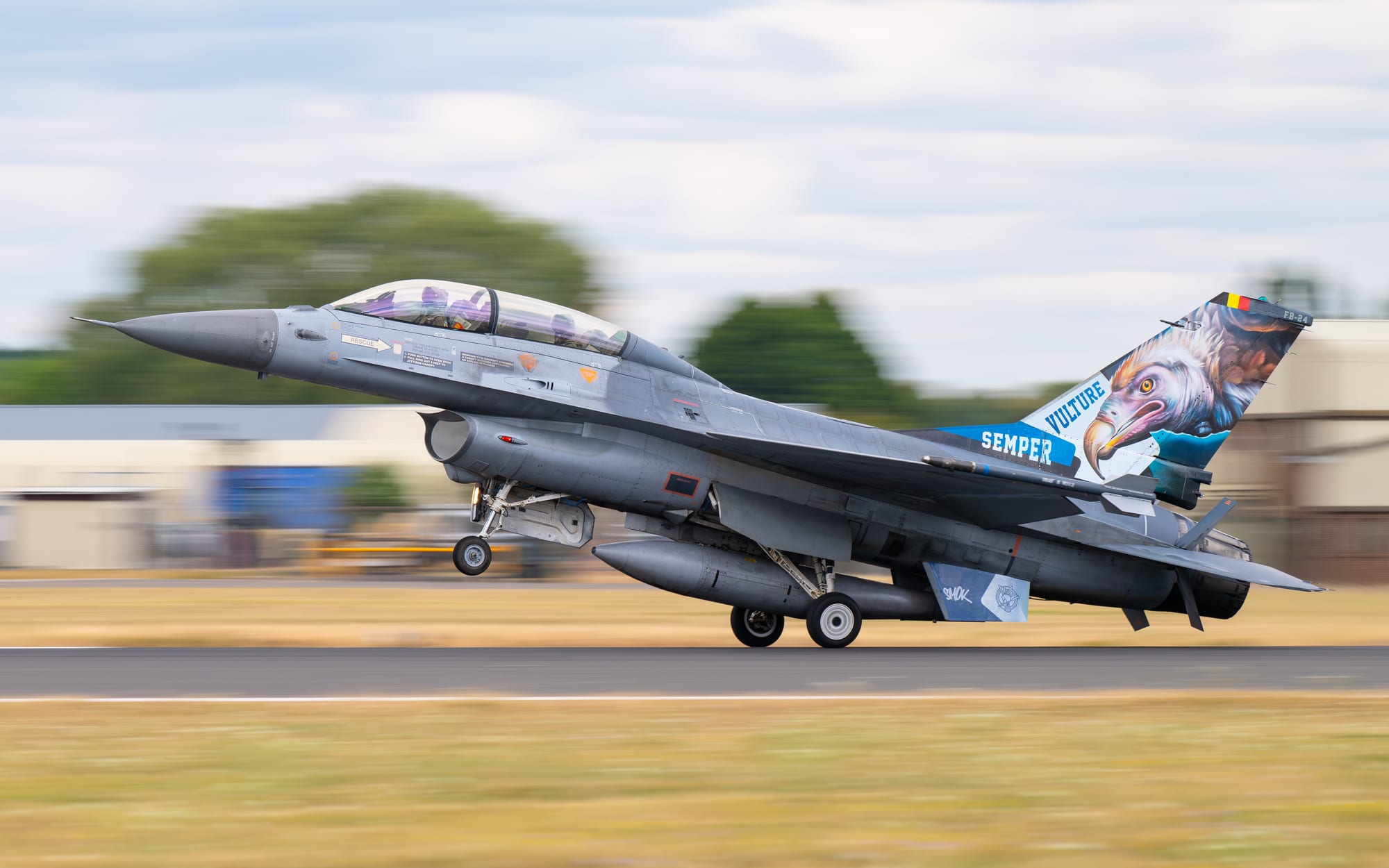
Context · a Belgian Air Force F-16, of the type that scrambled during the wave
Belgian Air Force General Dynamics F-16BM Fighting Falcon FB-24 Royal International Air Tattoo 2025 01.jpg · Wikimedia Commons · CC BY 4.0 · open original
The years in question
Between November 29, 1989 and the spring of 1990, thousands of civilians in Belgium (concentrated at first in the Eupen region to the east) reported dark triangular objects with three bright lights at the vertices and a central pulsing red light, moving silently at low speed. The Belgian gendarmerie logged numerous sightings by its own officers, and the civilian association SOBEPS gathered hundreds of accounts. The Belgian Air Force received and processed some of those reports. Its own report acknowledges, however, that before 30 March no radar station had confirmed the visual observations and that the interceptors sent up had never established the objects' presence; the Air Staff ruled out that B-2 or F-117 aircraft, remotely piloted vehicles, microlights or AWACS were flying over Belgium at the time.
The critical event occurred on the night of March 30-31, 1990 and is set out hour by hour in the report by Air Force Major P. Lambrechts. At 23:00 gendarme Renkin phoned the Glons radar control centre to report three motionless lights in an equilateral triangle over Thorembais and Gembloux, brighter than the stars and changing colour; at 23:28 a patrol under Captain Pinson confirmed them. Glons was then watching an unidentified contact north of Beauvechain, moving west at about 25 knots, and between 23:49 and 23:59 the Semmerzake radar confirmed it. At 00:05 two F-16s of the 1st Wing took off from Beauvechain. Between 00:07 and 00:54 they made nine interception attempts; they had brief contacts and, according to the report, in three cases achieved a lock-on of a few seconds, after which the target abruptly changed its parameters. In the 00:13 lock its speed went from 150 to 970 knots and its altitude from 9,000 to 5,000 feet, back up to 11,000 and then down almost to ground level; in the 00:30 lock, which lasted six seconds, the jamming indication appeared on the screen. At 00:32 Glons and Semmerzake tracked a contact heading toward Bierset at 478 to 690 knots, which the Maastricht centre did not detect. The pilots never had visual contact. The report also records that ground witnesses eventually counted eight points while the radars showed a single contact. The '46G' figure that circulates for these manoeuvres does not appear in the report, which gives speeds and altitudes, not accelerations.
Colonel Wilfried De Brouwer, then chief of operations of the Air Staff and later Major General, led the official follow-up and presented the data at a press conference on 11 July 1990, unclassified. There he said the evaluations had not made it possible to determine the nature of the object. The Lambrechts report goes further in its conclusions: it states that the measured speeds and altitude changes exclude confusion with aircraft; it rules out sounding balloons, optical illusion, planets and holograms; and it concedes it cannot explain either the absence of a shock wave despite supersonic speeds or the mismatch between the eight points seen and the single echo. One of its premises is fragile: to dismiss balloons and projections it asserts there was 'no inversion under way', while its own weather section records two slight inversions, one at the surface and another at 3,000 feet. De Brouwer has maintained for more than three decades that the episode found no satisfactory conventional explanation, without asserting a conclusion about its nature.
There are two serious counterweights. First, the most famous photograph of the wave (the sharp Petit-Rechain triangle, taken in April 1990) was confessed to be a fake in 2011: its author, Patrick Maréchal, stated on Belgian television (RTL) that he had built a polystyrene model with lights and suspended it to photograph it. That confession does not nullify the remaining sightings, but it removed the case's most-cited photographic exhibit from the table. Second, the most detailed analysis of that night's data was done by a physicist sympathetic to the reality of the phenomenon, Auguste Meessen of the University of Louvain, who obtained from Defence Minister Guy Coëme access to one F-16's tape and to the Glons and Semmerzake records. In his 2007 study he concludes that the ground echoes that prompted the scramble came from humid air masses ('invisible clouds') and that the F-16 lock-ons are explained by those same masses, with a Doppler speed falsified by interference; lock-ons 8, 9 and 10 on the tape were, moreover, on the other F-16. For the gendarmes' lights he notes that Sirius was visible and Jupiter higher up; our ephemeris calculation confirms it: at 23:00 local time Jupiter, at magnitude −2, stood about 40° high to the west-southwest of Ramillies, the direction of Thorembais. But the same study does not conclude that nothing was there: between 00:29 and 00:36 Semmerzake and Glons separately recorded a straight track at 820 to 1,200 km/h, climbing from 900 to 4,000 metres, which the nearby civil radar at Bertem did not pick up. Meessen rules out an aircraft, a microlight, a balloon, an invisible cloud, a radar mirage and a US stealth aircraft, denied by the embassy, and writes that he sees no possibility other than 'celle d'un ovni', calling it a 'trace non ambiguë d'un ovni'. He adds a second track, this time on the civil radar, on 18 March 1990: an echo with no transponder that appeared at 20:30, zigzagged alongside an identified airliner at about 800 km/h and left the screen toward Luxembourg, and which he could not check against the military radars because their tapes had by then been reused. He also holds that the many close-range visual sightings of the wave, which he credits, are enough to invalidate the conclusion that the F-16 echoes prove there were no UFOs.
Why it matters
Despite the counterweights, the Belgian episode left a file documented by a NATO air force: mass civilian and gendarmerie testimony, military follow-up with published radar data, and an open-transparency institutional stance sustained for decades by a named officer. It is the exact methodological contrast with the Pentagon's historical opacity: in Belgium the raw data and the doubts were made public, to the point that an independent physicist could reanalyse an F-16 tape with the minister's permission.
What is most often cited as proof (the F-16 lock-ons with impossible speed changes) is precisely what ended up best explained: Meessen's reanalysis attributes them to humid-air echoes and a falsified Doppler measurement, and some of them were on the other fighter; the gendarmes' lights are compatible with stars and Jupiter, and the Petit-Rechain photo was a fake. What remains is more modest and less cited, but not trivial: a fast track recorded independently by two military radars, with no echo on the civil radar, which Meessen himself (the same analyst who took the lock-ons apart) regards as the unambiguous trace of a UFO; another anomalous track on the civil radar on 18 March; and the body of close sightings of the wave, which he credits and which this record does not resolve. The multi-sensor combination was real, but the analysis of its own data reduced the anomaly to a concrete, checkable residue rather than the '46G accelerations' popular coverage attributes to it.
What's left on paper
Documented evidence
- Major Lambrechts' report (Belgian Air Force, 1990): timeline of the night of 30-31 March, with echoes on the Glons and Semmerzake radars and nine interception attempts
- Three radar lock-ons of a few seconds, one with a jump from 150 to 970 knots; the pilots never saw the object
- The report's conclusion: unexplained; it rules out aircraft, balloons, planets and holograms, despite recording slight temperature inversions
- Auguste Meessen's reanalysis (2007): the echoes and lock-ons are explained by humid air masses and Doppler interference; three lock-ons were on the other F-16
- Meessen's conclusion on the 00:29-00:36 track, recorded by Glons and Semmerzake at 820 to 1,200 km/h and absent from the civil radar: 'trace non ambiguë d'un ovni'; he points to another on the civil radar on 18 March 1990
- 2011 confession: the Petit-Rechain photo was a model
Sources
- Lambrechts, P. — 'Report concerning the observation of UFOs in the night from March 30 to March 31, 1990' (Belgian Air Force), transcription at ufologie.patrickgross.org — Preliminary official report; published by SOBEPS in 1991. Transcription on a ufology site, not the Air Force archive.
- Meessen, A. — 'In-depth study of the mysterious F-16 radar recordings' (2007) — Reanalysis of one F-16's tape and the Glons and Semmerzake data; explains the lock-ons and leaves one track unidentified.
- Kean, L. — UFOs: Generals, Pilots and Government Officials Go on the Record (2010), chapter by W. De Brouwer — Later testimony by the officer who led the follow-up (secondary)
Related cases
same object · same period
Mexico eclipse wave · the object filmed during totality on 11 July 1991
1991 · Tier B
same object · same period
Zaragoza · the light over the General Military Academy
1980 · Tier A
same object
Kaikōura Lights
1978 · Tier S
same object
Disappearance of Frederick Valentich
1978 · Tier A
Associated actors (1)