1975·Approach to Mexico City (MEX)
Mexico.Carlos de los Santos
On 3 May 1975, 23-year-old Mexican pilot Carlos Antonio de los Santos was flying from Zihuatanejo to Mexico City in his Piper when he reported three disk-shaped objects that surrounded his aircraft and forced an ascent he felt was beyond his control, until he issued a 'Mayday'.
Read the rest of the summary
The tower recorded the emergency call, the terminal radar controller said a second blip separated from the plane and turned 270 degrees at 450-500 knots, and the airport's chief of aviation medicine attributed it to a hallucination from low blood sugar. J. Allen Hynek interviewed the pilot. The pressure by alleged 'men in black' is the contested layer.
Tier A · AcceptableWhat do they mean? →
Institutional evidence: several identified independent witnesses, or contemporary official documentation, without an instrumental record to corroborate them.
What it was
55%no known cause
Most likely explanation: non-human, controlled by no state
See the split across the six explanations
No known cause
Natural or human cause
Read the full reasoning
It covers the pilot's perception; the claimed radar contact and confirmation by another aircraft have been neither verified nor explained. Per the APRO Bulletin (Aug. 1975), the airport physician, Luis Amezcua, judged he had low blood sugar and implied a hallucination, and Civil Aeronautics wanted to test the effect of flying high without oxygen; APRO disputed it.Primary documents
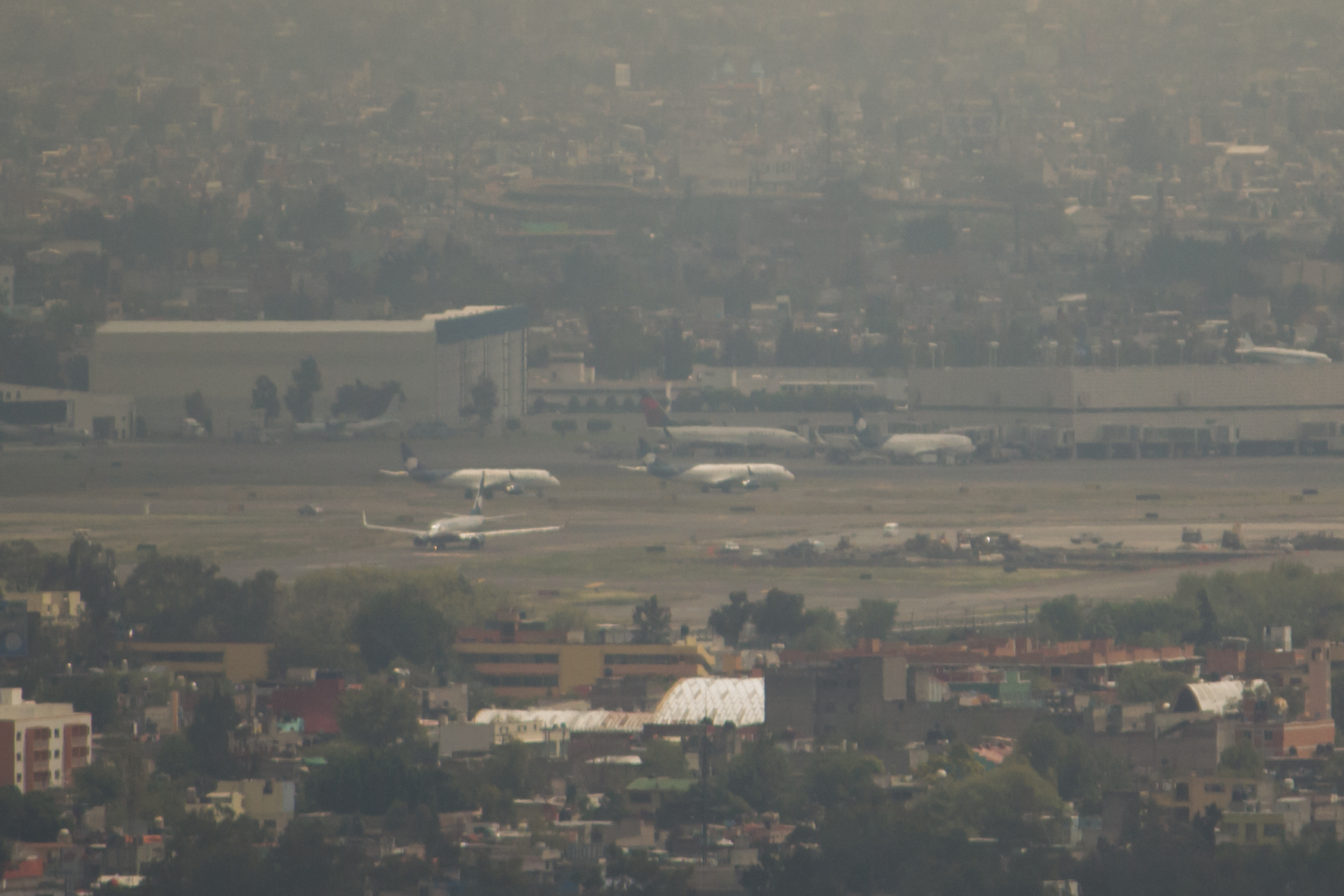
Context · Mexico City International Airport
Aeropuerto Internacional Benito Juárez.jpg · Wikimedia Commons · CC BY 4.0 · open original
APRO Bulletin, vol. 24, no. 2 (August 1975), 'Escort': Fernando Téllez's investigation
The contemporary investigation of the case, published three months later: the transcript of the distress call with the tower, the radar controller's statement and the airport's medical diagnosis. It dates the flight 'May 2, 1974', a typo for 1975. Copy from the AFU archive on archive.org; the bulletin is under copyright, so it is given as a link.
APRO · Archives for the Unexplained (archive.org) · view source
The night in question
On 3 May 1975, Carlos Antonio de los Santos Montiel, a 23-year-old Mexican pilot, was flying his Piper (an Aztec according to the APRO Bulletin, a PA-24 Comanche according to other sources) from Zihuatanejo toward Mexico City's Benito Juárez International Airport. According to the APRO Bulletin of August 1975, he took off from Zihuatanejo at 10:30 without breakfast (he had not eaten since 8 p.m. the day before) and climbed to 14,500 feet to get above the haze; near Tequesquitengo he descended to look for the lake and saw over the right wing, 20 centimetres above its surface and a metre and a half from the cabin, an object like two plates joined at the rim, with a cupola, a small window and an antenna; an identical one was over the left wing, and a third, which seemed about to hit the windshield head-on, passed underneath with a noise like an impact. His airspeed dropped from 140 to 120 knots. From that moment the pilot reported that the aircraft stopped responding to the controls: the controls were frozen and the landing gear would not lower. At 12:15 he radioed a 'Mayday' to Mexico City center: "I have three unidentified objects flying around me, one came under my aircraft and hit it", according to the recording heard by APRO investigator Fernando Téllez. The airport closed its runways and the tower put on the radio an uncle of his who was an aircraft expert, Ignacio Silva la Mora. The objects took the plane from 15,000 to 15,800 feet, altitudes dangerous for an unpressurized cabin.
The airport's terminal radar controller, Julio César Interián Díaz, told APRO that he picked up the plane's blip 43 miles from the city, that it was the only aircraft in that sector, and that the radar registered another blip which separated from it and made a 270-degree turn in a radius of three or four miles at 450-500 knots, a manoeuvre he knew of no aircraft able to perform. The primary records of that radar have not been released. On reaching the Ajusco navigation fix, the left-hand object rose above the cabin and the right-hand one, and both flew off toward the Popocatépetl and Iztaccíhuatl volcanoes; the controls responded again. For 40 minutes he circled the airport eight times, working on the control column with a screwdriver until the gear came down, and landed at 1:34 p.m. on the grass between runways 5 right and 5 left. The airport clinic found him normal, which ruled out the suspicion of drugs or alcohol. Two days later, the region's chief of Civil Aeronautics inspectors, Captain Augusto Ramírez Altamirano, said he would be tested to see whether it had been an illusion from flying too high without oxygen, and on 7 May the airport's chief of aviation medicine, Luis Amezcua, after neurological, physical and psychiatric tests, gave the opinion that he had low blood sugar from not having eaten and implied he had hallucinated; APRO replied that he showed no symptoms of hypoglycaemia and that in shock he could not have landed. The episode's proximity to an international airport and the existence of a recorded emergency call give the case an institutional anchor that sets it apart from the anonymous sighting.
The case was taken seriously by credentialed investigators. Astronomer J. Allen Hynek, former scientific consultant to the U.S. Air Force and, from 1973, director of the Center for UFO Studies (CUFOS), travelled to Mexico and personally interviewed De los Santos; the case circulated in the aviation and research literature as an example of a pilot-object encounter with reported loss of control. A frequent error is worth correcting: it is sometimes claimed the incident was investigated by the USAF's Project Blue Book, which is impossible, because Blue Book closed in December 1969, almost six years earlier. The serious investigation was Hynek's and his circle's, not that of an already-defunct program.
On top of the sighting's core a much more slippery layer was later built. De los Santos recounted that, in the following days, he was approached by suited men who warned him not to speak of the incident under veiled threats to him and his family: the classic 'men in black' motif. This part has no corroboration and belongs to a folklore (that of the MiB) most analysts treat as cultural construction, not evidence. The skeptical file on the sighting itself is equally serious: the 'loss of control' is subjective testimony under stress and possible incipient hypoxia from the climb; the 'disks' may be misidentifications of other aircraft, reflections or optical phenomena; and the radar confirmation rests on the controller's statement, without primary records. In the pilot's favour, the same source records that he had 370 flying hours, neither smoked nor drank and did not read about UFOs. The case thus stands as a pilot encounter well anchored in time and place, with a credible witness consistent for decades, but without the preserved instrumental evidence that would lift it out of the testimonial category.
Why it matters
De los Santos is one of the few Latin American pilot cases with airport anchoring: a 'Mayday' emergency recorded by an international control tower and a witness who has held the same account for half a century. It matters as an example of the pilot-object encounter outside the U.S., and as an illustration of two recurring problems: radar confirmation that is asserted but whose primary records are not preserved, and the contamination of a reasonable core by a layer of folklore (the 'men in black') that drags the case toward the unverifiable. It is strong, well-situated testimony, with a radar statement but without the instrumental records that would confirm it. Correcting the myth that Blue Book investigated it (closed in 1969) is, moreover, a matter of discipline: the source matters as much as the story.
What's left on paper
Documented evidence
- 'Mayday' emergency call logged by the Mexico City International Airport control tower (3 May 1975).
- Pilot's account: two objects like joined plates, with cupola and antenna, 20 cm above each wing and a third underneath; frozen controls and a climb from 15,000 to 15,800 feet.
- Case interview and investigation by J. Allen Hynek / Center for UFO Studies (CUFOS).
- The airport's terminal radar controller, Julio César Interián Díaz, stated that a second blip separated from the plane and turned 270 degrees at 450-500 knots; the primary records have not been released.
- Later episodes of alleged 'men in black': uncorroborated; folklore, not evidence.
- The airport's chief of aviation medicine, Luis Amezcua, attributed the episode to low blood sugar (the pilot had not eaten since the night before) and implied a hallucination; APRO disputed it.
Sources
- 1975 Mexican Case: The Carlos Antonio de los Santos UFO — Metabunk — Skeptical discussion with chronology and analysis of the case's claims.
- Hynek, J. Allen — Center for UFO Studies (CUFOS), archivo de casos — Hynek interviewed the pilot; the case circulated in the research literature (not in Blue Book, closed in 1969).
- APRO Bulletin, vol. 24 n.º 2 (agosto 1975), «Escort» — investigación de Fernando Téllez con la transcripción del Mayday — Period source: tower recording, radar controller's statement and the airport's medical diagnosis. The article dates the departure 'May 2, 1974', a typo for 1975.
Related cases
same object · same period
Robert Taylor · the only UFO investigated as a crime (Scotland, 1979)
1979 · Tier A
same object · same period
Dulce · Phil Schneider
1979 · Tier B
same object · same period
L'Amarante · the object over a biologist's garden in Nancy
1982 · Tier A
same explanation · same country · same period
The Great Mexican UFO Wave (1965)
1965 · Tier B