Case No. 171·United Kingdom
1979·Dechmont Law, Livingston, West Lothian, Scotland
United Kingdom.Robert Taylor · the only UFO investigated as a crime (Scotland, 1979)
On November 9, 1979, forester Robert 'Bob' Taylor was walking on Dechmont Law, near Livingston (Scotland), when he said he found in a clearing a 'flying dome' about 6 meters across and two spiked spheres that rolled toward him, grabbed his trousers and dragged him before he lost consciousness. He returned home with torn clothes and grazes to his chin and thighs. Because of the injuries, Lothian and Borders Police recorded the matter as common assault —making it the only UFO sighting that became an official criminal investigation. Ground marks were left at the site: two parallel ladder-like tracks and some 30-40 circular holes. A physical-trace and witness-effect case, genuinely ambiguous between a real encounter and a medical episode.
Year
1979
Tier
A
Probability
48%
Category
Incident
Institutional evidence: multiple verifiable witnesses or official documentation. Three independent axes: the «tier» measures the strength of the evidence; the «probability» estimates how genuinely unexplained the case is —a natural phenomenon can remain unexplained, so it does not equal «non-prosaic»—; and the partition of explanations (below) says what it most plausibly was. So a well-documented case can have a possible hoax as its most plausible cause, and a Tier B is not, for that reason, a hoax.
Primary documents · viewer
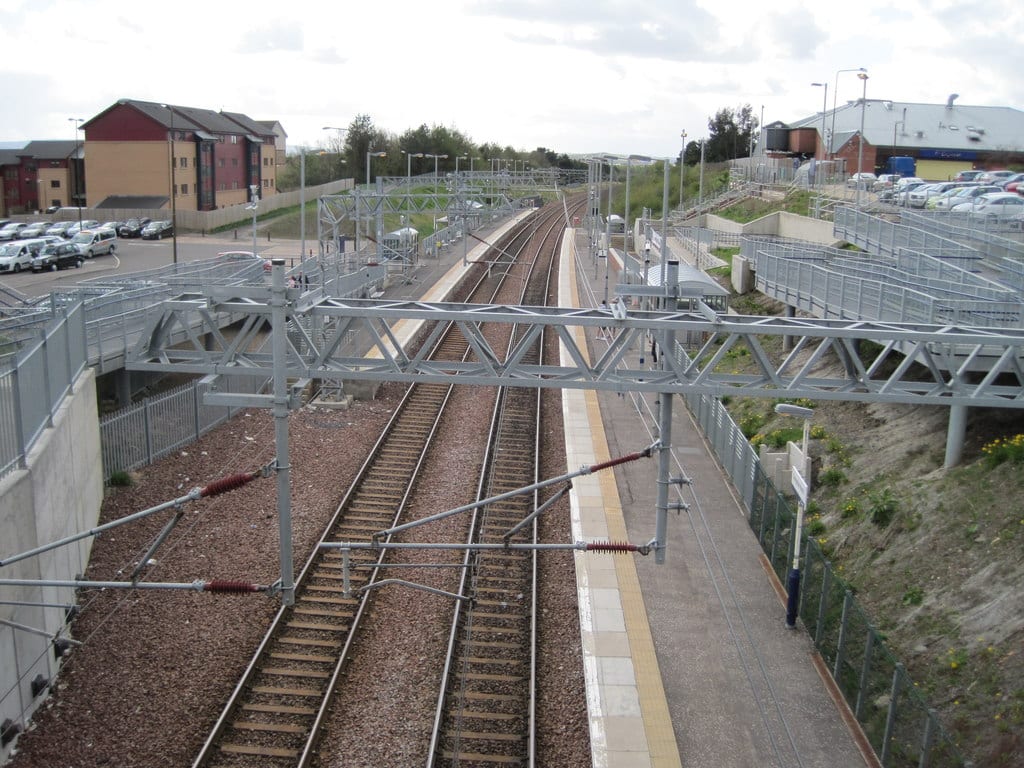
Context · Livingston (Scotland), site of Robert Taylor's Dechmont Law encounter
Livingston North railway station, West Lothian - geograph.org.uk - 3707656.jpg · Wikimedia Commons · CC BY-SA 2.0 · open original
Part 01
The night in question
On the morning of November 9, 1979, around 10:30, Robert 'Bob' Taylor, a 60-year-old forester with the Livingston Development Corporation, parked his pickup beside a road near the M8 motorway and walked up a path toward a newly-planted forestry area on Dechmont Law, West Lothian, accompanied by his Irish setter, Lara. His task that day was simply to keep the plantation clear of stray sheep. In a clearing, about 450 meters from the vehicle, he said he found a dome-shaped object —about 6 meters across, dark and with a shifting texture that seemed to turn partly transparent— hovering or resting above the ground. The dog barked, agitated.
By his account, two small spiked spheres, resembling sea mines, rolled toward him, attached to the legs of his trousers and dragged him toward the object; he smelled an acrid odor that made him choke, became dizzy and lost consciousness. When he woke, the object was gone. He made his way back on foot and in his truck, in shock and limping, with his trousers torn at the hips and grazes on his chin and thighs. His wife, Mary, and his employer found him in a state of shock; the doctor who attended him confirmed the injuries.
What distinguishes the case is the institutional response. Because of Taylor's injuries, Lothian and Borders Police opened a file and recorded the matter as a common assault —the only UFO sighting that formally became a criminal investigation. At the site, officers documented physical marks: two parallel sets of ladder-rung-like tracks (about 2.5 meters) and between 32 and 40 circular holes about 9 cm in diameter, arranged consistently with the account of the smaller objects. Taylor's personal credibility was a central factor: those who knew him described him as an honest man not given to fantasy —his employer, Malcolm Drummond, stated flatly that he was not one to make up stories—, he did not drink, and he held to the same account without changing it until his death in 2007. Prosaic explanations point to a medical episode —Taylor suffered from epilepsy, and a seizure, mini-stroke or episode producing olfactory hallucination and a fall has been suggested— while the ground marks never received an agreed explanation (forestry machinery was floated, unconfirmed). The case remained one of the few with police-documented physical traces and, at the same time, a serious medical alternative.
Part 02
Why this case moved the needle
It is unique in the global corpus: the only sighting that police processed as a crime, with a criminal file opened over the witness's injuries. That institutional response, together with the physical trace documented by officers (ladder-like tracks + dozens of holes) and the bodily effect on Taylor (torn clothes, grazes, dizziness), places it above a purely visual sighting. But its strength has a serious counterweight: Taylor was a single witness and suffered from epilepsy, which opens a plausible medical explanation —a seizure combining collapse, olfactory hallucination and a fall— that honest prose cannot ignore. The case is the archetypal example of ambiguous physical evidence: real ground marks and a real injury, over a single-observer experience with a clinical alternative. The analytical balance is delicate in both directions. In favor of an external event: the ground trace is physical and was documented by professional third parties, not by the witness; the injuries and torn clothing are real; and Taylor sought no publicity or profit, keeping a sober account for 28 years. Against it: a single witness, the absence of any recovered object, and a known neurological condition that can produce precisely olfactory hallucinations (the acrid smell he described is a classic epileptic aura), loss of consciousness and a fall with injuries. The medical hypothesis, however, does not by itself explain the ground marks, and the temporal coincidence between those marks and the episode remains unresolved. Tier A for the police documentation and the trace; moderate probability because of the non-excludable medical hypothesis.
Part 03
What's left on paper
Documented evidence
- Account of Robert Taylor, a forester, on November 9, 1979 at Dechmont Law (Livingston, West Lothian)
- Criminal investigation by Lothian and Borders Police, who recorded the matter as common assault — the only UFO processed this way
- Physical effect on the witness: trousers torn at the hips, grazes on chin and thighs, dizziness and loss of consciousness
- Ground traces documented by officers: two parallel ladder-like tracks (~2.5 m) and 32-40 circular holes (~9 cm)
- Description: dark dome ~6 m and two spiked spheres resembling sea mines
- Serious medical alternative: Taylor had epilepsy; a seizure/mini-stroke with hallucination and a fall has been proposed — the ground marks received no agreed explanation
Sources
- Wikipedia — Robert Taylor incident — Chronology, police investigation and traces.
- BBC News — 'The UFO sighting investigated by the police' — Coverage of the 40th anniversary and the police file.
- West Lothian Council — Dechmont Law UFO (información oficial) — Local institutional document on the incident and the site.
Patterns it exhibits (1)
Location
Dechmont Law, Livingston, West Lothian, Scotland · 55.89°, -3.50°
Distribution of explanations
This case is classified among the model's hypotheses: the bar splits 100% by how much each explanation weighs (the uncertainty is spread across the hypotheses the case supports). Summed across the corpus they produce the comparable partition. It is a different question from the Probability above: that one estimates how likely the case is a genuinely unexplained phenomenon; this one splits which the explanation would be.
Modal hypothesis: Misidentification 66% · sums to 100%
Confused with: No single object identified
Structured analytical judgment, not a calibrated frequency. Forced classification: the mass the evidence cannot assign is spread across the hypotheses the case does support.
Related cases