1987·Ilkley Moor, West Yorkshire, England
United Kingdom.Ilkley Moor 1987 · the policeman, the green humanoid and the blurry photo
On the morning of 1 December 1987, a former police officer the literature calls 'Philip Spencer' (a pseudonym) said he photographed on Ilkley Moor, West Yorkshire, a ~1.2 m green humanoid with a large head and long arms that gestured at him and fled; following it, he saw a silver dome rise and vanish, and on reaching Ilkley he found ~2 hours of 'missing time'.
Read the rest of the summary
The single, very blurry photo was examined by the Kodak laboratory at Hemel Hempstead with no evidence of tampering. Under hypnosis (March 1988) he 'recalled' an abduction. Investigated by Peter Hough and Jenny Randles, it remains unresolved; skeptics read it as a hoax.
Tier B · IndicativeWhat do they mean? →
Limited evidence: a single witness, testimony gathered years later, or an account without contemporary primary documentation.
What it was
66%natural or human cause
Most likely explanation: person
See the split across the six explanations
Natural or human cause
No known cause
Read the full reasoning
This is reported by Wikipedia ('List of UFO-related hoaxes'), citing Patrick Vidal (SOBEPS, Flash no. 1, Feb 1990), who asks how 'des enquêteurs expérimentés' could have been taken in by 'un aussi banal canular ou méprise'. But Vidal's text could not be read, and according to Patrick Gross, Hough and Randles traced that 'explanation' to a newsroom joke 'the paper had simply printed ... out as "the explanation"'; moreover, Kodak found no tampering in the photograph.Primary documents
File DEFE 24/1931: Ministry of Defence replies to MUFORA on the Ilkley case (July, October and December 1988)
Three letters from Sec(AS)2a, the British Ministry of Defence office that received UFO reports, to the Manchester UFO Research Association (MUFORA). The July 1988 letter answers its letter of 25 May: having searched its files, it finds nothing on sightings in the Ilkley area on 1 December 1987. The 24 October letter says the ministry does not visit witnesses, that it is not aware of any representative of its visiting MUFORA's witness on 15 January, that the two men were not bona fide officials, and that the card described does not tally with the current design. The 16 December letter adds that it knows of no previous design that matches either.
The National Archives (Reino Unido), DEFE 24/1931, págs. 277-278, 140 y 43 del PDF; copia digital en archive.org (BritishUFOFiles) · Open Government Licence v3.0 (Crown copyright, Ministry of Defence) · open original
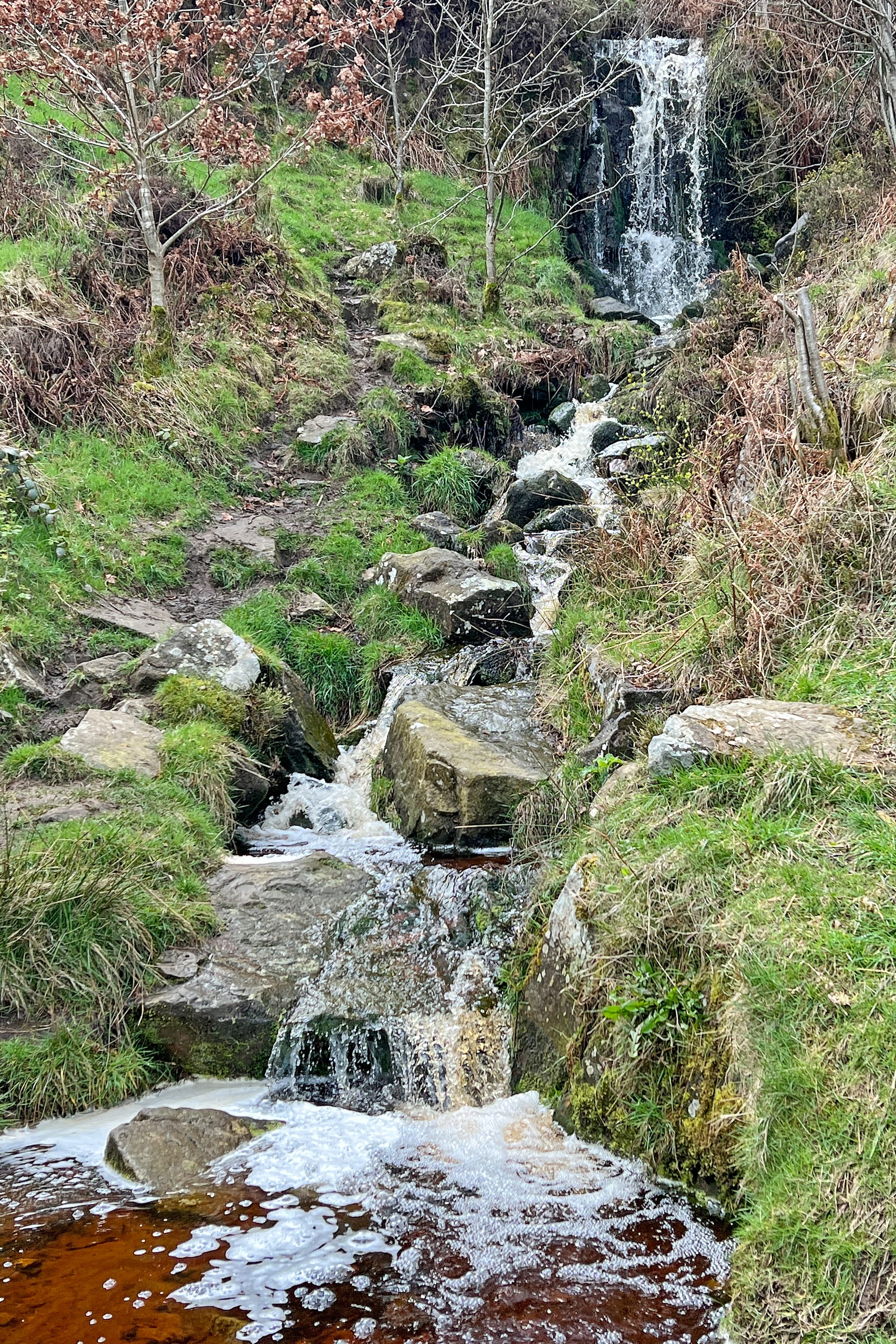
Context · Ilkley Moor (West Yorkshire, England)
Stream on Ilkley Moor.jpg · Wikimedia Commons · CC BY 2.0 · open original
MUFORA letters to the Ministry of Defence about the Ilkley witness (6 April, 25 May, 13 July and 29 November 1988), in DEFE 24/1931
Letters from the chairman of the Manchester UFO Research Association filed in DEFE 24/1931 (pp. 409, 364, 268-269 and 58 of the archive.org copy). The 6 April 1988 letter says that a man from Ilkley who claims a fourth-kind encounter was visited, according to him and his wife, by two men in suits carrying 'MOD' identity cards at about 8.50 pm on 15 January 1988, and asks whether they were from the ministry. The 25 May letter asks for UFO reports from around Ilkley on 1 December 1987. The 29 November letter concludes the visitors were posing as officials. They are private letters, not Crown works.
The National Archives (Reino Unido), DEFE 24/1931; copia digital en archive.org (BritishUFOFiles) · view source
Jenny Randles, 'To believe or not to believe: the lessons of Gulf Breeze and Ilkley Moor', UFO Times (BUFORA) no. 4, November 1989
Article by Jenny Randles in the British UFO Research Association's magazine. It says the case reached her in a letter of 3 December 1987 from a former police officer who claimed to have photographed a landed UFO and a small entity on Ilkley Moor two days earlier; that the witness gave the negative to the group DIGAP; and that Peter Hough arranged photo analysis by three sources, Kodak among them, studies of the compass and the site by university departments, and a clinical psychologist's evaluation with hypnosis. It concludes that the photo's nature has been neither proved nor disproved and that the witness seems sincere.
UFO Times n.º 4 (BUFORA, noviembre de 1989), págs. 6-9; copia en archive.org · view source
The night in question
The Ilkley Moor case is one of the most cited (and most disputed) in the British record of entity encounters. Its protagonist is a man the investigators shielded under the pseudonym 'Philip Spencer': a former police officer who, according to Jenny Randles in 1989, did not live in Yorkshire, had given only a box number on the other side of the country and was re-applying to join another police force, which is why he asked for anonymity. On the morning of 1 December 1987 he set out early to cross Ilkley Moor on foot (a high, often fog-bound moor dotted with rocky outcrops and prehistoric carvings) heading for the town of Ilkley, carrying his camera to photograph the landscape.
By his account, as he climbed a small rise he saw ahead of him, on the path, a strange figure: little over a metre tall, dark green, with a disproportionately large head and long, thin arms. The creature, he says, made an arm gesture he read as an order to keep away. Rather than retreat, Spencer raised his camera and took a single photo. The being turned and ran; Spencer gave chase, lost it in the fog and, as he crested the ground, glimpsed a silver dome-shaped structure rising from the moor and shooting upward out of sight.
Disoriented, he changed course and walked down toward Ilkley. Two anomalies marked the return. First, his compass behaved in reverse: the needle pointed south instead of north. Second, on reaching the town he found it was about two hours later than his internal clock told him: an episode of 'missing time', the classic marker of the abduction narrative. Spencer had the film developed; the image of the creature came out very blurry, but recognizable as a humanoid figure on the moor. Two days later, on 3 December 1987, he wrote to Jenny Randles about the sighting; getting no reply, he handed the negative to another group, DIGAP, through which it reached Peter Hough. The photo became news in the summer of 1988, when a DIGAP member sold or gave it, against the wishes of the witness and the investigators, to tabloids in the USA and Britain. Technicians at Kodak's laboratory in Hemel Hempstead examined it and declared they could find no signs of faking or double exposure, which rules out darkroom photomontage, but not that the photographed object was real.
Intrigued by the combination of photo, reversed compass and missing time, investigators Peter Hough and Jenny Randles took on the case. According to Randles, Hough arranged photo analysis by three sources (Kodak among them) and later computer enhancement, a study of the compass effects by a university department, a geomagnetic and radiological site survey by another, and a clinical psychologist's evaluation of the witness, followed by regressive hypnosis; and a local team repeated the photography at the site on the anniversary, 1 December 1988. Hough suggested hypnotic regression, conducted by hypnotherapist Jim Singleton on 16 March 1988, with researcher Arthur Tomlinson present. Under hypnosis, Spencer 'recalled' being taken aboard: small green beings examined him, inserting probes into his nose and mouth, showed him the craft and screened a film of apocalyptic imagery (nuclear explosions, famines and floods), the stock 'ecological message' of 1980s contact literature.
In 1988 the Manchester UFO Research Association (MUFORA), which was investigating the case, wrote to the Ministry of Defence. In July the Ministry replied that it had nothing on the incident, and on 24 October that the two men who had visited the witness on 15 January posing as its representatives were not Ministry officials: it made no such visits, and the identity card the witness described did not tally with its own.
The case was never closed. Skeptics hold to the hoax or misidentification hypothesis: the blurry figure could be a person, a cardboard cut-out or a doll placed for the shot, and the compass 'anomaly' and missing time admit prosaic explanations (a faulty or magnetized compass, a timekeeping error on a winter dawn). Defenders stress the witness's occupational credibility (a former policeman, trained to observe and testify) and the Kodak verdict. Neither side holds the piece that would settle it. Randles summed it up in 1989: despite the work on the photograph, 'we have not proved or disproved its nature'; the witness seemed sincere and shunned media attention.
Why it matters
Ilkley Moor matters as a high-profile testimonial case, not as evidence that moves the underlying narratives. It packs, into a single episode, nearly every element of the British abduction story: the liminal setting (a fog-bound moor), an occupationally credible witness, an ambiguous photograph, physical anomalies (compass, missing time) and a deep narrative recovered under hypnosis. That very accumulation is what compels caution.
The decisive methodological point is the hypnosis. The bulk of the extraordinary content (the beings, the exam, the apocalyptic film) comes not from conscious memory but from a later hypnotic regression. Memory recovered under hypnosis is notoriously prone to confabulation and to interviewer suggestion; in abduction research it has been shown to produce vivid, sincere accounts that carry no guarantee of having happened. The weight therefore falls on what is contemporaneous and physical: the photo and the compass. And there the photo, despite Kodak's verdict (which only rules out lab faking, not a real subject before the camera), is too blurry to identify anything, and the reversed compass was examined by a university department, according to Randles, but the sources consulted do not report the result.
The calibrated reading is thus skeptical: the package is consistent with a hoax or a misidentification amplified by a hypnotic narrative, without the anomalous being wholly excludable given the witness's apparent sincerity. Its role is to serve as a calibrator: it shows how a case can be famous, rich in detail and sincere in its witness, and still yield no probative evidence. A photograph's fame is not its evidential worth.
What's left on paper
Documented evidence
- Single sighting, 1 December 1987, on Ilkley Moor (West Yorkshire), by a former police officer under the pseudonym 'Philip Spencer'
- A single photograph of the humanoid, very blurry; Kodak's laboratory at Hemel Hempstead found no evidence of faking or double exposure
- Reported physical anomalies: compass pointing south (reversed) and ~2 hours of 'missing time' on reaching Ilkley
- Entity description: ~1.2 m, dark green, large head, long thin arms; a 'keep away' gesture before fleeing
- Abduction narrative (medical exam with probes, tour of the craft, film of apocalyptic imagery) recovered under hypnosis with Jim Singleton on 16 March 1988
Show 2 more items
- Investigated and documented by Peter Hough and Jenny Randles; dominant skeptical reading: hoax (cut-out/person) or misidentification amplified by hypnosis
- Jenny Randles, 'The lessons of Gulf Breeze and Ilkley Moor' (UFO Times no. 4, Nov 1989): witness's letter of 3 Dec 1987; photo analysis by three sources, university studies of the compass and site, psychological evaluation; 'we have not proved or disproved its nature'
Sources
- Wikipedia — Ilkley Moor UFO incident (fuente secundaria) — Synthesis of the case, Kodak's photographic analysis and skeptical readings.
- Peter Hough & Jenny Randles — investigación del caso (UFO casework, años 1988-1994) — Detailed account of the witness, the hypnotic regression and the chronology of the investigation.
- Wikipedia — List of UFO-related hoaxes (Ilkley Moor; cita a P. Vidal, SOBEPS Flash n.º 1, 1990) — Records the Daily Star's explanation (2 Jul 1989): an insurance broker photographed unawares.
- Gross, P. — «The Ilkley Moor encounter of the 3rd kind, 1987», UFOs at close sight — Records that Hough and Randles traced the newspaper's explanation to a newsroom joke.
- Jenny Randles, 'To believe or not to believe: the lessons of Gulf Breeze and Ilkley Moor', UFO Times (BUFORA) no. 4, Nov 1989, archive.org — Contemporary account by one of the investigators: how the case arrived, the analyses commissioned and the 1988 leak to the press.
Entity form (1)
Related cases
Associated actors (1)