1986·Izvestkovaya Hill (Height 611), Primorsky
Russia.Dalnegorsk · Height 611
On 29 January 1986, two schoolboys in Dalnegorsk, in the Soviet Far East, saw a glowing red ball the size of a football, trailing sparks and white smoke, strike 'Height 611', bounce amid flashes and fall; the fire lasted an hour. Teacher Valery Dvuzhilny collected metal drops and 'meshes' on the summit and claimed Soviet institutes found unusual properties in them; a local journalist attributed it to ball lightning and to debris already there.
Tier B · IndicativeWhat do they mean? →
Limited evidence: a single witness, testimony gathered years later, or an account without contemporary primary documentation.
What it was
63%natural or human cause
Most likely explanation: atmospheric
See the split across the six explanations
Natural or human cause
No known cause
Read the full reasoning
The report records another explanation, physicist Valentin Psalomshchikov's, which a member of the Russian Academy of Sciences' commission against pseudoscience considers definitive: a foreign "reconnaissance balloon probe"; that reading belongs to adversary technology, not to this class. Russian original: "Большаков выдвинул гипотезу о том, что в скалу попала шаровая молния".Primary documents
FBIS, Foreign Press Note 'USSR: Media Report Multitude of UFO Sightings' (22 Nov 1989, 5 pp.)
Summary by the CIA's foreign press monitoring service. Its first pages gather what the Soviet press published about 'Hill 611': Sotsialisticheskaya Industriya reported that many saw a sphere crash into one of the hill's peaks, that scientists from the Siberian Division of the Academy of Sciences were still studying the 'fine mesh', spherical objects and pieces of glass, and that A. Makeyev found gold, silver, nickel, alpha-titanium, molybdenum and beryllium compounds; a Tomsk physicist proposed a 'plasmoid'. It then cites the Poisk article in which physicist Yuriy Platov holds that the remains come from an unsuccessful launch of a Soviet rocket, against Vladimir Azhazha, who argues for a UFO crash. It is a record of how the case was debated in 1988-1989, not a report of the investigation.
FBIS (CIA), Foreign Press Note · CIA Reading Room 0000042346 (copia de archive.org) · Public domain · US Government work · open original
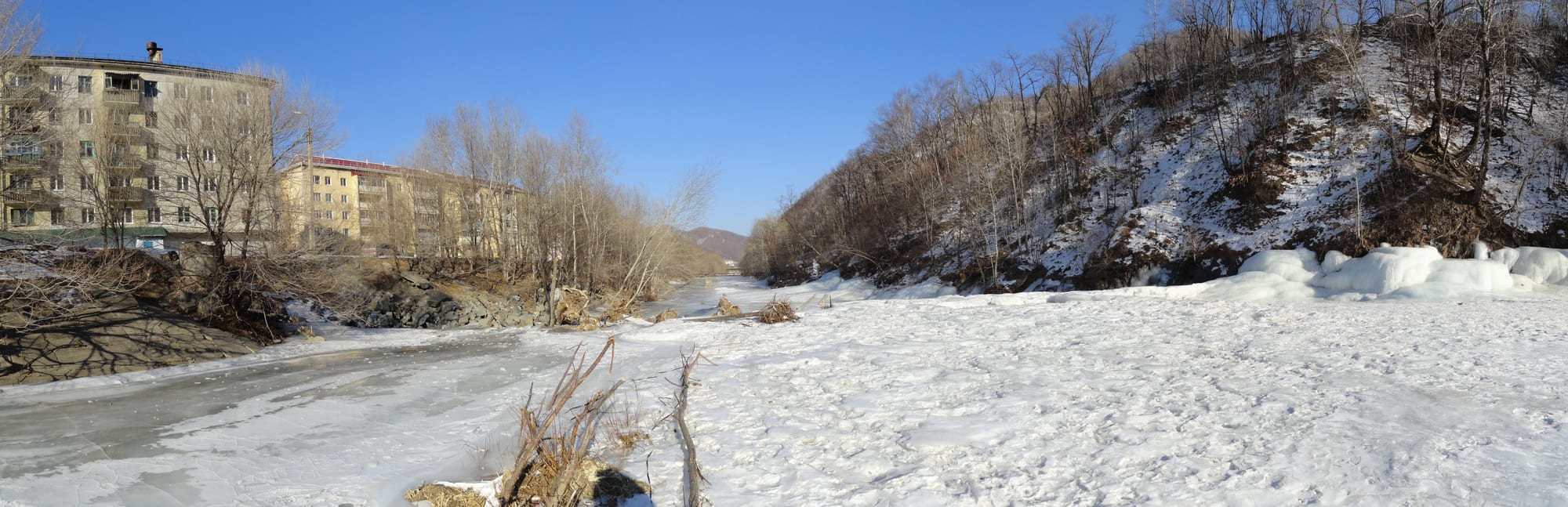
Context · Dalnegorsk (Primorye, Russia), below Height 611
Dalnegorsk, Primorsky Krai, Russia - panoramio.jpg · Wikimedia Commons · CC BY-SA 3.0 · open original
The night in question
The first account of the event was written by Valery Dvuzhilny, a biology teacher at Dalnegorsk School No. 1 and a member of the Geographical Society, in the local newspaper 'Trudovoye Slovo' of 22 February 1986: "At 19:55 on 29 January of this year, two schoolboys, Sergei Olkhov and Alyosha Maslov, saw a glowing red ball. It was flying from the southwest, from Gorely, almost parallel to the ground, on a somewhat inclined path. A trail of sparks and white smoke stretched behind the ball. Its size, as it seemed to the observers, was that of a football. Its colour changed from bright to dim, and as it flew it lit up the ground and moved the shadows of the trees." On reaching the bus station area, the account continues, "it went sharply down and struck the rock with a dull sound. A bright flash followed, the ball bounced, another flash, and it fell on the rocks. At that moment a fire started there, which stopped after an hour."
The site is the rocky summit of Izvestkovaya hill, known as 'Height 611' for its elevation, above the mining town of Dalnegorsk (Primorye), which has lived since the nineteenth century off lead and zinc deposits. Other witnesses emerged later, about twenty according to the press, and some claimed the object bounced off the rock several times and then flew on. First the family of one of the schoolboys climbed up, and on the third day the school local-history club led by Dvuzhilny did. One of his pupils, Konstantin Timush, recalls finding "a burned place, as if something burning had fallen", and on careful inspection "some metal drops, as if molten metal had splashed, and some metallized little meshes". Dvuzhilny described a stump half turned to charcoal and half covered in black, glass-like streaks, and said he later climbed about a hundred times to collect metal drops.
In 1989 Dvuzhilny wrote in the same newspaper that the samples had been studied at three academic centres and eleven research institutes and that "many samples show properties unusual for our earthly materials": the alloys contained 17 chemical elements, and in the 'mesh', a complex carbonaceous material, there were quartz threads 17 microns thick with a gold wire inside, a technology the specialists he cited called impossible at the time. That same year the newspaper 'Molodoy Kommunist' quoted metal physicists from the local 'Bor' and 'Dalpolimetall' enterprises saying no industry would use such a combination of elements at once. These results come from Dvuzhilny himself and the laboratories he consulted: the analysis reports have not been published or independently replicated, and his finds are now held by his family. Not even the finding that the alloy from the hill contained lead mined at a specific Soviet deposit changed his mind: as quoted by Mikhail Gershtein, Dvuzhilny reasoned that the visitors could use earthly lead as fuel and refuel along the way. Over time he concluded that the town sat over a 'wormhole' through which visitors entered.
Why it matters
At Dalnegorsk, as at Trans-en-Provence 1981 (↗), physical material collected on site was analysed in the laboratory. That it was collected by a schoolteacher with his pupils (not a military or intelligence agency) and that he openly shared the results in the local press distinguish it from the usual Anglo 'classified crash retrieval' pattern: here there was a biology teacher climbing a hill three days later with his school club, and no military secrecy. The chain of custody is essentially that of a single investigator and his network of laboratories; the samples were never subjected to blind counter-analysis by an independent Western laboratory, and the context of late-Soviet ufology and the glasnost-era press introduced narrative amplification that is hard to separate from the hard data.
The soberest skeptical reading requires no fraud. Journalist Valery Bolshakov of 'Trudovoye Slovo' proposed ball lightning in 2013 and produced a witness according to whom the summit had held, in the 1960s, a hut with electronic equipment, probably a relay, which lightning burned a couple of years before 1986: the drops and meshes could be debris that was already there. The 'anomalous' concentrations of gold and other elements may also reflect Dalnegorsk's own mining geology. Physicist Valentin Psalomshchikov instead proposed a foreign reconnaissance balloon probe that self-destructed. The original account does not describe anything that requires a craft either: a football-sized ball with a trail of sparks, an impact with a dull sound and a fire that lasted an hour. What keeps the case open is that no one has published the analyses that would allow these readings to be tested.
What's left on paper
Documented evidence
- Dvuzhilny's account in 'Trudovoye Slovo' (22 Feb 1986): two schoolboys saw a football-sized red ball, trailing sparks and white smoke, strike with a dull sound, bounce and fall; the fire lasted an hour
- Metal drops, 'meshes' and a charred stump found on the third day by Dvuzhilny's school club
- Dvuzhilny (1989): samples studied at three academic centres and eleven institutes, 17 elements and quartz threads with gold; the reports have not been published
- Bolshakov (2013): ball lightning and debris from a hut with electronic equipment burned before 1986; Psalomshchikov: foreign balloon probe
Sources
- Dvuzhilny, V. — crónicas en «Trudovoe slovo» (22 feb 1986 y 1989) — Primary source; quoted verbatim in the Takiedela report (2020), not consulted in the original
- Journal of Scientific Exploration — Dalnegorsk material analysis review
- Takiedela — 'Земля большая, а упали именно сюда' (October 2020, in Russian) — Report with the verbatim quote of the 1986 account, testimony from a member of the first expedition and from Bolshakov, and Psalomshchikov's hypothesis
Related cases
same object · same period
Capilla del Monte · Cerro Uritorco
1986 · Tier B
same explanation · same country · same period
Sasovo Explosion
1991 · Tier A
same object · same period
Val Johnson · patrol car with documented physical damage (USA, 1979)
1979 · Tier A
same object · same period
Cando Event · Galicia
1994 · Tier A