1975·Algiers · Ministry of National Defence
Algeria.Algeria Ministry of Defense démarche
On 7 March 1975, Colonel Abdelhamid Latreche, Secretary General of Algeria's Ministry of National Defence, called in the head of the U.S. mission in Algiers to ask whether the United States could explain 'machines' seen five times over Algeria since January, the latest the night before, first on radar and then visually. Washington replied that neither NASA nor the Pentagon knew anything.
Tier A · AcceptableWhat do they mean? →
Institutional evidence: several identified independent witnesses, or contemporary official documentation, without an instrumental record to corroborate them.
What it was
75%natural or human cause
Most likely explanation: planet or star
See the split across the six explanations
Natural or human cause
No known cause
Read the full reasoning
The Rabat embassy reported that Le Matin put the lights seen over Morocco down to "an infrequent conjunction of Venus with Sirius", citing an "amateur Casablanca astrologist". The ephemeris calculation places Venus (−3.8) in the west after sunset. Weak support: it does not explain the radar contact.Primary documents
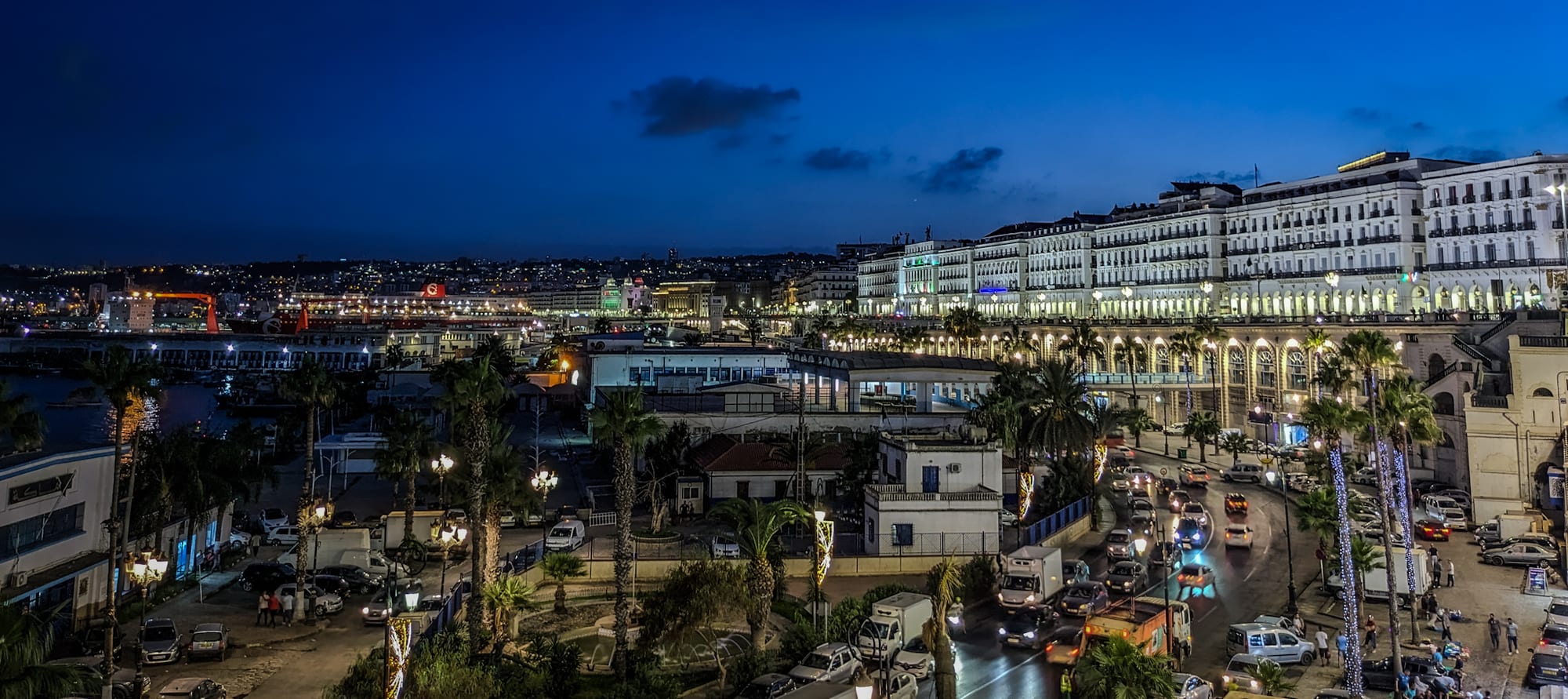
Context · Algiers (Algeria), seat of the Ministry of National Defence
At night in Algiers, Algeria.jpg · Wikimedia Commons · CC BY-SA 4.0 · open original
Cable 1975ALGIER00638 from the U.S. Embassy in Algiers, 7 March 1975
A "limited official use" telegram signed by Parker, head of the U.S. mission, after his meeting with Col. Abdelhamid Latreche, secretary general of Algeria's Defence Ministry. It records the five sightings of the object, around 19:00-19:30, the last off the coast on 6 March, seen first by radar and then visually at about 15,000 meters "(sic)", with a light compared to a car headlight. The embassy assumes "natural phenomenon of some sort" and asks for data on the radar contact; Latreche had already rejected the idea of a satellite or of a searchlight bouncing off clouds. It is an electronic telegram with no facsimile; the full text is in the PlusD archive.
Departamento de Estado de EE. UU. (NARA, telegramas electrónicos de 1975), vía WikiLeaks PlusD · view source
The night in question
By the Algerian account itself, the story began in January 1975 in Béchar, when three American journalists turned up there to cover the arrival of a balloon due to take off from California; the U.S. diplomat identified it as Malcolm Forbes's balloon crossing, aborted at the last minute. Almost immediately afterwards, still according to the Algerians, strange objects began to be seen in the sky, sometimes near military installations, and because of that coincidence in dates they asked the United States first. The embassy added in its comment that it had already reported a 'mysterious balloon' seen near Oran on 25 January, which it took to be the first sighting of the series.
On 7 March, Colonel Abdelhamid Latreche, Secretary General of the Ministry of National Defence, asked the head of the U.S. mission (the cable is signed Parker) to call at the ministry. He said the object had been seen five times, usually at about 19:00 or 19:30, and once for more than two hours: twice near Oran, once in the centre of the country, once near Béchar and most recently off the coast the night before, 6 March. He described it as a very bright light, which he kept comparing to a car headlight and which hid its shape; he said it manoeuvred and had been seen to land and take off. On 6 March at about 19:30 it had reportedly been picked up first by radar and then visually, at some 15,000 metres (the cable adds 'sic'); on other occasions it was estimated at 2,000 metres. Latreche stressed that it had always been seen by more than one person.
Latreche also asked whether it might be Sixth Fleet manoeuvres, since Algeria was tracking the fleet by radar and air surveillance. The diplomat granted that some phenomenon seen off the coast could have been produced by the fleet, but assured him categorically that no American aircraft, balloon or machine was using Algerian airspace without permission. The cable records that it was Latreche who rejected the explanations the American put to him, a satellite and, for the coastal sighting, a searchlight bouncing off clouds; it does not say that the ministry had itself studied and ruled out space debris or atmospheric optics. The embassy's comment describes Latreche as not an excitable person and the Algerian military as matter-of-fact, and concludes: 'We assume they have indeed seen something, but assume it natural phenomenon of some sort which has engendered a mild hysteria and reports of repeated sightings'; even so, 'given level at which query made, we must take it seriously'. It asked the addressees, among them European Command and the Sixth Fleet, for information above all on the alleged radar sighting of 6 March.
The replies came within six days. On 11 March the embassy in Rabat reported that the newspaper Le Matin had said hundreds of Casablanca residents saw two greenish lights west of the city and, the next day, that the same phenomenon was seen over Rabat, Fez and northern Spain, which the paper put down to a conjunction of Venus with Sirius. On 13 March the State Department told Algiers that NASA had no knowledge of the origin of the phenomena and that the Defense Department had no knowledge of any U.S. military activity that could explain the 6 March radar sighting. No further correspondence and no Algerian closure are on record. An ephemeris calculation supports the astronomical lead Rabat pointed to: from January to March 1975 Venus shone in the west after sunset at magnitude −3.8, and on 6 March at 19:30 it stood about 9° above the western horizon as seen from Oran, setting around 20:15; on 17 February it passed 0.2° from Jupiter. That fits a dazzling light that returns at the same hour, lasts two hours and seems to 'land' as it sets. Venus does not explain the radar contact, but that contact is known only from Latreche's oral account.
The regional context also counsels caution. In the early hours of 18-19 September 1976 Morocco's Royal Gendarmerie collected almost identical reports from half the country, which King Hassan II took to the U.S. embassy (cable 1976RABAT05209); Ted Molczan's reconstruction attributes them to the reentry of a Soviet rocket stage (see ↗). In the same region and era, a spectacular and widely witnessed report had an identifiable cause.
Why it matters
A non-aligned state, through its Ministry of Defence, took an unidentified aerial phenomenon to a foreign power through a verifiable diplomatic channel, and the contemporary record of that gesture survives in full: the embassy cable of 7 March 1975, the State Department reply of 13 March and the Rabat embassy note of 11 March, declassified in the 2006 systematic review and published in the PlusD database. It is the meeting as told the same day by one of its two participants.
But three layers need to be kept apart. The first, the Algerian gesture, is fully documented. The second, what was seen, reaches us only as Latreche's oral account transcribed by a diplomat: five sightings of a light that always appeared at nightfall, plus a radar contact at 15,000 metres that nobody documented with tracks, times or equipment, and which the cable itself calls 'alleged'. The third, the interpretation, the Americans gave bluntly: a natural phenomenon amplified by mild hysteria. Neither NASA nor the Pentagon had anything to add, and the Defense denial answers the specific Algerian suspicion, U.S. military activity, without offering any other explanation.
With those three layers separated, the case is an example of state acknowledgment from the Global South; its value is institutional, and it offers no evidence of unconventional technology. Venus in the western sky, with its February conjunction with Jupiter, accounts well for the repetitive visual part; the radar contact remains the one datum that does not fit, and it is precisely the worst documented. It also widens the geopolitical map of the phenomenon beyond the West: the pattern of taking it seriously through military and diplomatic channels is not exclusive to the United States or Europe, and the U.S. reply shows how such a query was closed at the time, with a denial of involvement and no investigation of its own.
What's left on paper
Documented evidence
- Algiers embassy cable 1975ALGIER00638 (7 Mar 1975): Latreche's account, five sightings, alleged radar contact on 6 March at about 15,000 m
- The cable records that Latreche rejected the diplomat's hypotheses (satellite, searchlight on clouds); the embassy assumed a natural phenomenon with 'mild hysteria'
- Cable 1975STATE057034 (13 Mar 1975): NASA has no knowledge and Defense knows of no U.S. military activity that could explain the radar contact
- Cable 1975RABAT01225 (11 Mar 1975): greenish lights over Casablanca, Rabat and Fez put down by the press to Venus and Sirius
- Ephemeris: Venus at magnitude −3.8 in the west at dusk, conjunction with Jupiter on 17 Feb 1975
- No known Algerian closure; the radar contact is on record only in the oral account
Sources
- Cable del Departamento de Estado 1975ALGIER00638, «Unidentified Flying Objects over Algeria» (7 mar 1975), en WikiLeaks PlusD — Declassified primary diplomatic cable (systematic review of 5 Jul 2006); full text
- Cable 1975STATE057034, respuesta del Departamento de Estado a Argel (13 mar 1975) — Primary reply: NASA and the Defense Department have no knowledge of the origin or of U.S. military activity
- Cable 1975RABAT01225, «Unidentified Flying Objects over Algeria (and Morocco)» (11 mar 1975) — Primary reply from the Rabat embassy; reports the Venus-and-Sirius explanation published by Le Matin
- Cable 1976RABAT05209 (25 sep 1976), consulta marroquí sobre los avistamientos del 18-19 sep 1976 — Primary; regional context (case morocco-gendarmerie-1976)
Referenced by 2 cases
Related cases