1981·Trans-en-Provence
France.Trans-en-Provence
On 8 January 1981, Renato Nicolaï said an object shaped like two upturned plates set down for about 40 seconds on his land at Trans-en-Provence and left a circular mark; GEPAN (CNES) and biochemist Michel Bounias (INRA) studied the soil and the alfalfa and found alterations GEPAN could not explain. The initial gendarmerie telex described the traces as tyre skid marks, and skeptics argue the site was contaminated before sampling.
Tier A · AcceptableWhat do they mean? →
Institutional evidence: several identified independent witnesses, or contemporary official documentation, without an instrumental record to corroborate them.
What it was
53%no known cause
The evidence is not enough to decide between the explanations
See the split across the six explanations
No known cause
Natural or human cause
Primary documents
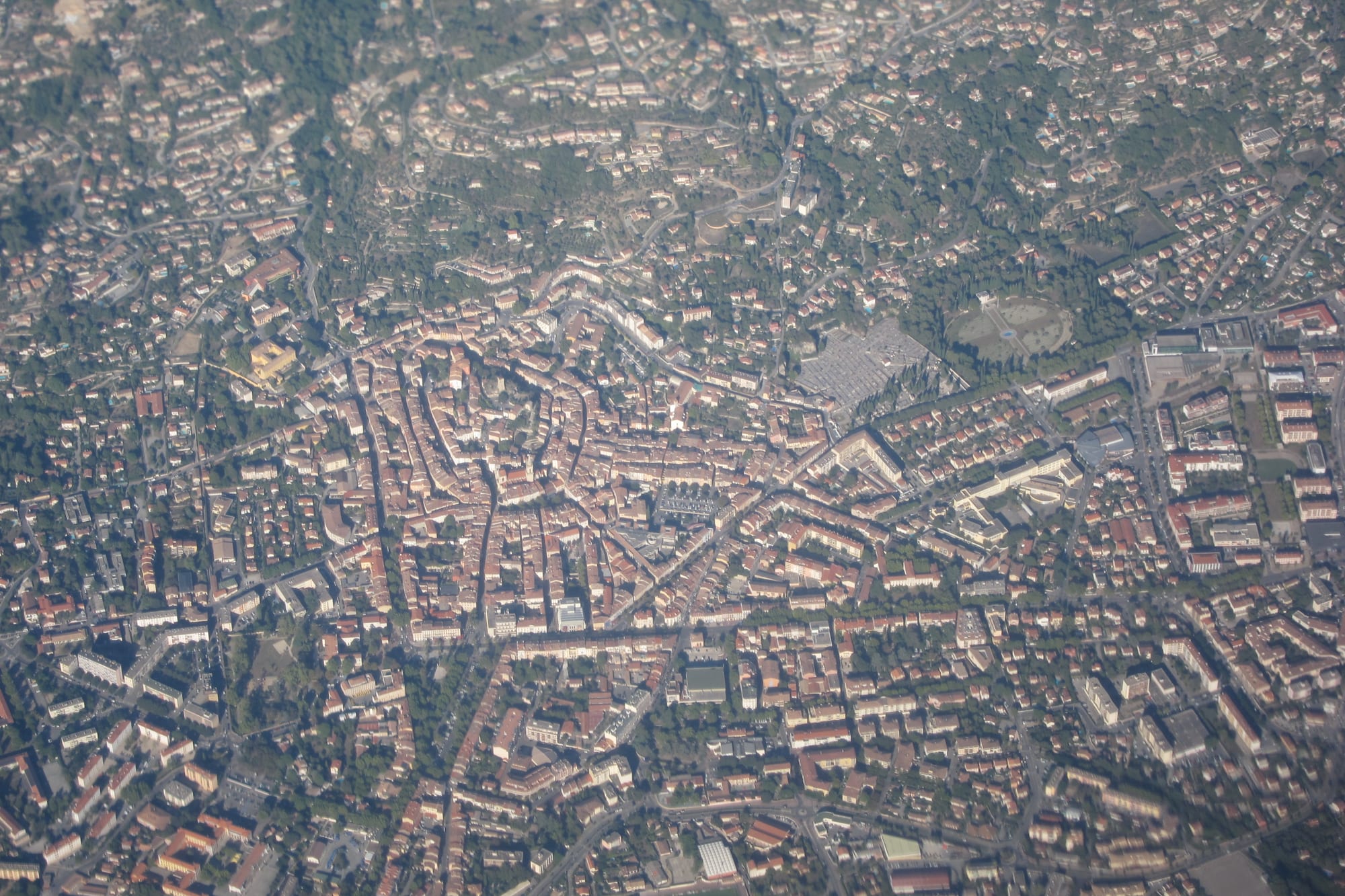
Context · the Draguignan area (Var, France), near Trans-en-Provence
Draguignan centre-ville, vue aérienne.jpg · Wikimedia Commons · CC BY 4.0 · open original
Draguignan gendarmerie: telex of 9 January 1981 and report no. 28/1981 with photographic plates, 11 pp.
Gendarmerie file published by GEIPAN. The telex of 9 January 1981 summarizes the landing on the 8th at about 17:00: an ovoid object about 3 m across, matt grey, with no portholes or antennas, that set down and left vertically, the whole observation lasting "about 1 minute"; and two arcs of a circle "resembling tyre skid marks". Report no. 28 (closed on 4 February) describes the ground, two concentric circles with black striations, the soil and grass samples sent to CNES, and seven photographs of the site and the traces. GEIPAN documents are © CNES, so it is linked only.
Gendarmería Nacional (brigada de Draguignan); expediente GEIPAN 1981-01-00849 · view source
The night in question
According to his statement to the gendarmerie, on Thursday 8 January 1981, at about 17:00, Renato Nicolaï, aged about 52, was building a cement shelter for the water pump in his garden at Trans-en-Provence (Var, southeastern France) when a faint whistle made him turn: he saw in the air, at the height of a large pine at the edge of the land, an object coming down toward the ground without spinning or showing flames. He moved closer, saw it resting about thirty metres away and almost at once saw it rise, raise a little dust and move off fairly quickly over the trees toward the northeast; the sighting lasted no more than 30 to 40 seconds. He described it as shaped like "two plates upturned against each other", lead-coloured, with a rib around it, about 2.50 m across and 1.80 m high, and underneath two round pieces like "jets or feet" and two circles like hatches. Afterwards he saw at the spot "a circle about 2 m in diameter" with, at some points along the curve, "a kind of skid marks". When his wife came home that evening she thought he was joking and called the neighbours, who saw the mark and advised alerting the gendarmerie.
The gendarmes came the next day, 9 January. According to the telex they sent to GEPAN, quoted by skeptic Éric Maillot, they saw "two arcs of a circle resembling tyre skid marks", a phrase the technical note later dropped, and took two vegetation samples. The case passed to GEPAN (Groupe d'Études des Phénomènes Aérospatiaux Non identifiés), the official office created in 1977 within CNES, the French space agency, with Jean-Jacques Velasco as investigator; on 23 January it asked for two control samples 20 metres away, and on 17 February, some 40 days later, it took further soil and plant samples itself. Meanwhile it rained heavily on 10 and 11 January, onlookers and journalists trampled the marks, and a ufology group took samples of its own.
The soil and vegetation samples (taken both from the affected area and from control zones at varying distances) were distributed to several French state laboratories. The biological analysis, led by Dr. Michel Bounias of INRA (Institut National de la Recherche Agronomique), examined wild alfalfa from the site and found, against the control samples, drops of 33% in chlorophyll A, 28% in chlorophyll B and up to 80% in violaxanthin in young leaves from the edge of the mark, abnormal ageing, and a relation with distance from the centre of the mark in some of the compounds analysed, as one would expect from exposure to a point-source energy. According to Technical Note no. 16, the physical soil analyses recorded compaction, heating of up to 600 °C and "an external input of various materials, mainly iron and phosphates, with combustion residues". Maillot replies that the laboratory only said the calcite crystals formed "below 600 °C", setting no minimum, so they could have formed barely above ambient temperature. The plant alterations appeared both in the samples the gendarmes took the next day and in those taken 40 days later. Bounias published his results in peer-reviewed literature and concluded that the pattern was compatible with an electromagnetic stress and hard to reconcile with an ordinary hoax, chemical contamination or fire. GEPAN Technical Note no. 16 (1 March 1983) concluded that no confusion (helicopter, sounding balloon, shell) explained what happened and that a very heavy object had set down there; its director, Alain Esterle, added that the physico-chemical effects admitted interpretations "too diverse and vague" to corroborate the testimony, though they attested a "large-scale event". The case is now in GEIPAN's 'D' category, unidentified after investigation.
Why it matters
The investigation involved a national space agency, a state agricultural research institute, the Gendarmerie supplying chain of custody, a controlled biochemical analysis with samples and control zones, and scientific publication. Astrophysicist Peter Sturrock included it among the physical-trace cases reviewed by his independent 1997 scientific panel (the 'Sturrock Panel'), which recognized the value of the physical data without endorsing an exotic interpretation.
The case does not point strongly in any direction. Its strongest effect is to erode the mundane/natural narrative: the combination of mechanical compression from a heavy object and foliar biochemical trauma graded by distance from a central point is hard to produce with lightning, fire or contamination, and that elimination is backed by a published analysis. But the case does not discriminate what left those traces. The same marks are compatible both with a structured craft of unknown origin and with a terrestrial experimental prototype (and Nicolaï's own initial intuition pointed to the latter); southern France in 1981 was an era and a geography of aerospace testing. To this is added the underlying weakness: there is a single eyewitness to the object, and although the traces are objective, the link between those traces and the description of the ovoid rests on his account alone. Skeptics add data from the same file: the witness himself and the gendarmes' telex spoke of skid marks, the witness was working with cement that day (a cement mixer was one of the hypotheses, which Bounias said he ruled out with a test), GEPAN sampled forty days later after rain and trampling, and GEPAN itself recorded a military Alouette II helicopter over Trans-en-Provence at about 16:30. For all these reasons the case proves quite robustly that something physical and energetic affected that ground, but not what it was: that is where the file ends.
What's left on paper
Documented evidence
- Witness's statement to the gendarmerie: a 2.50 m object resting about 40 seconds and "a circle about 2 m" with "a kind of skid marks"
- Gendarmerie telex (9 Jan 1981), per Maillot: "two arcs of a circle resembling tyre skid marks"
- Bounias (INRA) analysis of alfalfa with control samples: drops in chlorophyll and pigments and a distance relation in some of the compounds
- GEPAN Technical Note no. 16 (1983): no confusion explains the case; heavy object; case in GEIPAN's 'D' category
- GEPAN sampling 40 days later, after rain, trampling and samples taken by a ufology group
Sources
- GEPAN/CNES — Note Technique 16 (1983)
- Bounias, M. — «Biochemical traumatology as a potent tool for identifying actual stresses elicited by unidentified sources», Journal of Scientific Exploration 4(1), 1990 — Peer-reviewed publication of the analysis
- Velasco, J.-J. — Director GEPAN testimony — Institutional reconstruction
- GEIPAN (CNES) — case file 1981-01-00849, with GEPAN Technical Note no. 16 (1 Mar 1983) and the gendarmerie statement — The official file with INRA's soil and plant analyses; link only (© CNES).
- RR0 — 'L'affaire de Trans-en-Provence' (transcription of the witness's statement and of the conclusions of Technical Note no. 16) — Reproduces Nicolaï's statement to the gendarmerie, sourced to CNES/SEPRA
- Maillot, É. — «Les OVNI du CNES», cap. 13, «Trans-en-Provence (1981)» (Cercle Zététique) — Skeptical critique quoting the gendarmerie telex and the pages of Technical Note no. 16
- Maillot, É. — «Trans en Provence : le mythe de l'OVNI scientifique», Cercle Zététique (in French)
Referenced by 2 cases
Related cases
same country · same period
L'Amarante · the object over a biologist's garden in Nancy
1982 · Tier A
same explanation · same period
Friendship Island · Chilean contactee case
1984 · Tier B
same explanation · same period
Bower and Chorley · the crop-circle confession
1978 · Tier B
same explanation · same period
Valdés case
1977 · Tier A
Associated actors (3)