Caso Nº 305Case No. 305·Reino UnidoUnited Kingdom
1978–1991·Hampshire / Wiltshire, sur de InglaterraHampshire / Wiltshire, southern England
Reino UnidoUnited Kingdom.Bower y Chorley · la confesión de los círculos de las cosechasBower and Chorley · the crop-circle confession
El 9 de septiembre de 1991, el tabloide británico ''Today'' publicó la confesión de dos hombres de Southampton, Doug Bower y Dave Chorley, que afirmaron haber creado círculos en los campos de cultivo del sur de Inglaterra desde 1978. Su herramienta era trivial: una tabla de madera atada con una cuerda, más una gorra con una mira de alambre para caminar en línea recta. Inspirados por los ''nidos de platillo'' de Tully (Australia, 1966), querían simular el aterrizaje de un OVNI. Demostraron el método ante periodistas y, antes de revelar el truco, lograron que el cereólogo Pat Delgado declarara ''auténtico'' uno de sus círculos. La confesión desinfló buena parte del fenómeno de los crop circles simples y estableció el patrón de imitadores que siguió. Es el caso de fraude documentado y confesado por excelencia del corpus.On September 9, 1991, the British tabloid ''Today'' published the confession of two men from Southampton, Doug Bower and Dave Chorley, who claimed to have created circles in the crop fields of southern England since 1978. Their tool was trivial: a wooden plank tied with a rope, plus a cap with a wire sight to walk in a straight line. Inspired by the Tully ''saucer nests'' (Australia, 1966), they wanted to simulate the landing of a UFO. They demonstrated the method to journalists and, before revealing the trick, got the cerealogist Pat Delgado to declare one of their circles ''genuine''. The confession deflated much of the simple crop-circle phenomenon and established the copycat pattern that followed. It is the corpus's documented, confessed hoax par excellence.
AñoYear
1978–1991
TierTier
B
ProbabilidadProbability
6%
CategoríaCategory
Círculo de cultivoCrop circle
Evidencia limitada: testigo único, local o sin verificación primaria. Tres ejes independientes: el «tier» mide la fuerza de la evidencia; la «probabilidad» estima cuán genuinamente inexplicado está el caso —un fenómeno natural puede seguir sin explicación, así que no equivale a «no-prosaico»—; y la partición de explicaciones (abajo) dice qué fue más plausiblemente. Por eso un caso bien documentado puede tener como causa más plausible un posible fraude, y un Tier B no es, por eso, un fraude.Limited evidence: single-witness, local or without primary verification. Three independent axes: the «tier» measures the strength of the evidence; the «probability» estimates how genuinely unexplained the case is —a natural phenomenon can remain unexplained, so it does not equal «non-prosaic»—; and the partition of explanations (below) says what it most plausibly was. So a well-documented case can have a possible hoax as its most plausible cause, and a Tier B is not, for that reason, a hoax.
Documentos primarios · visorPrimary documents · viewer

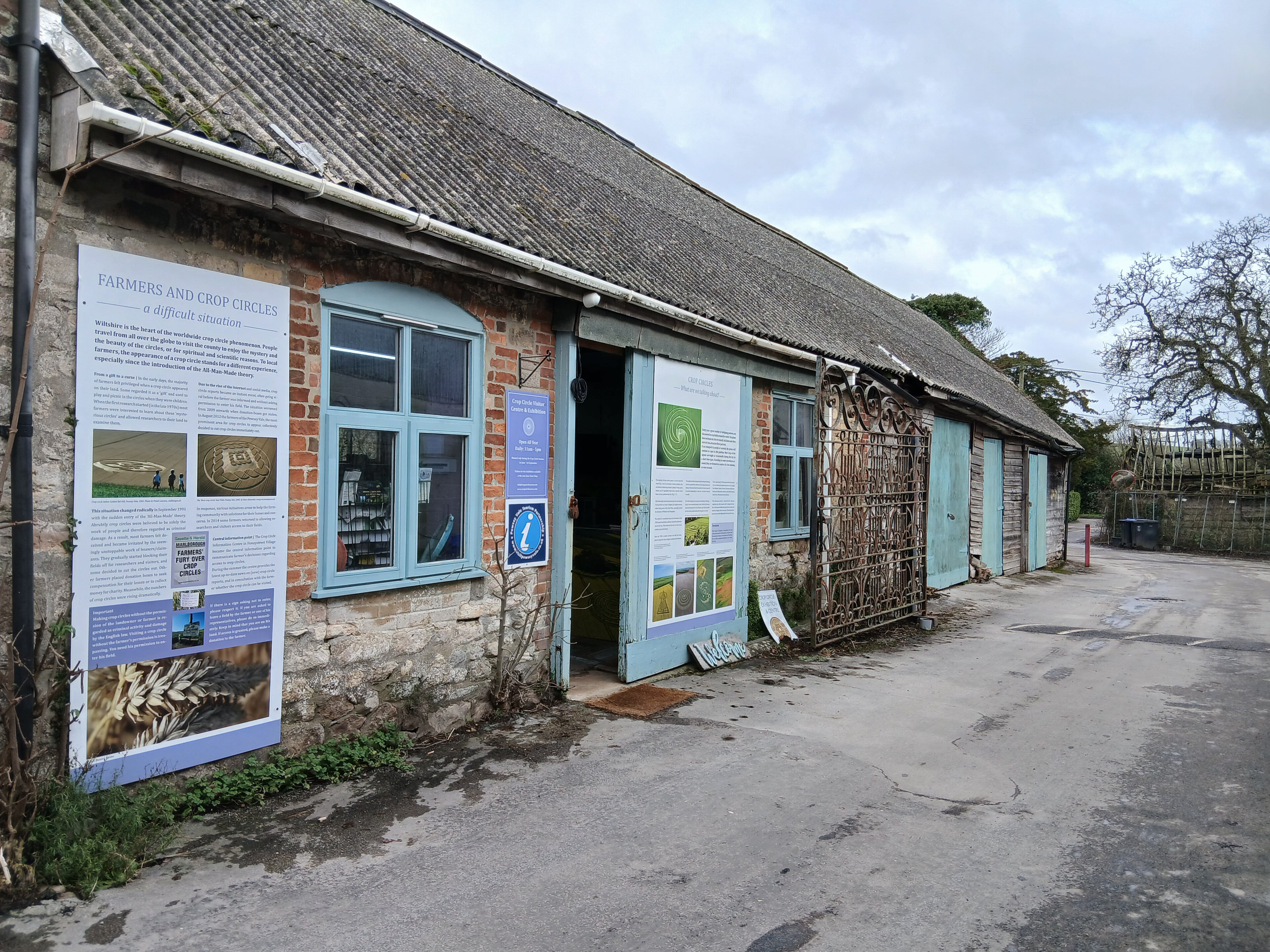
Contexto · un círculo de las cosechas en Wiltshire, del tipo que Bower y Chorley confesaron falsificarContext · a crop circle in Wiltshire, of the kind Bower and Chorley confessed to faking
Crop Circle Visitor Centre ^ Exhibition - geograph.org.uk - 8241724.jpg · Wikimedia Commons · CC BY-SA 2.0 · abrir originalopen original
Parte 01Part 01
Los años en cuestiónThe years in question
Durante los años ochenta, los círculos en campos de cultivo —crop circles— se convirtieron en uno de los fenómenos más mediáticos de la cultura OVNI, concentrados sobre todo en el sur de Inglaterra, en los condados de Hampshire y Wiltshire, cerca de monumentos como Stonehenge y Avebury. Aparecían de noche, sin testigos: formaciones de tallos de trigo o cebada aplanados en círculos limpios, a veces con anillos concéntricos. Surgió toda una disciplina aficionada, la ''cereología'', que sostenía que los patrones eran demasiado precisos para ser obra humana y los atribuía a vórtices de plasma, energías desconocidas o naves extraterrestres.
“ de los falsos no podían hacerlo. La confesión no explicó cada formación posterior —en los años noventa y dos mil aparecieron pictogramas enormes y geométricamente complejos, obra de equipos de artistas (los llamados ”
El 9 de septiembre de 1991, el tabloide británico ''Today'' demolió esa narrativa con una exclusiva: dos hombres de Southampton, Doug Bower y Dave Chorley —ambos paisajistas y pintores aficionados, entonces sexagenarios— confesaron que ellos habían hecho los círculos, y que llevaban haciéndolo desde 1978. Su motivación era una broma: Bower había vivido en Australia y conocía el caso de los ''nidos de platillo'' de Tully de 1966; quería crear algo que pareciera el rastro del aterrizaje de un OVNI y ver la reacción. Su tecnología era deliberadamente primitiva: una tabla de madera de algo más de un metro, sujeta por una cuerda que se tensaba con el pie y se tiraba con las manos para aplastar los tallos sin romperlos, y un truco de puntería —una gorra de béisbol con un lazo de alambre como mira— para caminar en línea recta en la oscuridad. Dos personas podían producir un círculo simple en unos quince minutos.
La parte demoledora de la confesión no fue solo el método, sino la demostración. Los periodistas de ''Today'' hicieron que Bower y Chorley fabricaran un círculo y luego invitaron al cereólogo más reconocido del momento, Pat Delgado —coautor de libros sobre el tema—, a examinarlo sin saber su origen. Delgado lo declaró auténtico y de imposible factura humana, ante las cámaras, antes de que le revelaran que acababa de validar un fraude. La escena resumió el problema epistemológico del campo: los expertos que afirmaban distinguir los círculos ''genuinos'' de los falsos no podían hacerlo.
La confesión no explicó cada formación posterior —en los años noventa y dos mil aparecieron pictogramas enormes y geométricamente complejos, obra de equipos de artistas (los llamados ''circlemakers'') que convirtieron el fraude en una forma de land art—, pero sí estableció el marco dominante: los crop circles son una tradición artística y de broma humana, iniciada documentadamente por Bower y Chorley y continuada por imitadores cada vez más sofisticados. La carga de la prueba para cualquier formación ''inexplicable'' quedó, desde 1991, firmemente del lado de quien afirme un origen no humano.
During the 1980s, crop circles became one of the most media-covered phenomena of UFO culture, concentrated above all in southern England, in the counties of Hampshire and Wiltshire, near monuments such as Stonehenge and Avebury. They appeared at night, without witnesses: formations of wheat or barley stalks flattened into clean circles, sometimes with concentric rings. A whole amateur discipline arose, ''cerealogy'', which held that the patterns were too precise to be human work and attributed them to plasma vortices, unknown energies, or extraterrestrial craft.
On September 9, 1991, the British tabloid ''Today'' demolished that narrative with an exclusive: two men from Southampton, Doug Bower and Dave Chorley —both landscapers and amateur painters, then in their sixties— confessed that they had made the circles, and that they had been doing so since 1978. Their motivation was a prank: Bower had lived in Australia and knew of the 1966 Tully ''saucer nests'' case; he wanted to create something that looked like the trace of a UFO landing and watch the reaction. Their technology was deliberately primitive: a wooden plank a little over a meter long, held by a rope tensioned with the foot and pulled with the hands to flatten the stalks without breaking them, and an aiming trick —a baseball cap with a wire loop as a sight— to walk in a straight line in the dark. Two people could produce a simple circle in about fifteen minutes.
The devastating part of the confession was not only the method, but the demonstration. The ''Today'' journalists had Bower and Chorley make a circle and then invited the most renowned cerealogist of the moment, Pat Delgado —co-author of books on the subject—, to examine it without knowing its origin. Delgado declared it genuine and of impossible human manufacture, on camera, before they revealed to him that he had just validated a hoax. The scene summed up the field's epistemological problem: the experts who claimed to distinguish ''genuine'' circles from fakes could not do so.
The confession did not explain every later formation —in the 1990s and 2000s huge, geometrically complex pictograms appeared, the work of teams of artists (the so-called ''circlemakers'') who turned the hoax into a form of land art— but it did establish the dominant framework: crop circles are a human artistic and prank tradition, documentedly begun by Bower and Chorley and continued by ever more sophisticated imitators. The burden of proof for any ''inexplicable'' formation has, since 1991, rested firmly with whoever claims a non-human origin.
Parte 02Part 02
Por qué este caso movió la agujaWhy this case moved the needle
El caso Bower y Chorley es, para el corpus, el ejemplo canónico de fraude confesado y demostrado, y por eso es la primera entrada de la categoría crop_circle. Su posterior carga casi toda la masa en mundano/natural con la subclase de fraude, dejando apenas un residuo de indeterminación: no porque queden dudas sobre el mecanismo —el fraude está admitido y reproducido—, sino porque la categoría de los crop circles incluye formaciones posteriores cuya autoría individual no siempre está documentada, aunque el marco general (obra humana) sea sólido.
Su valor metodológico es alto y específico. Primero, ancla la categoría crop_circle y el patrón de marcadores geométricos en vegetación (8p) en su lectura honesta: el corpus reconoce el fenómeno, pero lo clasifica como tradición artístico-fraudulenta humana, no como evidencia de presencia no humana. Segundo, ilustra un fallo epistemológico recurrente en la ufología de campo: la incapacidad demostrada de los ''expertos'' para distinguir lo genuino de lo falso, escenificada cuando Pat Delgado validó un círculo fabricado minutos antes. Ese episodio es una advertencia transferible a otros dominios del corpus: la confianza de un investigador en su propio criterio no sustituye un protocolo ciego de verificación. Tercero, conecta hacia atrás con Tully (1966), el ''nido de platillo'' australiano que inspiró a Bower, mostrando la genealogía cultural del fenómeno.
La lectura honesta no afirma que cada círculo del mundo sea obra de estos dos hombres —sería imposible y falso—, sino que ellos iniciaron de forma documentada una práctica que explica el grueso del fenómeno y que desplazó de manera decisiva la carga de la prueba. Frente a un crop circle, la hipótesis por defecto, bien fundada empíricamente, es la autoría humana. Cualquier afirmación de anomalía debe superar ese umbral con evidencia física que, hasta hoy, no se ha presentado de forma concluyente.
The Bower and Chorley case is, for the corpus, the canonical example of a confessed and demonstrated hoax, and that is why it is the first entry in the crop_circle category. Its posterior places almost all the mass on mundane/natural with the hoax subclass, leaving only a residue of indeterminacy: not because doubts remain about the mechanism —the hoax is admitted and reproduced— but because the crop-circle category includes later formations whose individual authorship is not always documented, even if the general framework (human work) is solid.
Its methodological value is high and specific. First, it anchors the crop_circle category and the geometric-markers-in-vegetation pattern (8p) in its honest reading: the corpus recognizes the phenomenon, but classifies it as a human artistic-fraudulent tradition, not as evidence of a non-human presence. Second, it illustrates a recurring epistemological failure in field ufology: the demonstrated inability of ''experts'' to distinguish the genuine from the fake, staged when Pat Delgado validated a circle made minutes earlier. That episode is a transferable warning to other domains of the corpus: an investigator's confidence in his own judgment does not replace a blind verification protocol. Third, it connects back to Tully (1966), the Australian ''saucer nest'' that inspired Bower, showing the cultural genealogy of the phenomenon.
The honest reading does not claim that every circle in the world is the work of these two men —that would be impossible and false— but that they documentedly began a practice that explains the bulk of the phenomenon and decisively shifted the burden of proof. Faced with a crop circle, the default hypothesis, well founded empirically, is human authorship. Any claim of anomaly must clear that threshold with physical evidence that, to this day, has not been conclusively presented.
Parte 03Part 03
Lo que queda en papelWhat's left on paper
Evidencia documentadaDocumented evidence
- Confesión publicada por el tabloide ''Today'' el 9 de septiembre de 1991: Doug Bower y Dave Chorley afirman haber hecho círculos desde 1978Confession published by the tabloid ''Today'' on September 9, 1991: Doug Bower and Dave Chorley claim to have made circles since 1978
- Método reproducido y filmado: tabla de madera con cuerda para aplastar los tallos + gorra con mira de alambre para caminar en línea recta; dos personas, ~15 minutos por círculo simpleMethod reproduced and filmed: wooden plank with rope to flatten the stalks + cap with a wire sight to walk in a straight line; two people, ~15 minutes per simple circle
- Demostración decisiva: el cereólogo Pat Delgado declaró ''auténtico'' un círculo fabricado por la pareja antes de que le revelaran el engañoDecisive demonstration: cerealogist Pat Delgado declared ''genuine'' a circle made by the pair before they revealed the deception
- Genealogía: Bower se inspiró en los ''nidos de platillo'' de Tully (Australia, 1966), ya documentados en el corpusGenealogy: Bower was inspired by the Tully ''saucer nests'' (Australia, 1966), already documented in the corpus
- Continuidad documentada: las formaciones complejas posteriores se atribuyen a equipos de artistas (''circlemakers''), consolidando el marco de autoría humanaDocumented continuity: later complex formations are attributed to teams of artists (''circlemakers''), consolidating the human-authorship framework
FuentesSources
- ''Today'' (Reino Unido) — confesión de Doug Bower y Dave Chorley (9 de septiembre de 1991) — Fuente primaria de la confesión y la demostración del método.Primary source of the confession and the demonstration of the method.
- Cobertura de prensa británica sobre la validación errónea de Pat Delgado (1991) — Documenta cómo un cereólogo de referencia declaró auténtico un círculo fabricado.Documents how a leading cerealogist declared a fabricated circle genuine.
- Registro del colectivo de artistas de crop circles (''circlemakers'') sobre la continuidad del fenómeno — Atribución de las formaciones complejas posteriores a autoría humana organizada.Attribution of later complex formations to organized human authorship.
Patrones que exhibe (1)Patterns it exhibits (1)
UbicaciónLocation
Hampshire / Wiltshire, sur de InglaterraHampshire / Wiltshire, southern England · 51.07°, -1.79°
Distribución de explicacionesDistribution of explanations
Este caso se clasifica entre las hipótesis del modelo: la barra reparte el 100% según cuánto pesa cada explicación (la incertidumbre se reparte entre las hipótesis que el caso apoya). Sumadas en todo el corpus producen la partición comparable. Es una pregunta distinta de la Probabilidad de arriba: aquella estima qué tan probable es que el caso sea un fenómeno genuinamente no explicado; esta reparte cuál sería la explicación.This case is classified among the model's hypotheses: the bar splits 100% by how much each explanation weighs (the uncertainty is spread across the hypotheses the case supports). Summed across the corpus they produce the comparable partition. It is a different question from the Probability above: that one estimates how likely the case is a genuinely unexplained phenomenon; this one splits which the explanation would be.
Hipótesis modalModal hypothesis: Posible fraudePossible hoax 97% · suma 100%sums to 100%
Juicio analítico estructurado, no frecuencia calibrada. Clasificación forzada: la masa que la evidencia no permite asignar se reparte entre las hipótesis que el caso sí apoya.Structured analytical judgment, not a calibrated frequency. Forced classification: the mass the evidence cannot assign is spread across the hypotheses the case does support.
Casos relacionadosRelated cases
1 patrón1 pattern
Nidos de Tully · investigación RAAFTully Saucer Nests · RAAF investigation
1966 · Tier A · 35%
mismo paíssame country
Lakenheath-BentwatersLakenheath-Bentwaters
1956 · Tier S · 80%
mismo paíssame country
Rendlesham ForestRendlesham Forest
1980 · Tier S · 70%
mismo paíssame country
Calvine · PerthshireCalvine · Perthshire
1990 · Tier A · 62%