1913·Brown Mountain, Burke and Caldwell counties, North Carolina
United States.Brown Mountain Lights · North Carolina
Over Brown Mountain, in the Appalachians of North Carolina, night lights have been reported for more than a century: orbs that rise, flicker and go out.
Read the rest of the summary
The phenomenon became famous in the early 20th century and prompted two United States Geological Survey (USGS) investigations; the 1922 one, by George Rogers Mansfield, attributed most of the lights to locomotive and automobile headlights, brush fires and refracted fixed lights. In 2016, two Appalachian State University cameras recorded a light its authors did not identify, raising ball lightning as one possibility; the same researcher estimates that around 95% of reports are town lights.
Tier B · IndicativeWhat do they mean? →
Limited evidence: a single witness, testimony gathered years later, or an account without contemporary primary documentation.
What it was
78%natural or human cause
Most likely explanation: human light or activity
See the split across the six explanations
Natural or human cause
No known cause
Primary documents
Mansfield, 'Origin of the Brown Mountain Light in North Carolina' · USGS Circular 646 (extract)
Report by geologist George Rogers Mansfield for the U.S. Geological Survey, issued in 1922 as Press Notice 14328 and reprinted unchanged as Circular 646 in 1971. The extract (cover, pp. 1-6 with the map, p. 16 and the final conclusion) covers the first USGS visit, by D. B. Sterrett in October 1913, who attributed the lights to locomotive headlights; the Charlotte Daily Observer dispatch of September 23, 1913; the 1916 flood, with the lights 'seen as usual' while no trains came within 40 or 50 miles; the Weather Bureau's 1919 proposal; and the conclusion: 47% automobile headlights, 33% locomotive headlights, 10% stationary lights and 10% brush fires.
U.S. Geological Survey, Circular 646 (1971), pubs.usgs.gov · Public domain (US Government work) · open original
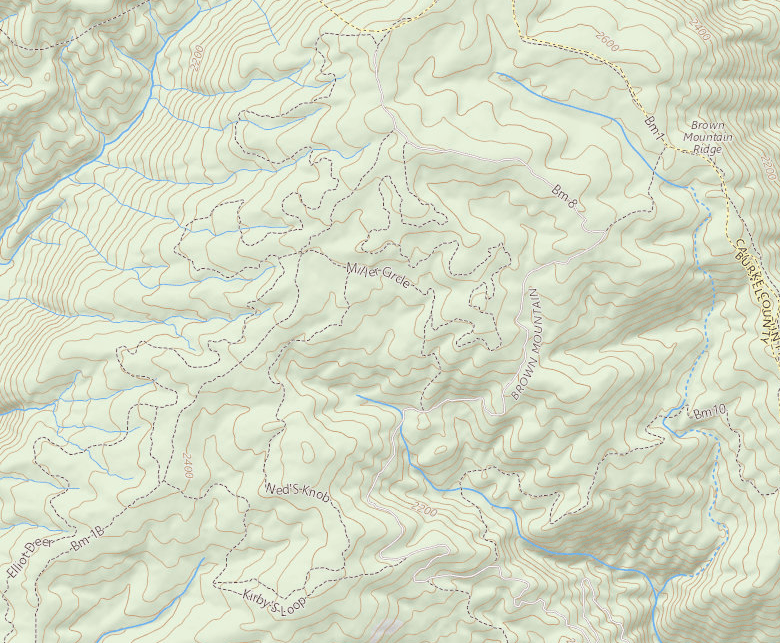
Context · Brown Mountain (North Carolina), where the recurring 'lights' appear
Brown mountain trails.png · Wikimedia Commons · Public domain · open original
The night in question
The Brown Mountain Lights are one of the oldest and best-documented recurring luminous phenomena in the United States. They are observed in western North Carolina, over Brown Mountain, a low wooded ridge between Burke and Caldwell counties, at the edge of the Appalachian Mountains. Witnesses (observing from overlooks such as Wiseman's View or milepost 310 of the Blue Ridge Parkway) describe lights that rise over or near the ridge, hold for an instant, flicker, and fade, sometimes reddish or yellow in color. Present-day tradition attributes to them origins ranging from Cherokee legends to paranormal interpretations, but the 1922 USGS report found no published account earlier than a September 1913 dispatch in the Charlotte Daily Observer, which credited the discovery to members of the Morganton Fishing Club who had seen it 'more than two years ago' and been 'laughed at'.
The phenomenon's fame grew so much in the early 20th century that the United States Geological Survey (USGS) itself investigated it twice. A first review, in October 1913, at the request of Representative E. Y. Webb, was made by geologist D. B. Sterrett, who after a few days of observation declared the lights were locomotive headlights seen over the mountain from the neighbouring heights. When a great flood in 1916 halted the area's rail traffic for weeks and the lights, according to reports, continued to appear, the objection arose that trains could not be the cause. That prompted a second and more thorough study: the report by George Rogers Mansfield, published by the USGS in 1922. Mansfield carried out instrumental observations with a telescopic alidade and maps, checked against train schedules, and concluded that, of the lights he was able to study instrumentally, about 47% were automobile headlights, 33% locomotive headlights, 10% stationary lights and 10% brush fires, all of them lifted, doubled, or made to flicker by differential refraction in the valley atmosphere, a basin into which cool air of differing temperature and density creeps after sunset, above all in clearing spells after rain; mist and dust, he wrote, give the light 'the reddish or yellowish tints so frequently observed'. Meanwhile, in 1919, the Weather Bureau had proposed, from witnesses' letters, an electrical discharge akin to the 'Andes light', and a National Museum entomologist judged fireflies possible but improbable because of the late hour.
Mansfield's explanation is the dominant one to this day, but the case retains a tail that is not completely closed. Mansfield himself accepted that, during the weeks of 1916 when the flood suspended all rail traffic within 40 or 50 miles, the lights were reported 'to be seen as usual', and wrote that this 'showed that the Brown Mountain lights could not be ascribed solely to locomotive headlights'; his answer was to add automobiles, stationary lights and brush fires. On the night of July 16, 2016, two time-lapse cameras run by Daniel Caton and Lee Hawkins of Appalachian State University recorded a light that 'appeared, four times, above the distant horizon' and 'doesn't move during the [camera] exposure'; according to Caton, it 'came on and went back off virtually instantly four times over several minutes'. He said they had eliminated the likely man-made and natural sources and raised ball lightning as a possibility, not a conclusion. Caton himself estimates that 'something in the order of 95%' of reports are town lights, such as flashing cell-phone tower lights. The resulting picture is that of a mostly prosaic phenomenon with a possible genuine natural residue, not yet consolidated.
Why it matters
Brown Mountain matters as the recurring-lights case with the best skeptical institutional pedigree: it is one of the few popular paranormal phenomena that prompted not one but two investigations by the United States Geological Survey, with instrumental measurement. Mansfield's 1922 report is an early model of methodical debunking (quantifying what fraction of the lights corresponds to each conventional source) and the unidentified light recorded by the 2016 cameras leaves a residue open.
Its methodological value lies in the structure of the debate. The 1916 flood episode ('the lights continued even though there were no trains') shows how an explanation gets refined: Mansfield did not dismiss it, he accepted it as proof that trains were not enough and widened the inventory of light sources instead of abandoning the prosaic explanation. At the same time, the Appalachian State work (2016) shows the opposite stance: not everything in a lights case has to be misidentification, and a genuine natural residue (ball lightning, as Caton suggested) is a legitimate and testable hypothesis, distinct both from the mistaken headlight and from the non-human.
A careful reading places Brown Mountain on the same axis as Marfa, Min Min, and Hessdalen, but in an intermediate position: more resolved than Hessdalen, less experimentally closed than Min Min. Together with the others, it anchors the principle that recurring lights over relief and valleys (with traffic, towns, and thermal inversions) are, by default, atmospheric optics over ordinary sources, and that the burden of proof for any exotic natural residue rests on measurement, not on tradition.
What's left on paper
Documented evidence
- Recurring reports documented since the early 20th century, with established overlooks (Wiseman's View, milepost 310 of the Blue Ridge Parkway)
- First USGS review (D. B. Sterrett, October 1913): attributes the lights to locomotive headlights
- George Rogers Mansfield's USGS report (1922, published as Circular 646 in 1971): of the lights studied instrumentally, 47% car headlights, 33% locomotives, 10% stationary lights and 10% brush fires
- The 1916 flood: the lights were reportedly still seen without trains, and Mansfield accepted it as proof that locomotive headlights alone were not enough
- Appalachian State University (Daniel Caton, July 2016): two cameras record an unidentified light, with ball lightning as a possibility; Caton estimates ~95% of reports are town lights
- First published account according to Mansfield: Charlotte Daily Observer, 23 Sep 1913; in 1919 the Weather Bureau proposed an 'Andes light' type electrical discharge
Sources
- George Rogers Mansfield, 'Origin of the Brown Mountain Light in North Carolina', U.S. Geological Survey (1922; Circular 646, 1971) — Instrumental report attributing most of the lights to refracted conventional sources.
- WFDD — 'Mysterious Brown Mountain Lights Caught On Tape, Questions Remain' (10 ago 2016), con Daniel Caton (Appalachian State University) — Recording of an unidentified light in July 2016 and Caton's estimate that ~95% of reports are town lights.
- WLOS — 'ASU scientists capture rare images of WNC's Brown Mountain Lights' (2016) — Caton and Hawkins's two time-lapse cameras and the description of the light that came on four times.
- U.S. Forest Service / Pisgah National Forest — registro de los miradores de Brown Mountain — Documents the official observation points and the tradition of the phenomenon.
Related cases
same explanation · same country
Marfa Lights · Texas
1883 · Tier B
same explanation · same country
Nash-Fortenberry · two Pan Am pilots (Virginia)
1952 · Tier A
same explanation · same country
Haynesville · pulsating light and scorched bark
1966 · Tier B
same explanation · same country
Betz Sphere · Fort George Island
1974 · Tier B