1838·Channel Country, between Boulia and Winton, Queensland
Australia.Min Min Lights · Australian outback
On the plains of the Channel Country, in western Queensland (Australia), travelers have recounted since the 19th century a light, the 'Min Min', that appears at night, seems to follow whoever observes it, keeps its distance and fades when approached. The name comes from a vanished hotel between Boulia and Winton.
Read the rest of the summary
In 2003, neuroscientist Jack Pettigrew proposed that it is a Fata Morgana-type mirage: light from real, very distant sources ducted by a thermal inversion over the ground; his paper concludes that these optics explain 'many of the strange properties' of the light 'if account is also taken of the human factors'.
Tier B · IndicativeWhat do they mean? →
Limited evidence: a single witness, testimony gathered years later, or an account without contemporary primary documentation.
What it was
85%natural or human cause
Most likely explanation: optical
See the split across the six explanations
Natural or human cause
No known cause
Context image (not a document from the case)
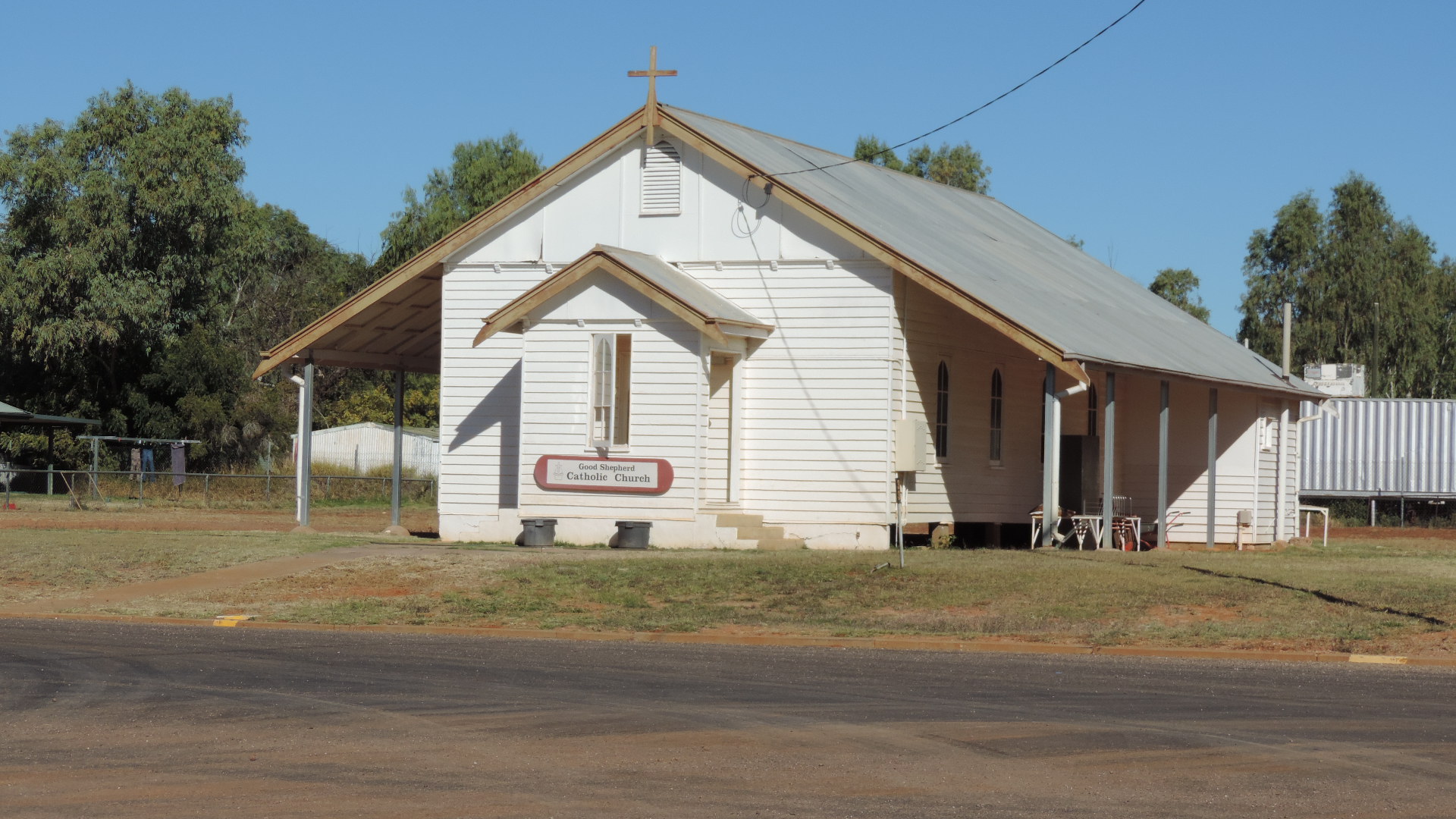
Context · Boulia (Queensland), in the Channel Country of the Min Min lights
Good Shepherd Catholic Church, Boulia, 2019.jpg · Wikimedia Commons · CC BY 4.0 · open original
The night in question
The Min Min light is the most famous luminous phenomenon of Australian outback folklore. It is associated with the vast, flat plains of the Channel Country, in western Queensland, especially the corridor between the towns of Boulia and Winton. The name comes from the Min Min Hotel, an inn and stagecoach relay station on that route, which burned down in the early 20th century and of which today only the nearby cemetery remains; according to tradition, it was there that the accounts became popular. The tradition is, however, older: there are references in the culture of the area's Aboriginal peoples, which places the phenomenon long before European colonization, with an early date often cited around 1838.
Witnesses (drovers, truck drivers, nighttime drivers) describe a single light, sometimes described as a diffuse disc or a luminous globe, that appears at low height over the flat horizon. The distinctive feature is its apparently intentional behavior: the light seems to follow the observer over kilometers, always keeping its distance, and disappears if one tries to approach or when one gets too close. That 'elusive' behavior is precisely what fueled the supernatural interpretation (spirits, omens) in the outback imagination for a century.
The scientific explanation came from Professor Jack Pettigrew, a neuroscientist at the University of Queensland, in work published in 2003. Pettigrew proposed and demonstrated that the Min Min light is a Fata Morgana-type mirage: on clear desert nights, a layer of cold, dense air settles over the ground beneath warmer air, creating a density gradient that acts as an optical waveguide. That layer can carry the light of a real source (a campsite fire, a vehicle's headlights or another natural or man-made source) over tens or hundreds of kilometers, keeping it concentrated and making it appear as a floating luminous point. The apparent 'following' is explained because the source is so far away that the parallax is nil: as the observer moves, the refracted light stays in the same relative direction, as the Moon does. The first time he saw the light, he said, he took it for Venus, 'but it didn't set': it went down to the horizon and sat there for some time. The mirage idea came from another observation of his own: a light that he and two colleagues took for a cat's eyeshine about fifty metres away turned out, by their calculation with the car compass, to be more than 300 kilometres away, and they later learned that a car had been driving straight towards them at the time. Pettigrew supported the hypothesis with a field experiment: on a cool night after a hot day, he drove about ten kilometres away, beyond a slight rise and below the line of sight, and six observers saw the vehicle's light float above the horizon. The next morning, he said, there was a spectacular Fata Morgana of a distant mountain range that is normally not visible, which supported the idea that the light was due to that night's conditions. The old-timers he had interviewed, he said, were terrified by it.
According to Pettigrew, the mechanism explains many of the features of the classic account, provided the human factors before an isolated light with no landmarks are taken into account: the appearance over flat terrain (necessary for the duct), the elusive behavior (nil parallax), the disappearance on approach (the duct geometry breaks), and the rarity of the sighting (it requires specific atmospheric conditions).
Why it matters
The Min Min light is an almost textbook case of complete natural explanation: a phenomenon with a long century of tradition, apparently intelligent behavior, and strong cultural weight, that a controlled experiment reduces to atmospheric optics over real light sources. Unlike many cases where the mundane explanation is a plausible but undemonstrated hypothesis, here Pettigrew reproduced the effect in a field demonstration, although he himself says it explains 'many' of its properties, not all, and the accounts that do not fit cleanly into the duct conditions remain outside it.
Its value in the catalog is threefold. First, it extends the local-persistence pattern (8g) to the southern hemisphere and to an environment (the outback) of flat horizons ideal for the mirage, complementing Marfa (Texas desert) and Hessdalen (Norwegian valley). Second, it is a good example of how 'elusive' behavior that seems intentional (the light that follows you and flees) has a trivial geometric explanation (nil parallax of a very distant source), defusing one of the most persistent witness intuitions. Third, it shows the role of oral tradition: the phenomenon was transmitted with a supernatural framing for generations before physics resolved it, a reminder that the antiquity and repetition of an account add no evidentiary weight to the extraordinary interpretation.
A careful reading recognizes that witnesses see a real light (they really see it) but that the object they infer does not exist: it is ordinary light traveling an extraordinary path. Min Min anchors, alongside Marfa, the principle that the recurrence of a diffuse sighting over terrain prone to mirage is, by default, a sign of atmospheric optics rather than anomaly.
What's left on paper
Documented evidence
- Tradition of more than a century in the Boulia-Winton corridor of the Channel Country, with roots in Aboriginal accounts predating colonization (early date cited around 1838)
- Origin of the name in the Min Min Hotel, a route inn destroyed by fire in the early 20th century
- Jack Pettigrew study (University of Queensland, 2003): identifies the phenomenon as a Fata Morgana-type mirage from thermal inversion
- Pettigrew field experiment: the light of a car about 10 km away, beyond a rise and below the line of sight, seen by six observers floating above the horizon; in an earlier observation, a light turned out to be more than 300 km away
- According to Pettigrew, the optics explain 'many' of the strange properties, taking human factors into account: appearance over flat terrain, 'following' by nil parallax, disappearance on approach, and rarity from specific atmospheric conditions
Sources
- J. D. Pettigrew, 'The Min Min light and the Fata Morgana', Clinical and Experimental Optometry (2003) — Original paper (abstract on PubMed): direct observations and a field demonstration in the Channel Country; the Fata Morgana explains 'many' of the light's properties if human factors are taken into account.
- University of Queensland — cobertura del trabajo de Jack Pettigrew sobre la luz Min Min — Institutional summary of the study and the field experiment.
- Registro folclórico del outback (corredor Boulia-Winton) sobre la luz Min Min — Documents the oral tradition and the origin of the name at the Min Min Hotel.
- ABC Science, «Mystery of the Min Min lights explained» (28 mar 2003) — Interview with Pettigrew: the observation of the light more than 300 km away and the experiment with a car about 10 km away.
Related cases