1883·Mitchell Flat, east of Marfa, Texas
United States.Marfa Lights · Texas
Since the late 19th century, travelers and residents of West Texas have described diffuse lights appearing at night over Mitchell Flat, east of Marfa, toward the Chinati Mountains: orbs that seem to float, split, merge and move. Systematic investigations, including a study by physics students at the University of Texas at Dallas (2004), correlated most of the lights with vehicle headlights on US 67 between Marfa and Presidio, refracted by desert thermal inversions, with a minor tail of reports without closed explanation.
Tier B · IndicativeWhat do they mean? →
Limited evidence: a single witness, testimony gathered years later, or an account without contemporary primary documentation.
What it was
83%natural or human cause
Most likely explanation: vehicle
See the split across the six explanations
Natural or human cause
No known cause
Primary documents
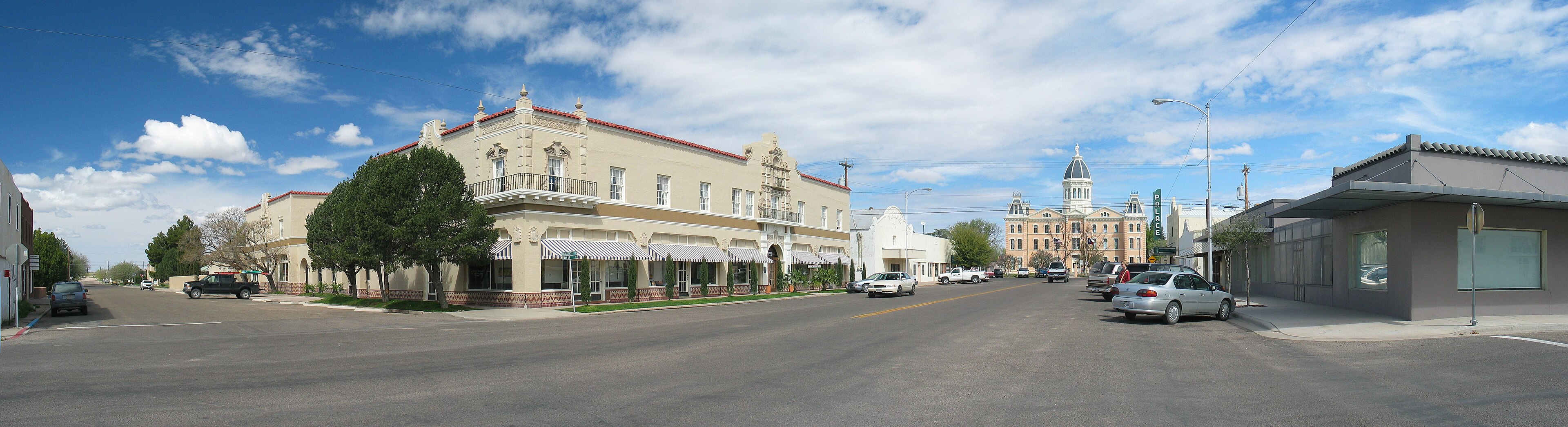
Context · Marfa (Texas), near Mitchell Flat where the lights appear
USA Marfa pano TX.jpg · Wikimedia Commons · CC BY-SA 3.0 · open original
Paul Moran, 'The Mystery of the Texas Ghost Light' · Coronet, July 1957
Article by Paul Moran in Coronet magazine (vol. 42, no. 3, July 1957), one of the first nationally circulated accounts of the Marfa light. It describes a single light in the Chinati Mountains, visible from Highway 90 between Alpine and Marfa, which 'settlers first reported more than 70 years ago'; it vanishes when sought by land or air, shifts a few degrees, sometimes looks double and sometimes outshines a headlight. It reviews the mica-vein, swamp-gas and mirage theories, objecting to the last that 70 years earlier the brightest light in the area was a kerosene lantern. It does not name Robert Reed Ellison.
Coronet 42(3), julio de 1957 (archive.org) · view source
The night in question
The so-called Marfa Lights are one of the best-known recurring luminous phenomena in the United States. They are observed in West Texas, over the semi-desert plain of Mitchell Flat, east of the town of Marfa (Presidio County), looking toward the Chinati Mountains. Local tradition places the first sighting in 1883, attributed to a cowboy named Robert Reed Ellison, who reportedly saw flickering lights and feared they were Apache campfires; but the first published account of the lights, in the July 1957 issue of Coronet magazine, mentions neither Ellison nor that date, and consistent reports accumulate throughout the 20th century. Witnesses describe orbs (white, yellowish, or orange) that appear near the horizon, seem to float at mid-height, split into two or more, merge again, move laterally, and go out, all at a distance of several kilometers and with no associated sound.
The phenomenon's popularity led the state of Texas to build an official viewing platform (Marfa Lights Viewing Area) on US Route 90, about 14 kilometers east of the town, where visitors gather each night to await the lights. That tourist institutionalization is part of the case's history: the lights became a cultural and economic asset for the region, with an annual festival included, which in turn encouraged accounts and kept the mystery narrative alive.
The most rigorous investigations point in a largely prosaic direction. In 2004, a group of students from the Society of Physics Students at the University of Texas at Dallas carried out a systematic observation campaign with telescopes and cameras, simultaneously recording the lights and vehicle traffic. They found a close correlation between the appearances and the headlights of cars traveling on US Route 67, which connects Marfa with Presidio and whose route lies in the line of sight of the viewing platform. The physical key is the desert atmosphere: strong nighttime thermal inversions (cold, dense air near the ground beneath warmer air) create optical ducts and mirages that carry, lift, double, and make light flicker from sources that would otherwise be hidden behind the curvature of the terrain or too far to see. Headlights, ranch lights, and distant campfires are thus transformed into apparently floating, moving orbs.
Not the entire body of reports is closed by this explanation: there is a tail of sightings predating the automobile era and of observations that some investigators consider unresolved, and secondary hypotheses have been proposed (plasma-type discharges, rock piezoelectricity, gases) without robust confirmation. But the weight of systematic evidence favors the misidentification of real light sources under atmospheric optics as the dominant mechanism.
Why it matters
The Marfa case matters precisely as an example of skeptical calibration: a famous, recurring luminous phenomenon, marketed as a mystery, that, subjected to systematic observation, resolves mostly as atmospheric optics over conventional light sources. It is the kind of case a serious catalog must include not to inflate the mystery, but to show where the evidence pushes hard toward the prosaic. The pre-automobile reports and those no campaign measured remain open.
Its methodological value is twofold. First, it anchors the sustained-local-persistence pattern (8g) in its prosaic version: like Hessdalen or Popocatépetl, Marfa is a site that 'produces' lights stably for decades, but unlike Hessdalen (where there is genuinely anomalous instrumented residue) at Marfa the measurement campaign points to an ordinary cause. The contrast between the two is pedagogical: local recurrence does not imply anomaly. Second, it illustrates how tourist institutionalization (an official viewing platform, a festival) can sustain and amplify a mystery narrative long after the physical explanation is available, a sociological factor to keep in mind when weighing popular reports.
A careful reading, then, does not deny that people see something real (they see lights, and they are real lights, refracted) but separates the observation from the interpretive leap. Marfa is a reminder that the night sky over a desert with thermal inversions is a natural projector of mirages, and that the burden of proof for the extraordinary is not met by the mere repetition of a diffuse sighting several kilometers away.
What's left on paper
Documented evidence
- Reports from local tradition since the late 19th century (the 1883 sighting attributed to Robert Reed Ellison is the most cited, but it does not appear in the first published account, Coronet, July 1957)
- Official Texas state viewing platform (Marfa Lights Viewing Area) on US Route 90, with sustained nighttime tourist attendance
- University of Texas at Dallas Society of Physics Students study (2004): simultaneous observation of lights and traffic correlating the appearances with headlights on US Route 67
- Documented physical mechanism: nighttime thermal inversions in the desert producing optical ducts and mirages (Fata Morgana) capable of lifting and doubling light from distant sources
- Open tail: reports predating the automobile era and secondary hypotheses (plasma, piezoelectricity) without robust confirmation
Sources
- University of Texas at Dallas — Society of Physics Students, estudio de las Luces de Marfa (2004) — Observation campaign correlating the lights with headlights on US Route 67.
- Texas State Highway / Marfa Lights Viewing Area — registro del mirador oficial — Documents the institutionalization of the phenomenon as a tourist attraction.
- Texas Monthly / cobertura periodística histórica de las Luces de Marfa — Covers the tradition since 1883 and the debate over explanations.
- K. D. Stephan, J. Bunnell et al., «Quantitative intensity and location measurements of an intense long-duration luminous object near Marfa, Texas», Journal of Atmospheric and Solar-Terrestrial Physics 73 (2011)
- Wikipedia — «Marfa lights»
- Paul Moran, 'The Mystery of the Texas Ghost Light', Coronet 42(3), July 1957 (first published account)
Related cases
same explanation · same country
Brown Mountain Lights · North Carolina
1913 · Tier B
same explanation · same country
Nash-Fortenberry · two Pan Am pilots (Virginia)
1952 · Tier A
same explanation · same country
Haynesville · pulsating light and scorched bark
1966 · Tier B
same explanation · same country
Betz Sphere · Fort George Island
1974 · Tier B