1952·Near Norfolk, Virginia
United States.Nash-Fortenberry · two Pan Am pilots (Virginia)
On July 14, 1952, Pan American pilots William Nash and William Fortenberry observed from their DC-4, near Norfolk, Virginia, six reddish-glowing discs flying in formation below their aircraft; the discs executed an abrupt flip, were joined by two more and departed at high speed. Project Blue Book filed it as "Unknown".
Tier A · AcceptableWhat do they mean? →
Institutional evidence: several identified independent witnesses, or contemporary official documentation, without an instrumental record to corroborate them.
What it was
51%natural or human cause
Most likely explanation: beacon or searchlight
See the split across the six explanations
Natural or human cause
No known cause
Primary documents
Blue Book file on Norfolk (July 1952): record card, cable AFOIN 53722, Maj. Sharpe's AF Form 112 intelligence report with overlay, and ATIC summary, 7 pp.
NICAP scan. The record card describes six disc-shaped objects 100 feet across that approached the airliner at about 2,000 feet and notes five jets near Langley. Cable AFOIN 53722 of 16 July relays the OSI report: eight luminous circular objects in formation, at about 1,000 miles per hour. Maj. John H. Sharpe's AF Form 112 report of 15 July records the debriefing of Nash and Fortenberry, with their impressions (among them, that the objects "are definitely not of earthly origin"); Sharpe judges them reliable and reckons they were in view five to ten seconds. The overlay of the path and the ATIC summary, which concludes "Unknown", close the extract.
Proyecto Blue Book (NARA), escaneo publicado por NICAP · Public domain · US Government work · open original
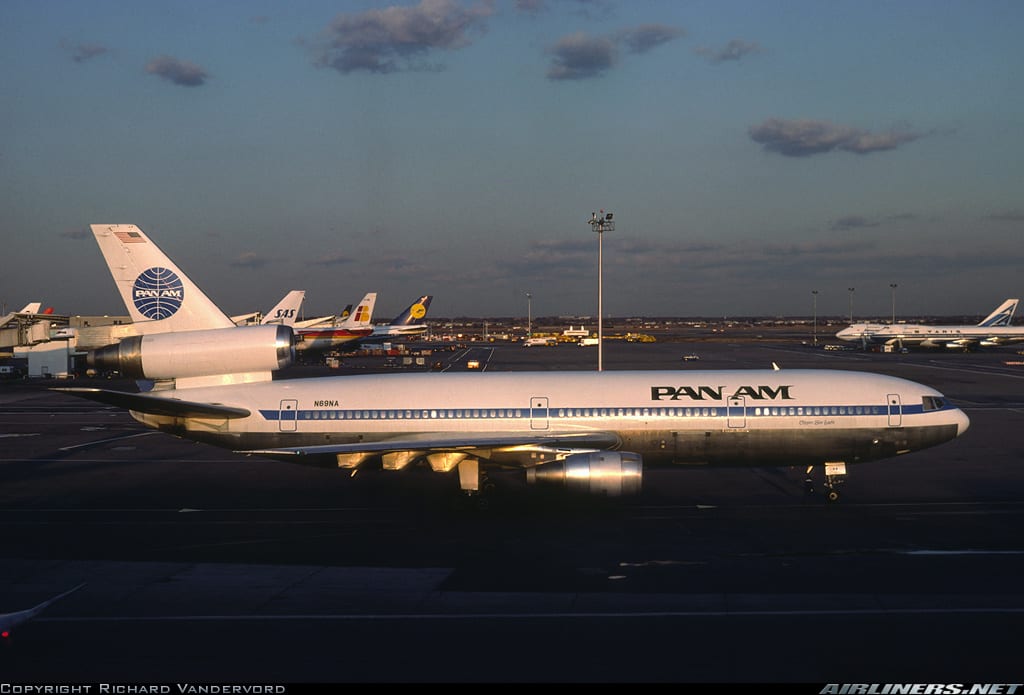
Context · a Pan American Douglas DC-4, the aircraft type of the Norfolk sighting
Pan American World Airways - Pan Am McDonnell Douglas DC-10-10 N69NA.jpg · Wikimedia Commons · CC BY-SA 4.0 · open original
The night in question
On the night of July 14, 1952, during that summer's intense sighting wave (the same that a few days later would culminate in the famous radar events over Washington) a Pan American World Airways DC-4 was flying south from New York (the Air Force cable calls it the New York–San Juan flight; the OSI report, New York–Miami) with ten passengers and a crew of three. Captain F. V. Koepke was in command; First Officer William B. Nash and Second Officer William H. Fortenberry were in the cockpit. The aircraft was cruising at about 8,000 feet over Chesapeake Bay, approaching Norfolk, Virginia, with the autopilot engaged, when at about 20:12 Eastern Standard Time Nash and Fortenberry saw a formation of six disc-shaped objects appear below their plane, glowing with an intense red-orange light and showing sharp edges.
Per their report (detailed and consistent between the two) the discs flew in line, executed a near-instantaneous flip (they 'turned' edge-on), were joined by two more discs to total eight, and the whole group accelerated, climbed and dimmed before vanishing. The pilots' size and speed estimates implied extreme dynamics, with speeds on the order of thousands of kilometers per hour and an acute-angle turn. The incident occurred about four months after Project Blue Book received that name and five days before the first radar events over Washington. The next morning, in Miami, agents of the Air Force Office of Special Investigations (OSI) interrogated the pilots; according to Nash, they were told the investigators already had seven other reports of red discs in formation, none of which appear in the Blue Book file. The report by Major John H. Sharpe (AF Form 112, 15 July) records among the two pilots' impressions that the objects "are definitely not of earthly origin", and reckons they were in view for at least five seconds, possibly ten. The Blue Book record card summarizes the case: six disc-shaped objects, 100 ft in diameter, emitting a reddish glow, approached the airliner at about 2,000 ft, made an erratic turn to avoid collision and sped away in their original formation. The card notes that five jet aircraft were in the vicinity of Langley AFB at the time; Blue Book ruled them out as the explanation and filed the case as "Unknown".
The skeptical explanations on record are two, both from astrophysicist Donald H. Menzel. In his 1962 correspondence with Nash, preserved in the Blue Book file, he first proposed a reflection in the cockpit windows; Nash replied that the objects were between the aircraft and the west, that they had followed them through three different windows and that no one was smoking in the cockpit, whose door was closed. In his book "The World of Flying Saucers" (1963), Menzel moved to a second hypothesis: a searchlight or beacon on the Virginia coast seen through layers of haze concentrated by temperature inversions, which would appear as a series of discs able to 'ricochet' as the beam turned. His critics object that the weather reports for that night recorded no inversions, that Menzel never identified the light source and that the objects were seen against the dark background of the bay's water.
Why it matters
Two professional witnesses with the same detailed observation, filed by Blue Book as "Unknown" and occurring five days before the same wave produced the Washington radar incidents. The two pilots described a maneuver (instantaneous flip, formation, acceleration) hard to reconcile with a trivial light phenomenon. The pilots placed the objects below the aircraft, between it and the west, and followed them through three windows, which weakens the window-reflection hypothesis; the searchlight hypothesis, for its part, requires inversions that the weather reports for that night did not record.
Its limit is that it is a purely visual case, with no radar record or independent instrument to corroborate size, distance or speed. All the dramatic speed figures are witness estimates from an angular size whose real distance was never determined, and distance-estimation errors in nighttime sightings are the classic source of apparently impossible speeds.
What's left on paper
Documented evidence
- Sighting by Pan Am pilots William Nash and William Fortenberry from a DC-4 at 8,000 ft, Jul 14, 1952, at about 20:12 EST
- Six reddish-glowing discs in formation, with an abrupt flip, joined by two more before accelerating and climbing
- Detailed, coinciding report from both professional pilots
- Interrogated by the OSI in Miami the next morning; Blue Book filed the case as "Unknown"
- Blue Book record card: six 100-ft discs with a reddish glow at about 2,000 ft; the five jets near Langley AFB were ruled out as the explanation
- Menzel's explanations (window reflection, 1962; searchlight through inversion layers, 1963) rejected by Nash
Sources
- Project Blue Book · Norfolk file, Jul 14, 1952 (MAXW-PBB12-168 to 192) — copy at NICAP — Primary source. Record card (PDF p. 5), with the description of the six discs and the note on the five Langley jets, plus OSI reports.
- Project Blue Book · Norfolk file (MAXW-PBB12-193 to 217) — copy at NICAP — Primary source. Interrogation of the pilots and correspondence between Nash and Donald H. Menzel.
- Project Blue Book · Norfolk file (MAXW-PBB12-218 to 241) — copy at NICAP — Primary source. Nash and Menzel letters of 1962 and the pages of "The World of Flying Saucers" on the case.
- Cable AFOIN 53722 of Jul 16, 1952 (7th OSI District) — transcription at NICAP — Transcribed primary source. Eight luminous circular objects in formation near Langley AFB; crew interviewed by the OSI in Miami.
- Tom Tulien, "Revisiting One of the Classics: The 1952 Nash/Fortenberry Sighting" — NICAP — Secondary. Reconstruction based on the file, Nash and Fortenberry's True article (October 1952) and the Menzel correspondence.
Related cases