2026·Iranian airspace (exact location undisclosed)
Iran.F-15E downed over Iran · 'jellyfish' drone formation (Operation Epic Fury, 2026)
In April 2026, during Operation Epic Fury, a U.S. F-15E Strike Eagle was shot down over Iran. According to CNN (June 23, 2026, citing four sources), the pilot described in his debriefings a formation of Iranian drones moving as a single unit in a 'jellyfish' shape: larger drones above and smaller ones below like tentacles.
Read the rest of the summary
The pilot was rescued within hours and the weapons systems officer evaded capture for more than a day. The account sparked debate in the intelligence community between a more advanced Iranian drone swarm than assessed and a UAP; the pilot was concussed in the crash, and some analysts question his reliability.
Tier B · IndicativeWhat do they mean? →
Limited evidence: a single witness, testimony gathered years later, or an account without contemporary primary documentation.
What it was
65%natural or human cause
Most likely explanation: adversary technology
See the split across the six explanations
Natural or human cause
No known cause
Primary documents
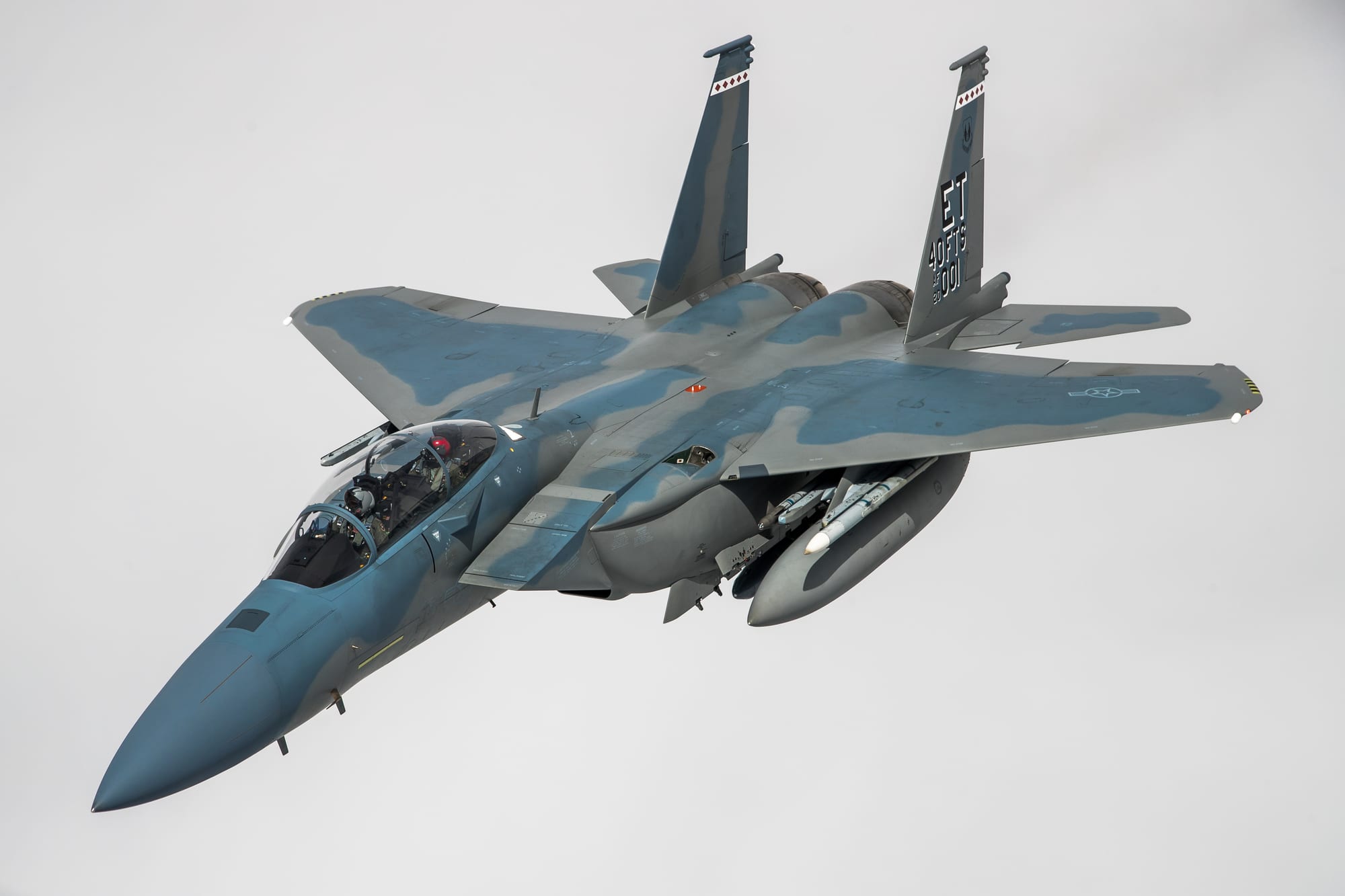
Context · a USAF F-15 Strike Eagle, of the type downed over Iran in 2026
F-15EX Eagle II.jpg · Wikimedia Commons · Public domain · open original
CNN, "Exclusive: Downed US pilot reported seeing Iranian drones swarm in 'jellyfish' formation" (23 Jun 2026)
The only source for the account: no official document has been released. According to four sources, the pilot of the F-15 downed over Iran in April told intelligence debriefers he saw several drones "moving as one with smaller drones below the bigger drones like legs"; another source spoke of a "minefield of drones". Officials disagree on how to read it and on whether the pilot, who was concussed and had already been downed by Kuwaiti friendly fire, could recount it clearly. Initial reports saw it as possible that the formation enabled the shootdown. The Air Force referred queries to CENTCOM, which did not address them, and ODNI did not reply.
CNN · view source
The night in question
In April 2026, at the height of Operation Epic Fury, the U.S. air campaign over Iran, a U.S. Air Force F-15E Strike Eagle was shot down over Iranian territory. By initial assessments, it was the first confirmed loss of a U.S. fighter over Iran in the conflict. The crew survived: the pilot ejected and was rescued by special operations forces within hours, while the weapons systems officer (WSO) evaded capture for more than a day before being successfully extracted. An A-10 was also lost during the rescue, its pilot ejecting outside Iranian airspace.
The element that moved the episode from the after-action report into the UAP conversation appeared in the later intelligence debriefings. According to an exclusive CNN report of June 23, 2026 (citing four sources familiar with the matter), the pilot described having seen, before the shootdown, a formation of Iranian drones moving as a single unit with a striking morphology: several larger drones up high and smaller drones suspended beneath them, like tentacles, together evoking a 'jellyfish'. One source summarized it to CNN as 'multiple drones interconnected and moving as one, with smaller drones below the bigger drones like legs'. The starkness of the description, and the reaction attributed to the pilot ('real alien sh*t'), fueled headlines about a possible anomalous phenomenon.
Within the intelligence community, however, the debate turned mainly on a technical, not ontological, question: whether Iran has developed a networked swarm capability (coordinated drones flying and maneuvering as a single system) more advanced than assessed, and whether that formation played a role in the jet's downing. According to CNN, officials disagreed on how to interpret the account, the debate remained unresolved, and the capability described (which the sources called 'one-to-many meshed networking') was not something U.S. intelligence had previously assessed Iran possessed; initial reports suggested the formation may have enabled the shootdown. Another source said the pilot described a 'minefield of drones', and the officials debriefing him asked something to the effect of 'Are you sure you saw what you are saying you saw?'. CNN framed the alternatives as questions: a mature capability U.S. intelligence was unaware of, a beta test, a mirage in the desert?
The calibrated reading must hold both the novelty and the limits. The novelty is real and militarily weighty: if the description is accurate, it documents a leap in Iranian drone warfare with direct implications for the survivability of crewed aircraft. But the limits are serious. It is a single-witness account, with no published instrumental material (no sensor video, telemetry or radar backing the morphology has been published); the source is a news report about classified debriefings, not a primary document; and, the decisive caveat, the pilot was concussed in the crash (and it was the second time he had been shot down in that war: earlier he had gone down in a friendly-fire incident by Kuwaiti forces), leading several intelligence officials to expressly question the reliability of his perception at that moment of extreme stress. The reading analysts discuss is that of a real adversarial drone formation interpreted under extreme stress; The War Zone adds other prosaic possibilities, such as a flock of birds or balloons used as decoys, or an effect of the concussion itself. The 'UAP/alien' frame comes from one anonymous source's remark and from media amplification, not from the intelligence assessments cited.
Why it matters
The case matters more for what it says about drone warfare than for what it adds to the UAP phenomenon. If the pilot's description is correct, the 'jellyfish' formation would be evidence of an Iranian networked-swarm capability (drones coordinated as a single system, with a hierarchy of large and small platforms) exceeding what had been attributed to Tehran, with immediate tactical consequences: it degrades the survivability of crewed fighters and forces a rethink of air defense. That is the substantive content, and it is adversarial in nature (another state's technology), not anomalous.
Its value is twofold and calibrating. First, it illustrates how a real combat event becomes a UAP story through language ('jellyfish', 'real alien sh*t') and media amplification, when the intelligence community itself reads the episode as a question of enemy capabilities. Second, it is a methodological reminder about witness reliability: a concussed pilot, under fire and mid-ejection, is exactly the scenario where perception is least reliable, something the analysts themselves flagged. It should be distinguished from the 2018 Iraq 'jellyfish' video (↗), which is an object captured by an infrared sensor rather than a drone formation reported by a witness.
What's left on paper
Documented evidence
- April 2026: U.S. F-15E Strike Eagle shot down over Iran during Operation Epic Fury (first confirmed loss of a U.S. fighter over Iranian territory)
- Crew rescued: the pilot within hours by special operations; the WSO evaded capture >1 day before extraction
- Exclusive CNN report (Jun 23, 2026, 4 sources): the pilot described in debriefings an Iranian drone formation in a 'jellyfish' shape (larger drones above, smaller below like tentacles)
- Intelligence-community debate: a more advanced Iranian networked-swarm capability than assessed vs. a UAP
- Reliability caveat: the pilot was concussed in the crash (the second time he had been shot down in the war); the officials debriefing him asked whether he was sure of what he saw
Show 2 more items
- No published sensor video, telemetry or radar; single-witness account via a news report, not a primary document
- Reading discussed by analysts: adversarial (Iranian) drone formation, with alternatives such as birds, decoy balloons or an effect of the concussion (The War Zone); the debate remains open; distinct from the 2018 Iraq 'jellyfish' video
Sources
- CNN — Exclusive: Downed US pilot reported seeing Iranian drones swarm in 'jellyfish' formation (23 jun 2026) — Original report (four sources) on the pilot's intelligence debriefings.
- The War Zone (TWZ) — What Was The 'Jellyfish-Like' Drone Swarm The Downed F-15E Pilot Reportedly Saw Over Iran? — Technical analysis of the networked-swarm hypothesis and the context of the shootdown.
- The Times of Israel — US pilot downed over Iran reported seeing jellyfish-like drone formation — Corroborating coverage with context of the conflict.
- Departamento de Guerra — «Operation Epic Fury», hoja informativa (3 mar 2026) — Official name of the U.S. campaign against Iran, launched on February 28, 2026.