1990·Calvine, Perthshire, Scotland
United Kingdom.Calvine · Perthshire
On 4 August 1990, two men photographed over the moors at Calvine (Scotland) a large diamond-shaped object hovering silently, with a jet, probably a Harrier, visible in several of the six images. The Daily Record did not publish the photos and sent them to the RAF; the Ministry of Defence analysed the negatives and returned them to the paper within four days, and their later whereabouts are unknown. In 2022 David Clarke made public a copy kept by RAF press officer Craig Lindsay.
Tier B · IndicativeWhat do they mean? →
Limited evidence: a single witness, testimony gathered years later, or an account without contemporary primary documentation.
What it was
57%natural or human cause
Most likely explanation: classified human technology
See the split across the six explanations
Natural or human cause
No known cause
Primary documents
File DEFE 24/1940: note on the Calvine incident, minute of 14 September 1990 and lines to take with the Daily Record
Three pages from the Ministry of Defence file DEFE 24/1940. A handwritten note, 'UFO Incident: Saturday 4th August 90', places the sighting at Calvine, 20 miles north of Pitlochry off the A9, at about 9 pm: a diamond-shaped UFO hovering for about 10 minutes before ascending vertically at high speed, while an RAF aircraft believed to be a Harrier made low-level passes. The Sec(AS)2a minute of 14 September says the six negatives arrived on 10 September, that the jet is a Harrier, with a barely visible second one, that no conclusion was reached on the object and there is no record of Harriers in the area, and that the negatives were returned to the newspaper.
The National Archives (Reino Unido), DEFE 24/1940, págs. 114-116 del PDF; copia digital en archive.org (BritishUFOFiles) · Open Government Licence v3.0 (Crown copyright, Ministry of Defence) · open original
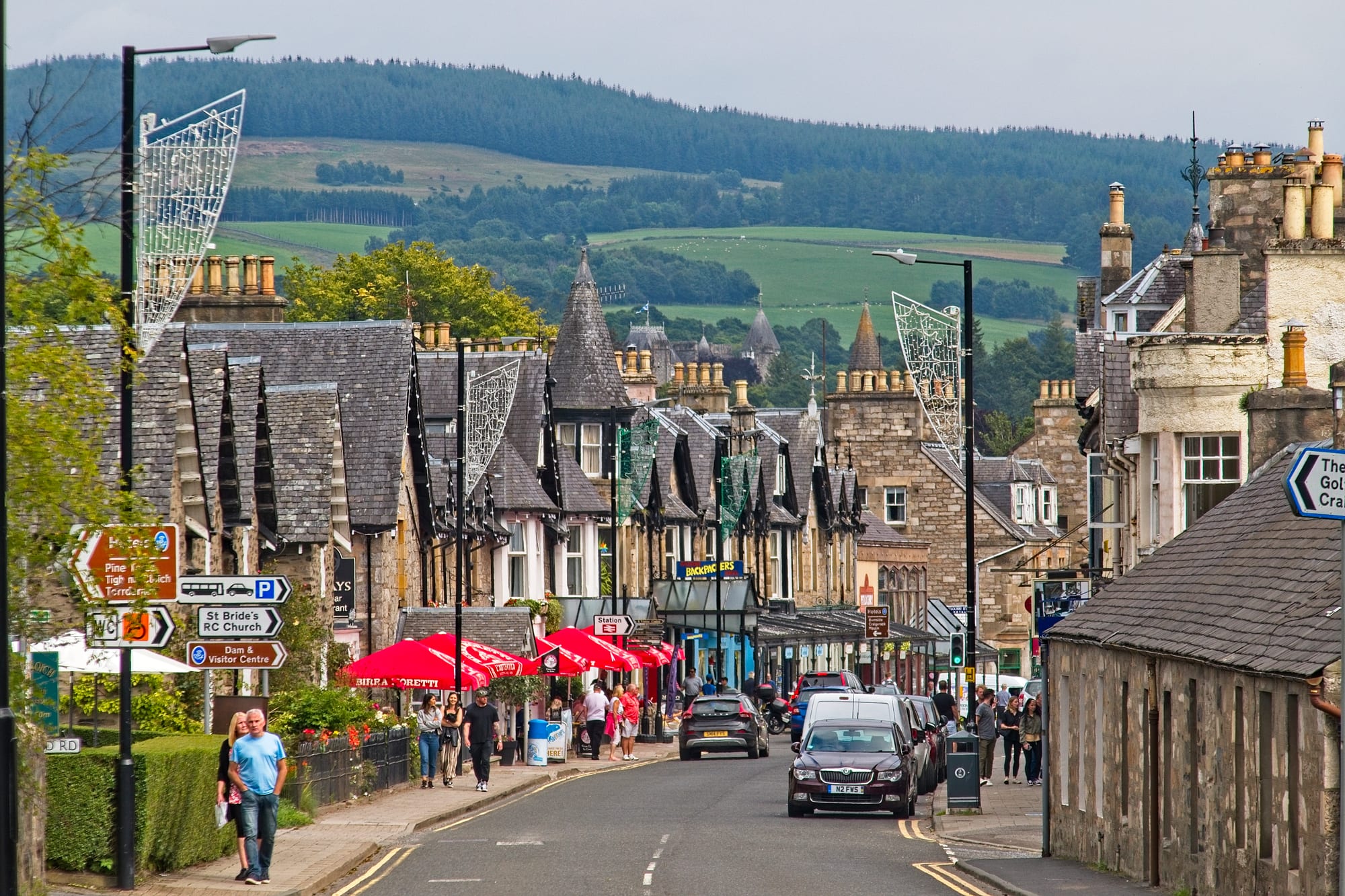
Context · Pitlochry (Perthshire, Scotland), near where the Calvine photograph was taken
Pitlochry, Perthshire (50248925367).jpg · Wikimedia Commons · CC BY 2.0 · open original
The night in question
On the evening of 4 August 1990, two men (by the account, two cooks from a nearby hotel walking on the moors above the hamlet of Calvine, in Perthshire, Scotland) observed a large diamond-shaped object hovering silently in the sky. They took shelter under some trees and from there shot a series of six photographs; according to the witnesses, the object hovered silently for four or five minutes and then slowly ascended vertically, gradually gaining speed. The handwritten note that opened the Ministry of Defence file records another version: the object hovered for about 10 minutes before ascending vertically at high speed, while an RAF aircraft, believed to be a Harrier, made a number of low-level passes for 5 to 6 minutes. In at least four of the six images, alongside the diamond-shaped object, appears what has been interpreted as a military jet (probably a Harrier) flying nearby, a decisive detail because it suggests military aircraft were present in the scene. According to the MoD file quoted by Clarke (DEFE 24/1940/1), its specialists established that the jet was a Harrier and identified "a barely visible second aircraft, again probably a Harrier"; yet, according to the ministry's own briefing, there was "no record of Harriers operating in the area at the time" the photographs were taken. A former defence intelligence official later told Clarke the two jets were US and UK aircraft that were "escorting the object", a claim no document supports.
The witnesses took the photos to the Scottish newspaper the Daily Record, which instead of publishing the scoop sent a copy to the RAF press office at Pitreavie. Its press officer, Craig Lindsay, photocopied it and faxed it to the Ministry of Defence (MoD) UFO desk, which asked for the negatives; according to an MoD document, they reached London on 10 September, were analysed, a response to possible questions in Parliament was drafted, and on 14 September they were returned to the Daily Record. What happened to them afterwards is unknown, and the paper never published the story. A photocopy of the image appeared in the MoD files released by the National Archives in 2009, but for more than three decades the photographs themselves were beyond public reach; one of the witnesses, moreover, never spoke publicly about the matter again.
After years of research, the academic, journalist and former adviser to the British archives David Clarke located former RAF press officer Craig Lindsay, who on his own initiative had kept for more than 30 years a copy of one of the prints together with the envelope and the photocopies he had once handled for the MoD. In 2022 Lindsay showed him that material and the image was made public for the first time. A photographic analysis by Andrew Robinson of Sheffield Hallam University concluded that the copy is "without doubt" of the original photograph the MoD analysed, that the image is a genuine photograph of a scene in front of the camera, and that if any manipulation or construction took place, it occurred in the scene rather than in camera or in post-production, though he found no evidence of it. He also cautioned that the copy cannot confirm the date or place, that there is "insufficient data" to conclude what the object is, and that working from a copy (and not the original negatives, still missing) precludes a definitive forensic verdict.
Why it matters
In Calvine, the weight lies in what happened to the image. The analytical core is the institutional behavior, though it is less opaque than the legend told: the paper chose to consult the RAF rather than publish, the Ministry of Defence analysed the negatives within four days, prepared an answer for Parliament and returned them to the paper, and from there their trail is lost. What is notable is that the result of that analysis is not known, that the image only came out in 2009 as a photocopy, and that the case emerged in 2022 because an RAF press officer kept a copy on his own.
That said, two things that enthusiasm tends to fuse need to be separated. One is the MoD's conduct, which is documented and leaves open questions. The other is the nature of the object, which remains undetermined and admits serious mundane readings. The theories published since 2022 are mostly of a hoax staged in the scene, such as an ornament hung from a thread near the camera, which Robinson's analysis cannot exclude though it found no sign of it; another serious reading is that the diamond-shaped object could be an optical phenomenon, a reflection, or even a classified aerial program, one's own or an ally's (the jet's presence in the scene is consistent with a military exercise, and several RAF and MoD personnel told Clarke they thought it showed an F-117 or a secret U.S. or British prototype), which would explain the image without invoking a non-human origin. What Calvine robustly demonstrates is that the authorities examined the images and did not say what they saw in them; what was photographed remains undemonstrated. The loss of the original negatives is, ironically, what prevents closing the case in any direction.
What's left on paper
Documented evidence
- Series of six photographs taken on 4 August 1990 by two witnesses on the Calvine moors
- A jet, probably a Harrier, beside the object in at least four of the six images
- MoD document (DEFE 31/179): the negatives reached London on 10 September 1990 and were returned to the Daily Record on the 14th; their later whereabouts are unknown
- Photocopy of the image released by the UK National Archives in 2009; print kept by Craig Lindsay until 2022
- Analysis by Andrew Robinson (Sheffield Hallam): genuine photograph of a scene before the camera, no evidence of a hoax and no data to identify the object
Sources
- David Clarke — Calvine UFO photograph (investigación y publicación, 2022) — Recovered the copy kept by Craig Lindsay and made it public.
- Newsweek — 'Best UFO Picture Ever, the Calvine Photo, Found After 30 Years Missing' (2022)
- A. Robinson — 'Photographic Analysis of the Calvine UFO Photograph', Sheffield Hallam University — 34-page report with the analysis conclusions and extracts from the MoD documents (DEFE 24/1940 and DEFE 31/179)
- Clarke, D. — «Calvine UFO revisited» (Substack) — Investigation by the man who recovered the copy: the Harrier in four of the six images, the hoax theories and the testimony of RAF and MoD personnel
Related cases
Associated actors (1)