2014–2015·Atlantic, U.S. East Coast (Virginia–Florida)
United States.USS Theodore Roosevelt (Gimbal/GoFast)
F/A-18 pilots of squadron VFA-11, from the USS Theodore Roosevelt air wing, log near-daily contacts off the U.S. East Coast from 2014, first on their newly upgraded radar and then on infrared.
Read the rest of the summary
The Gimbal and GoFast videos come from the same squadron, both dated 21 January 2015 by the Navy and recorded further south, off Jacksonville and Savannah, not in Virginia's warning area W-72, where Ryan Graves places the near-collision he testified to in 2023. AARO resolved GoFast in 2025 as an object one meter or less across, at about 13,000 feet, travelling downwind at no anomalous speed, without being able to identify it.
Tier S · SolidWhat do they mean? →
Strong evidence: a contemporary instrumental record (radar, sensor, film or photo of known provenance) that corroborates several independent witnesses.
What it was
52%natural or human cause
Most likely an ordinary cause that no one has identified
See the split across the six explanations
Natural or human cause
No known cause
Read the full reasoning
The absence of a published analysis is not evidence against an ordinary cause: in its 2024 report AARO stated that 'all 174 cases have been finalized as resolved to prosaic objects including balloons, birds, UAS, satellites, and aircraft'. The same report adds that 'many other cases remain unresolved', so the figure is the rate among resolved cases, not among all cases.Primary documents
GIMBAL video — object rotating above the clouds off Jacksonville, crew mentions 'a whole fleet' on radar (Jan 20, 2015)
US Navy, oficialmente desclasificado por el Pentágono (abril 2020), vía DVIDS · Public domain · US Government work · open original
GOFAST video — object moving at low altitude over the Atlantic Ocean
US Navy, oficialmente desclasificado por el Pentágono (abril 2020), vía DVIDS · Public domain · US Government work · open original
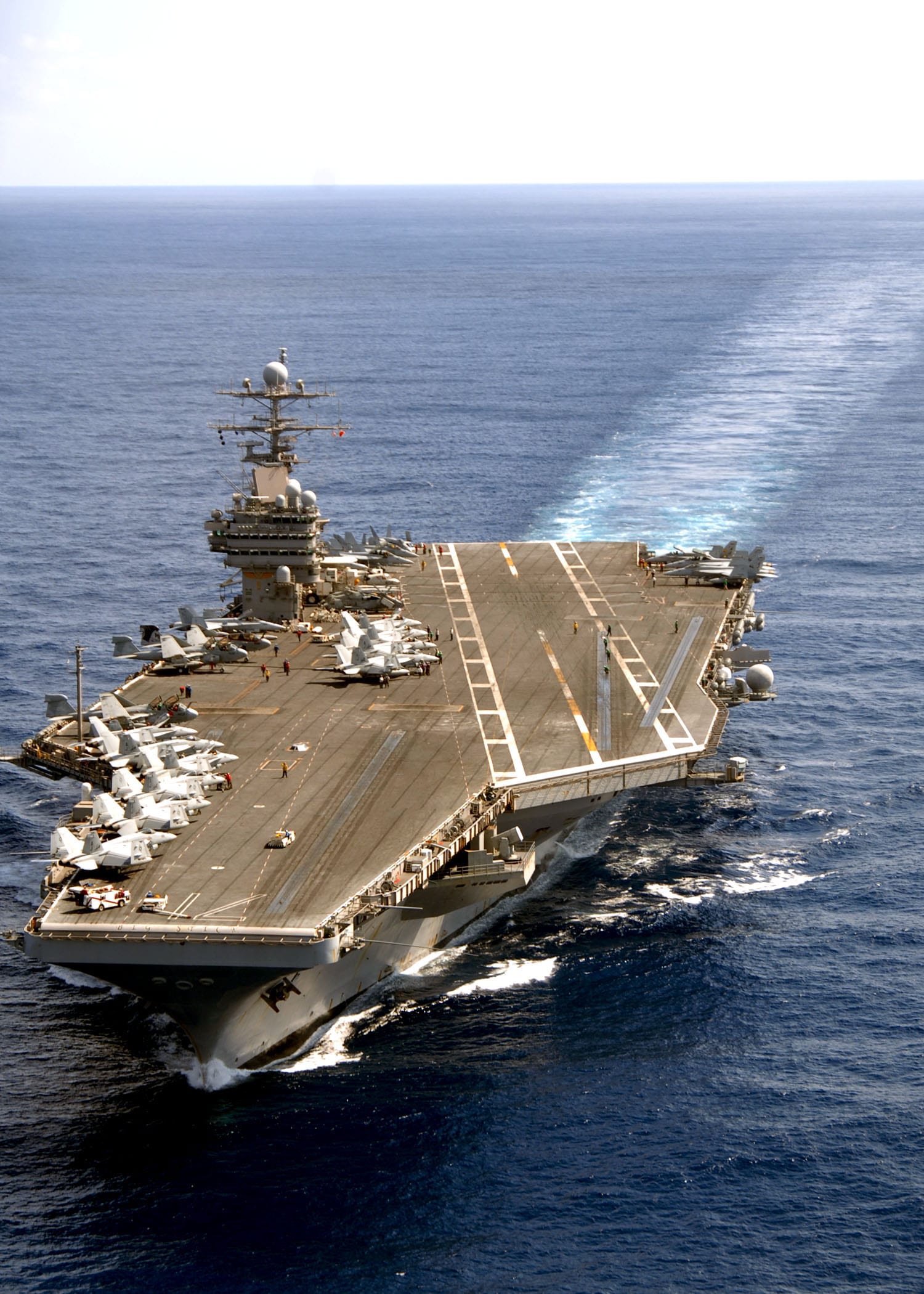
Context · the carrier USS Theodore Roosevelt, whose pilots recorded the objects (Gimbal/GoFast)
USS Theodore Roosevelt at sea.jpg · Wikimedia Commons · Public domain · open original
The years in question
In 2014, while squadron VFA-11 'Red Rippers', flying F/A-18F Super Hornets as part of the USS Theodore Roosevelt carrier air wing, trained in the warning areas off Virginia Beach, its crews began detecting unknown objects. According to the written testimony that Ryan Graves, a pilot in the squadron, submitted to Congress in 2023, it began with the upgrade of the jets' radar: the first contacts were dismissed as software glitches until crews corroborated them with infrared sensors. The sightings became so frequent that they entered the daily briefs; most of his colleagues saw them on radar and some saw them up close. Graves describes objects that accelerated up to Mach 1, held position against 'hurricane-force' winds and operated continuously throughout the day, outlasting the fighters themselves, with no visible means of lift, control surfaces or propulsion.
The central incident he recounts took place in Warning Area W-72, ten miles east of Virginia Beach, during an air combat training mission: just as two jets, 100 feet apart, crossed the area's entry point, one of the pilots saw 'a dark gray cube inside of a clear sphere', motionless against the wind at that very point. The jets took evasive action, terminated the mission and returned; the squadron submitted a safety report which, according to Graves, never received official acknowledgement. Graves adds, on the word of Rear Admiral Tim Gallaudet, that in 2015 his superior at Fleet Forces Command, the operations commander, sent the subordinate admirals a classified email titled 'Urgent safety of flight issue', with the GoFast video attached, which mentioned multiple near mid-air collisions in those warning areas and by the next day had been removed from his system and his deputy's. Two recordings from the ATFLIR infrared sensor come from the same squadron, but from a different setting: GIMBAL, showing an object rotating above the clouds as the crew, audibly, talks about 'a whole fleet' on the display and remarks that it is going against the wind, and GOFAST, which appears to show a fast object skimming the sea. In 2019 the Navy dated both to 21 January 2015, and that same year filmmaker Dave Beaty noted in The Black Vault that the deck logs of the cruiser USS Normandy, which stays with the carrier, placed the group that day in the Jacksonville operating area (JAX OPAREA), a little more than 100 miles east of the coast, midway between Jacksonville and Savannah; AARO places GoFast off Florida's east coast. That is not Warning Area W-72, off Virginia, where Graves places the near-collision.
On 16 December 2017, The New York Times revealed the Pentagon's AATIP program and published the FLIR1 (Nimitz) and GIMBAL videos; GOFAST was released by To The Stars Academy in March 2018. In September 2019 the Navy told The Black Vault that it considered the phenomena in all three videos 'unidentified', and on 27 April 2020 the Department of Defense authorized their official release, noting they had been circulating after unauthorized releases. In July 2023 Graves (by then retired and founder of Americans for Safe Aerospace) testified under oath before the House Oversight subcommittee about these encounters, the lack of a reporting channel and the classification of UAP videos since 2021, which, he says, keeps the full GIMBAL video out of public view.
Why it matters
Unlike Nimitz, the core of Roosevelt is the recurrence, told by those who lived it, of radar and infrared contacts over months in training areas, with a near-collision that prompted a safety report. Two of its recordings became, alongside the Nimitz FLIR, the public window that opened the modern disclosure era, and Graves's testimony put the lack of a reporting channel on the congressional record. The June 2021 ODNI preliminary assessment names no specific incidents, but its sample is of this kind: 144 reports from government sources between 2004 and 2021, 80 involving multiple sensors, only one identified (a deflating balloon) and the rest unexplained; most, it says, 'probably do represent physical objects', and in 18 incidents observers described objects stationary in winds aloft or with no discernible propulsion.
Each piece has to be weighed on its own. Of the two recordings, GOFAST already has an official resolution: in February 2025 AARO assessed 'with high confidence' that the object did not move at anomalous speeds. It was at about 13,000 feet, not skimming the sea, and pixel analysis puts it at one meter or less, 'comparable to a small drone or bird'; after compensating for the 69 mph westerly wind at that altitude, its own speed ranged from 5 to 92 mph depending on the jet's heading, its heading deviated at most 32° from the wind's and in no simulation did it move against it: it was travelling downwind at no anomalous speed. The impression of speed is parallax. AARO itself states the limits: it worked from the public 34-second version because the original file and its metadata no longer exist, it does not know the fighter's exact heading and position, and it says it cannot identify the object. On GIMBAL, independent analysts such as Mick West argue that the striking rotation may come from the sensor's own mechanism (the gimbal that gives the video its name) rather than from a maneuver, and the pilots reply that this does not explain what was seen by eye or the persistence against the wind. What remains is the pattern Graves describes, which rests on testimony rather than on published sensor data: the W-72 safety report and the radar data from those months have not been made public. The case stays open, but one of its two recordings no longer supports the anomalous reading.
What's left on paper
Documented evidence
- Ryan Graves's (VFA-11) written testimony to Congress: contacts on upgraded radar corroborated by infrared from 2014, almost daily
- Near-collision in Warning Area W-72: 'a dark gray cube inside of a clear sphere' at the entry point; the squadron submitted a safety report
- GIMBAL and GOFAST ATFLIR videos, dated by the Navy to 21 January 2015 and placed in the JAX OPAREA, between Jacksonville and Savannah, per the USS Normandy deck logs; the Department of Defense authorized their release on 27 April 2020
- Classified 2015 email 'Urgent safety of flight issue' with GOFAST attached, per Tim Gallaudet's account as relayed by Graves
- AARO (February 2025): GOFAST at about 13,000 feet, one meter or less ('comparable to a small drone or bird'), travelling downwind at no anomalous speed 'with high confidence'; original file lost and object unidentified
- ODNI preliminary assessment (June 2021): 144 reports, 80 multi-sensor, one identified (a balloon), no specific incidents named
Sources
- Ryan Graves — Written Statement, House Oversight Subcommittee on National Security (26 jul 2023) — Primary source for the squadron's account: upgraded radar, W-72 near-collision, safety report and the 2015 email per Gallaudet.
- The New York Times — 'Glowing Auras and ‘Black Money’: The Pentagon's Mysterious U.F.O. Program' (16 dic 2017)
- The Black Vault — 'Navy Officially Releases UFO/UAP Videos; Calls Them Historical' (27 Apr 2020) — Reproduces the Department of Defense statement and NAVAIR's FOIA letter: three videos, one from November 2004 and two from January 2015.
- The Black Vault — 'U.S. Navy Releases Dates of Three Officially Acknowledged Encounters with Phenomena' (11 Sep 2019) — Statements by Navy spokesperson Joseph Gradisher: 'unidentified' phenomena; GIMBAL and GOFAST from 21 January 2015. Includes Dave Beaty's reading of the USS Normandy deck logs: the group was in the JAX OPAREA, a little more than 100 miles east, between Jacksonville and Savannah.
- DVIDS — videos oficiales GIMBAL y GOFAST (mirror del Pentágono) — Both videos are embedded in this case's viewer.
- US Navy — formularios «Range Fouler Debrief» (costa este 2019/2020 y Atlántico 2020) — Navy standardized UAP reporting forms for aircrew — the institutional mechanism behind the East Coast incursions. AARO UAP Records, release 04 (DOWUAPD089/090/091).
- AARO — 'Go Fast' Case Resolution (6 Feb 2025), copy at The Black Vault — Altitude ~13,000 feet, own speed 5 to 92 mph after wind compensation, heading within 32° of the wind, size one meter or less (p. 4), 'high confidence' of no anomalous speed; original file and metadata lost; object not identified.
- ODNI — Preliminary Assessment: Unidentified Aerial Phenomena (25 Jun 2021) — 144 reports, 80 multi-sensor, one identified as a balloon; names no specific incidents.
Related cases
same country · same period
Boyd Bushman · Deathbed Confession
2014 · Tier B
same country · same period
Pantex · unidentified object over the nuclear plant (2015)
2015 · Tier S
same country · same period
An eight-pointed star with unequal-length arms
2013 · Tier A
same country · same period
Borland · the Langley triangle and the phone interference
2012 · Tier B
Associated actors (2)