1994·Cando (A Pedrada), Outes, Galicia, Spain
Spain.Cando Event · Galicia
At dawn on 18 January 1994, dozens of people saw a very bright luminous object descend over Galicia (Spain), some for a minute. Within a kilometre of the projected 'impact' point a 'crater' 29 by 13 metres appeared at A Pedrada (Cando, Outes), with about 200 m³ of soil lost and pine trees over 20 metres tall thrown downhill, but no meteorite or foreign material. The 1998 study ruled out a bolide and an impact and proposed an eruption of subsurface gases; one coauthor attributed it to a landslide after heavy rain.
Tier A · AcceptableWhat do they mean? →
Institutional evidence: several identified independent witnesses, or contemporary official documentation, without an instrumental record to corroborate them.
What it was
72%natural or human cause
Most likely explanation: atmospheric
See the split across the six explanations
Natural or human cause
No known cause
Primary documents
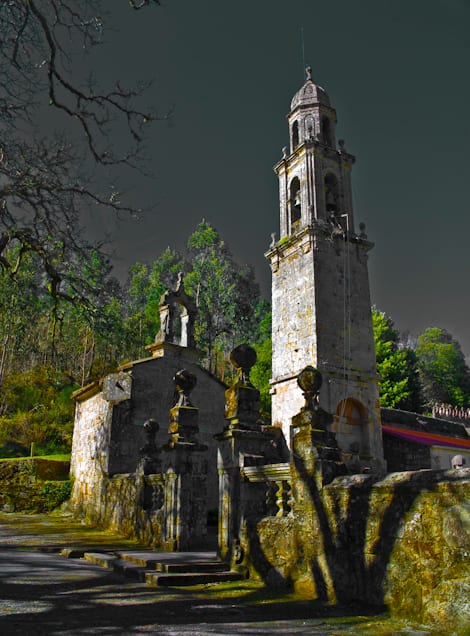
Context · Cando (Galicia, Spain), where the object that left the crater fell
Churche of San Tirso de Cando, Cando, Outes, A coruña.jpg · Wikimedia Commons · CC BY 2.0 · open original
Docobo, Spalding, Ceplecha, Díaz-Fierros, Tamazian and Onda, 'Investigation of a bright flying object over northwest Spain, 1994 January 18', Meteoritics & Planetary Science 33 (1998)
The scientific study of the event: it gathers the testimony, the measurements of the Cando crater, the January rainfall and Onda's appendix. It concludes that the object was not a fireball, that an impact is very unlikely because no meteorites or impact materials were found, and proposes an eruption of gases from the ground that opened the crater. Copy at Harvard's ADS; the article is under the journal's copyright, so it is given as a link.
Meteoritics & Planetary Science · NASA ADS · view source
The night in question
At dawn on 18 January 1994, shortly before 8:15 local time and about 45 minutes before sunrise, many people around Santiago de Compostela saw a very bright luminous object descending from north-northeast to west-southwest, with a small red-orange tail and an apparent size some compared with the full moon. The Ramón María Aller Astronomical Observatory, of the University of Santiago, gathered 34 witnesses and measured the positions given by the most reliable with a theodolite; some followed it for about a minute, and a couple driving by stopped, got out and watched it drop sharply behind the horizon. Unlike an ordinary meteor, it did not burn out in flight. The study published in 1998 by astronomer José Ángel Docobo, physicist Richard Spalding of Sandia laboratories, Czech astronomer Zdeněk Ceplecha and three other authors concluded, from its low, slow trajectory and its brightness, that it was not a meteoric fireball. They also ruled out other causes: the PAM-D stage of a Navstar satellite re-entered that day, but very far from Spain; according to the Spanish Air Force, its radars recorded no anomalies and there were no military manoeuvres, and the authorities excluded a missile impact.
On 22 April 1994 a local woman, E. Dosil, called the observatory to say that something strange had happened in January at A Pedrada, in the parish of Cando, Outes, within a kilometre of the projected 'impact' point: a large amount of soil and trees had been thrown aside, leaving a 'crater'. The investigators measured an irregular gouge about 29 by 13 metres and 1.5 metres deep, with an estimated soil loss of about 200 cubic metres. Numerous trees over 20 metres tall had been thrown 50 to 100 metres down the slope, over a two-metre walkway that stayed clear, while the down-slope edge of the 'crater' remained intact; trees still standing below had soil and plant residues embedded more than three metres up. No meteorites, artifacts or foreign materials were recovered, and nothing showed shock features, so the study judged an impact very improbable. The date of the gouge is uncertain: residents placed it anywhere from late 1993 to February 1994, though the vast majority put it in mid-January, and the Santiago seismograph was not working on 17 and 18 January because of a telephone-line fault. Even so, the authors put at only a few percent the probability that the luminous object and the gouge were independent events.
The explanation they propose is geophysical: an eruption of earth gases would have opened the crater, and the rising gas plume, interacting with atmospheric electricity, would have produced the fireball seen moving across the sky, a mechanism that connects with some of the hypotheses considered for the Sasovo explosion in Russia. The same paper records the opposite reading. About 400 millimetres of rain fell in the area in the first 17 days of January, and in an appendix coauthor Y. Onda, a landslide specialist, proposes that the gouge was a landslide caused by internal erosion from groundwater ('piping') and that the coincidence in time may be casual; another small landslide 300 metres to the northwest, which the landowner said appeared the same day, was judged typical and ordinary by soil scientist F. Díaz-Fierros. The authors present the gas eruption as 'a possible explanation' able to reconcile the observations, not as a closed identification, and the episode remained a small geophysical anomaly cited ever since as the Galician 'small Tunguska'.
Why it matters
Cando matters as a small-scale replica (on European soil) of the problem posed by Tunguska and Sasovo: an event that combines an aerial luminous phenomenon with considerable physical ground damage and yet leaves none of the material one would expect. Its value is that it reinforces, with a third independent case, that there exists a class of genuine terrestrial anomalies (gouges, localized devastation, bolides) whose exact cause may remain undetermined without that implying anything extraordinary in the ufological sense.
The unknown lies in the mechanism, not in the terrestrial nature of the event. The two hypotheses put forward (meteorite impact and an eruption of subsurface gas) are both prosaic, and the study itself ruled out the first for lack of foreign material and shock features, in favour of the same family of mechanisms (sudden gas emissions) invoked for Sasovo; even so, its authors present it as a possibility, not a verdict. Cando serves a coherence function: alongside Tunguska, Chelyabinsk and Sasovo, it delimits a 'genre' of natural energetic events worth characterizing well, precisely so as not to mistake a bolide or a gas vent for an anomalous manifestation.
What's left on paper
Documented evidence
- Very bright luminous object seen by 34 witnesses at dawn on 18 Jan 1994 (around 8:15), some for a minute; according to the 1998 study, it was not a bolide
- 'Crater' 29 × 13 m and 1.5 m deep at A Pedrada (Cando, Outes), within 1 km of the projected 'impact' point; about 200 m³ of soil lost
- Trees over 20 m tall thrown 50-100 m downhill over a walkway that stayed clear; soil embedded more than 3 m up the standing trees
- No meteorite or artifact; impact 'very improbable'; no radar anomalies or military manoeuvres; the PAM-D re-entry was very far away
- Uncertain date of the gouge (found on 22 Apr 1994; seismograph out on 17-18 Jan); the authors give only a few percent to the events being independent
Show 2 more items
- About 400 mm of rain in the first 17 days of January; coauthor Onda proposes a landslide by piping and a casual coincidence
- Main hypothesis by Docobo, Spalding, Ceplecha et al. (Meteoritics & Planetary Science, 1998): an eruption of subsurface gases whose plume produced the fireball
Sources
- Wikipedia — Cando, Spain (1994 Cando event)
- Docobo et al. — análisis del evento de Cando (Meteoritics & Planetary Science, 1998) — Primary source: the scientific study of the event, with the crater measurements and the gas-eruption hypothesis.
- Virtual Globetrotting — '1994 Cando event site'
- Docobo, Spalding, Ceplecha, Díaz-Fierros, Tamazian y Onda, «Investigation of a bright flying object over northwest Spain, 1994 January 18», Meteoritics & Planetary Science 33 (1998): 57-64, texto completo en ADS — Primary source: the full paper, with the testimony, the crater measurements, the January rainfall and Onda's appendix.
Related cases
same explanation · same country · same period
Noia · the motionless echo on the Iroite radar
1989 · Tier A
same object · same period
Dalnegorsk · Height 611
1986 · Tier B
same object · same period
Capilla del Monte · Cerro Uritorco
1986 · Tier B
same object
Val Johnson · patrol car with documented physical damage (USA, 1979)
1979 · Tier A