1803·Coast of Hitachi Province (present-day Ibaraki)
Japan.Utsuro-bune · Hitachi
According to several Japanese texts of the Edo era, early in 1803 (the documents give different dates; the most cited is the 22nd day of the second month of the Japanese lunisolar calendar, not 22 February) fishermen on the Hitachi coast sighted a strange floating object shaped like an incense burner (about 3.3 m high and 5.5 m wide, with windows and an unknown script inside) from which a young woman with pale skin and red hair, holding a box, emerged. The 'hollow ship' (utsuro-bune) tale is a classic of Japanese folklore.
Tier B · IndicativeWhat do they mean? →
Limited evidence: a single witness, testimony gathered years later, or an account without contemporary primary documentation.
What it was
62%natural or human cause
Most likely explanation: folklore or literary account
See the split across the six explanations
Natural or human cause
No known cause
Primary documents
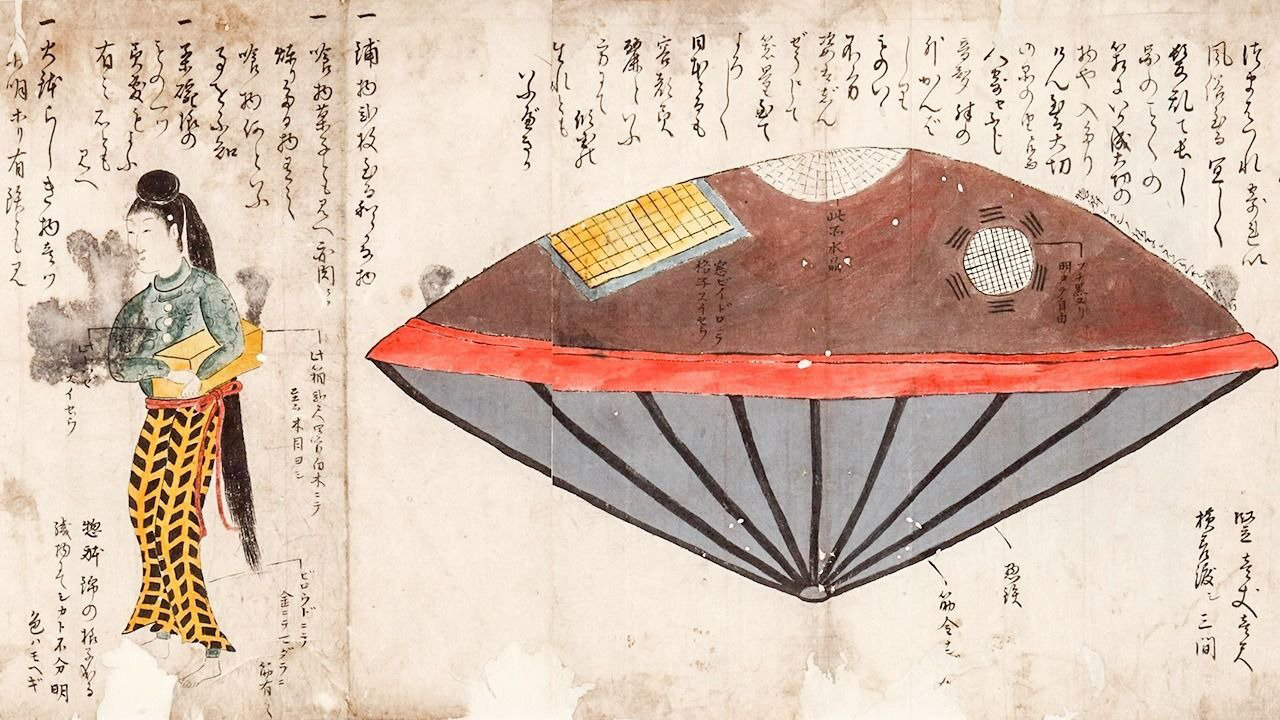
Utsuro-bune · the «hollow ship» drifted ashore (period illustration, c. 1803)
Ilustración japonesa de la época (Manjudō) vía Wikimedia Commons · Public domain · work published before 1928 · open original
The night in question
The utsuro-bune ('hollow ship') tale is a singular tale of Japanese folklore and an antecedent of the 'unidentified object' narrative predating the modern era. According to several Edo-era texts, early in 1803 (the documents give different dates, according to Tanaka Kazuo, and the most cited is the 22nd day of the second month of the lunisolar calendar), fishermen in Hitachi Province (present-day Ibaraki Prefecture, on Japan's eastern coast), sighted a strange drifting vessel and towed it ashore (some texts place the landing at Harayadori or Haratonohama, places for which there is no evidence according to Tanaka, while the report of the Ban family of Kōka ninja, which he considers very reliable, gives Hitachihara Sharihama).
The descriptions, remarkably concrete, agree on the essentials. The object was about 3.3 metres high and 5.4 wide, and its shape recalled a kōro, a Japanese incense burner or censer. The upper part seemed to be of red-lacquered rosewood, while the lower was clad in metal plates, a detail modern enthusiasts stress for its resistance to rocks. In the upper half were several windows of glass or crystal, protected with bars and sealed with a kind of resin. And, above all, the interior was decorated with texts written in an unknown language. Inside traveled a young woman, between 18 and 20, with very pale skin and red hair, dressed in an unfamiliar manner, who could not communicate in Japanese and who held a box she would let no one touch.
The story survives in at least four texts: Oushuku Zakki (1815), Toen Shōsetsu (1825) (edited by the famous writer Kyokutei Bakin, with one of the most detailed versions), Hyōryū Kishū (1835) and Ume-no-chiri (1844). The folklorist Yanagita Kunio held that all utsurobune legends were groundless fictions; Tanaka Kazuo, professor emeritus at Gifu University and the leading researcher of the Hitachi account, has gathered eleven documents about it. Tanaka first theorised a shipwrecked Russian whaler, but found no mention of such a disaster in official records; he now thinks the account was probably based on something that happened, but notes that the arrival of foreigners in the largely closed Japan of the time would have been a huge event and left a public document, and suggests that brief witness testimony at Kashimanada may have 'become tied in with earlier utsurobune legends'. Only much later did some ufologists reinterpret the episode as an encounter with extraterrestrial life.
Why it matters
The utsuro-bune matters as the Japanese equivalent of the European prodigy broadsheets (Nuremberg 1561, Basel 1566): a pre-photographic document demonstrating that fascination with a strange, unidentified object with an incomprehensible occupant is deeply rooted in very different cultures and long predates 20th-century ufology. Its value is historiographic and comparative: it extends the longue-durée anchor beyond Europe and shows that the narrative mold of the 'incomprehensible visitor arrived in a strange craft' is a cultural universal, not an invention of the space age.
Japanese scholars read it in two ways: Yanagita Kunio counted it among the utsurobune legends he considered groundless fictions; Tanaka Kazuo thinks something real probably happened, perhaps brief testimony on the coast that merged with earlier legends, but dropped his first hypothesis of a shipwrecked Russian whaler after finding no record of it, and notes that the arrival of foreigners in the closed Japan of the Edo period would have left official documents. The woman's features (pale skin, red hair, unintelligible language and script) have fed the idea of a foreigner, with no document to back it. No one can now verify witnesses from over two centuries ago or cleanly separate the fact from the literary adornment added by copyists like Bakin. The extraterrestrial reading is a late reinterpretation. The utsuro-bune is the Asian witness that the 'encounter with the unknown' has cultural roots as deep as they are universal.
What's left on paper
Documented evidence
- Account of the sighting and towing of a floating object on the Hitachi coast early in 1803 (22nd day of the second lunisolar month in the most cited version)
- Consistent description: incense-burner (kōro) shape, ~3.3 m high and ~5.45 m wide, lacquered upper part and metal base
- Glass windows with bars and texts in an unknown language inside
- Young woman with pale skin and red hair, unfamiliar dress, holding a box and not speaking Japanese
- Four Edo sources: Oushuku Zakki (1815), Toen Shōsetsu (1825, ed. Kyokutei Bakin), Hyōryū Kishū (1835), Ume-no-chiri (1844)
- Folkloric study by Kazuo Tanaka and Yanagita Kunio: 'women come from the sea' tradition; possible mythologized real foreigner