1979·Dulce, New Mexico (Archuleta Mesa)
United States.Dulce · Phil Schneider
Geological engineer Phil Schneider claimed in lectures (1995–96) to have survived a 1979 firefight against non-human beings in an underground base beneath Dulce (New Mexico), with 66 dead by his account. He displayed scars as 'proof'. His credentials were never verified and the sources consulted offer no documentary evidence of the base or the incident. He died in 1996; the medical examiner ruled it suicide, and his ex-wife maintained it was murder. He is the archetype of the uncorroborated underground-base (DUMB) 'insider witness'.
Tier B · IndicativeContacteeWhat do they mean? →
Limited evidence: a single witness, testimony gathered years later, or an account without contemporary primary documentation.
What it was
79%natural or human cause
Most likely explanation: medical or neurological cause
See the split across the six explanations
Natural or human cause
No known cause
Primary documents
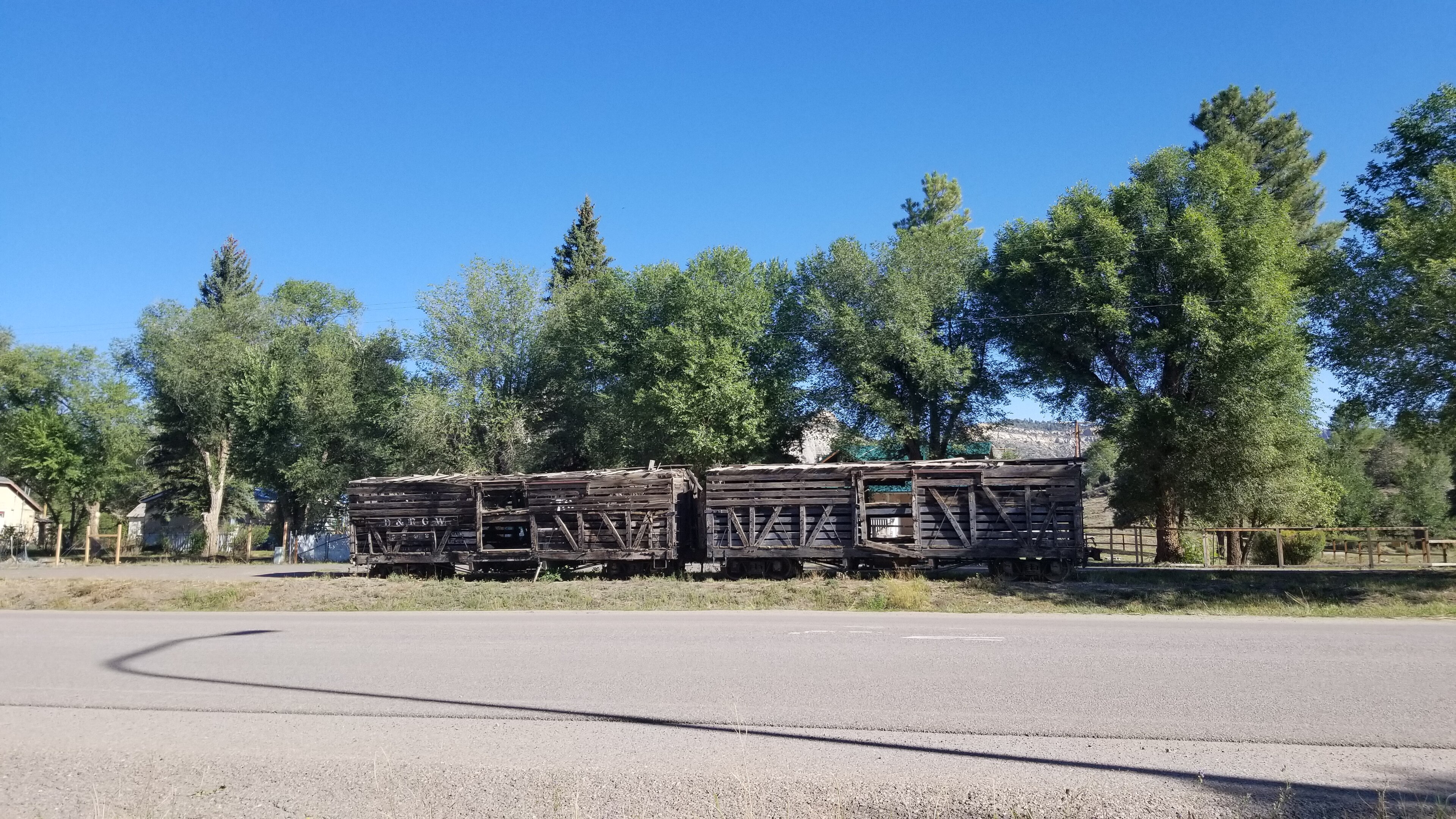
Context · Dulce (New Mexico), at the foot of Archuleta Mesa
D&RGW Boxcars At Dulce, New Mexico.jpg · Wikimedia Commons · CC BY 3.0 · open original
Phil Schneider, 'UFOs and Cattle Cars' · transcript of the May 1995 lecture
Transcript of the lecture Phil Schneider gave in May 1995, the primary source for his account, published on zianet.com with an anonymous introduction that takes his murder for granted. In it Schneider claims to have helped build the Dulce base, to have taken part in a 1979 firefight with 'alien humanoids' in which 'sixty-six secret service agents, FBI, Black Berets and the like' died, and to be one of three survivors. He attributes the clash to the 1954 'Greada Treaty', says he received 'cobalt radiation', and speaks of 129 underground bases and a 'Ryolite-38' clearance. It is the testimony, not a corroboration.
zianet.com (transcripción sin autor declarado) · view source
The night in question
The Dulce story rests, in its best-known form, on the testimony of a single man: Philip Schneider (1947–1996), who presented himself as a geological and structural engineer with a reputation on military and aerospace projects, and who said he had helped drill and build 'deep underground military bases' (DUMBs) for companies such as Morrison-Knudsen and EG&G. In the May 1995 lecture whose transcript circulates under the title 'UFOs and Cattle Cars', he said he had helped build two main bases in the United States, the first the one at Dulce, in northern New Mexico, and had hollowed out more than thirteen in all, besides working on the 'Malta project' in West Germany, Spain and Italy. According to him there were 129 such bases in the country, underground cities more than a mile deep on average, connected by magnetic trains that reached Mach 2.
The Dulce firefight, he said, happened 'quite by accident' in 1979, within a treaty the Eisenhower administration supposedly signed in 1954 with alien entities, the 'Greada Treaty': the beings could take a few cows and test their implanting techniques on a few humans in exchange for information, until, he said, they slowly altered the bargain. Schneider was helping build an addition to what he described as probably the deepest base, seven levels and over two and a half miles down. Four holes had been drilled in the desert so they could be linked and large sections blown out at a time, and his job was to go down, check the rock samples and recommend the explosive suited to each rock. As he went down, he said, they found themselves in a large cavern full of 'large Greys', who had lived on the planet for perhaps a million years. Schneider said he shot two of them; that there were about 30 people down there, joined by about 40 more when the shooting started, and that 'sixty-six secret service agents, FBI, Black Berets and the like' died. He was one of three survivors, 'the only talking survivor'; the other two, he said, were 'under close guard'.
What came afterwards, in his account, marked the rest of his life. One of the beings' weapons, 'a box on their body', blew a hole in his chest and gave him 'a nasty dose of cobalt radiation', which he blamed for the cancer he said he had and which, he reckoned, might give him six months to live. In his talks he showed a scarred hand and chest wounds as proof. After about two years recuperating he went back to work for Morrison-Knudsen, EG&G and other companies, and it was at Area 51, he said, that he became interested in flying-saucer technology, which he compared to Bob Lazar's story. He said that until a few weeks before the lecture he held a 'Ryolite-38' security clearance, and that he cut up his security card and sent it back to the government, with the threat of uploading 140,000 pages of documentation to the internet if he were threatened, something he said had already happened. He claimed to have spoken 19 times to about 45,000 people, that eleven of his best friends had been murdered in 22 years, eight of them as 'suicides', and that near Needles, California, two government vans with G-14 plates, one carrying an occupant with an Uzi, followed him until he stopped in the middle of the road; the vans went around him on both sides and down a ravine.
His talk wove the Dulce episode into a much wider account: a father, Otto Oscar Schneider, a former German U-boat captain repatriated to the United States who he said worked on the atomic bomb and the Philadelphia Experiment, a secret budget of 1.25 trillion dollars a year, stealth aircraft built from crashed discs, 'Star Wars' as a buffer against an alien attack, and 107,200 railroad cars fitted with shackles. He also spoke of AIDS as a biological weapon, 64,000 black helicopters, a 'Tesla' earthquake device and a small nuclear bomb in the World Trade Center bombing, on which he said he had written a report. The appeal of the testimony was its specificity and the speaker's conviction; its weakness, that nothing of substance could be checked.
The skeptical file is decisive. Schneider's credentials were never independently verified: there is no confirmed record of the jobs, contracts or security clearances he claimed to have held. The sources consulted offer no primary documentation (plans, contracts, casualty reports, military medical records) of a base beneath Dulce or of a firefight with sixty-six dead, an event that, if real, would have left an enormous administrative trail. The very idea of Dulce as an alien base traces back to the disinformation campaign U.S. agencies ran in the 1980s against businessman Paul Bennewitz (a documented case of manipulation that seeded much of the myth) suggesting that Schneider built his account on a pre-existing legend rather than on an experience. The scars, without a medical file dating and explaining them, do not prove their origin, and documents obtained under freedom-of-information law after his death point to another: he was hospitalized for schizophrenia at Dammasch State Hospital (Oregon) from July 1968 to January 1969, had a history of self-harm and had amputated two of his own fingers.
The exception to the case's purely narrative nature is his death. On 17 January 1996, Schneider was found dead in his apartment in Wilsonville (Oregon), with a rubber tube (a surgical catheter) around his neck; according to the letter his ex-wife wrote in November that year, he had probably been dead since 11 January, and 'the medical examiner has established suicide'. The autopsy was performed by Dr Karen Gunson, and his Wikipedia entry, which ascribes the death to a stroke, clashes with that ruling. His ex-wife, Cynthia Drayer, wrote to the authorities and to other researchers alleging inconsistencies: among them, that Schneider's fingerprints were not found on the tube, despite self-strangulation having required handling it. That anomaly keeps open, for some, the foul-play hypothesis she suggested, which Greg Valdez and Norio Hayakawa dismiss. The two questions should be separated: that his death has unresolved aspects does not retroactively validate his claims about Dulce, which remain without a single piece of corroboration. The case is therefore double: an extraordinary statement without evidence, and a death with legitimate forensic questions but independent of the account's content.
Why it matters
Dulce/Schneider matters as an archetype, not as evidence: it is the textbook case of the underground-base (DUMB) 'insider witness' (a convincing speaker, a specific story of combat with non-humans, scars displayed as proof) with not a single verifiable piece behind it. Its value is twofold. First, it anchors in a single file the family of 'insider' claims that runs through UAP culture, making its pattern explicit: unverified credentials, absence of a documentary trail for events that would have left one, and dependence on a prior legend (the Bennewitz disinformation). Second, it disciplines apart two things the folklore fuses: Schneider's claims, uncorroborated, and his death, with real but independent forensic anomalies. Its prosaic explanation is psychological or medical: after his death his ex-wife said he suffered from paranoid schizophrenia, and skeptics and ufologists alike, among them Greg Valdez and Norio Hayakawa, have read his claims as delusions built on the Dulce story John Lear had spread since the 1980s. Including it does not lend credence to Dulce: it catalogs it, just as Maury Island catalogs the 'men in black', a reminder of how an underground-base myth is manufactured and sustained.
What's left on paper
Documented evidence
- Phil Schneider's public lectures (1995–96): in May 1995 he claimed a 1979 firefight beneath Dulce with 66 dead and three survivors, and a chest wound with 'cobalt radiation'; scars displayed as 'proof'.
- Credentials and security clearances never independently verified.
- The sources consulted offer no primary documentation of the base or the incident (plans, contracts, casualty reports, medical records).
- The Dulce myth originates in the 1980s disinformation campaign against Paul Bennewitz, a pre-existing legend on which the account was built.
- Schneider's death (found 17 Jan 1996): the medical examiner ruled suicide, per his ex-wife's letter of November 1996 (Wikipedia speaks of a stroke); she maintained it was murder (no fingerprints on the catheter), which Valdez and Hayakawa dismiss, a question independent of the Dulce account.
Show 3 more items
- His ex-wife stated in 1999 that Schneider suffered from paranoid schizophrenia; Greg Valdez and Norio Hayakawa read his claims as delusions based on John Lear's stories
- Documents obtained after his death: hospitalization for schizophrenia at Dammasch State Hospital (Jul 1968 - Jan 1969), a history of self-harm and the amputation of two of his own fingers
- Persecution Schneider said he suffered, in his 1995 lecture: government vans with G-14 plates near Needles, eleven friends murdered in 22 years (eight as 'suicides') and threats over his talks.
Sources
- Phil Schneider — Wikipedia — Secondary source: biography; its attribution of the death to a stroke clashes with the medical examiner's suicide ruling.
- Bishop, Greg — 'Project Beta' (sobre la desinformación contra Paul Bennewitz) — Documents the origin of the Dulce myth in a U.S. intelligence disinformation operation.
- Phil Schneider — transcripción de la conferencia de mayo de 1995 («UFOs and Cattle Cars») — Transcript hosted on a UFO site, with an editor's introduction that takes for granted that he was murdered; it was not checked against the recording. The quotes and figures of his account come from here.
- Cynthia Schneider Drayer — cartas del 23 de noviembre de 1996 sobre la muerte de Schneider (alt.paranet.abduct) — Dates the discovery (17 Jan) and probable death (11 Jan) and records that the medical examiner established suicide, which she disputes.
- Norio Hayakawa — «Phil Schneider's Dulce base delusions» (2015) — Secondary source: Dr Gunson's autopsy (suicide) and Greg Valdez's critique of the murder theory.
Entity form (1)
Related cases
same object · same country
Eagle River · encounter with occupants and pancakes
1961 · Tier B
same object · same period
Robert Taylor · the only UFO investigated as a crime (Scotland, 1979)
1979 · Tier A
same object · same period
L'Amarante · the object over a biologist's garden in Nancy
1982 · Tier A
same object · same period
Carlos de los Santos
1975 · Tier A
Associated actors (1)