1964·Cisco Grove, Tahoe National Forest, California
United States.Cisco Grove · California
On the night of 4 September 1964, bow hunter Donald Shrum, separated from his two companions near Cisco Grove (California), climbed a pine tree and told the Air Force that two humanoid beings in silvery suits and a 'robot' that exhaled a vapor which knocked him unconscious besieged him until dawn, after he saw lights circling above him. He defended himself with arrows and burning clothing. McClellan AFB intelligence interviewed him and described him as stable and consistent; Project Blue Book closed the case as 'Other (psychological)'.
Tier B · IndicativeWhat do they mean? →
Limited evidence: a single witness, testimony gathered years later, or an account without contemporary primary documentation.
What it was
52%natural or human cause
Most likely explanation: psychological, medical or social cause
See the split across the six explanations
Natural or human cause
No known cause
Primary documents
Project Blue Book file · 'Sacto Area', 4 September 1964
Five-page extract from the Blue Book file. The record card dates the event to the night of 4 September 1964 and closes it as 'Other (Psychological)': an encounter with 'beings' attributed to psychological causes, with the arrowhead and the taped interview in the specimen file. The telex from the 552nd AEW&C Wing at McClellan AFB (24–25 Sep) summarizes the interview taped on 21 September by Capt McCloud and SMSgt R. Barnes and describes the witness, about 27, as 'stable, mature, not inclined to speculate'. Then come the Foreign Technology Division letter of 2 October, asking whether an owl or other animal coupled with an overactive imagination could explain it, and the 8 October reply: 'Yes'; the area could not be searched because of fire danger.
Project Blue Book · 1964-09-9421270-SactoArea-California, pp. 1, 10, 13, 12 y 2 (NARA, espejo en archive.org) · Public domain (US Government work) · open original
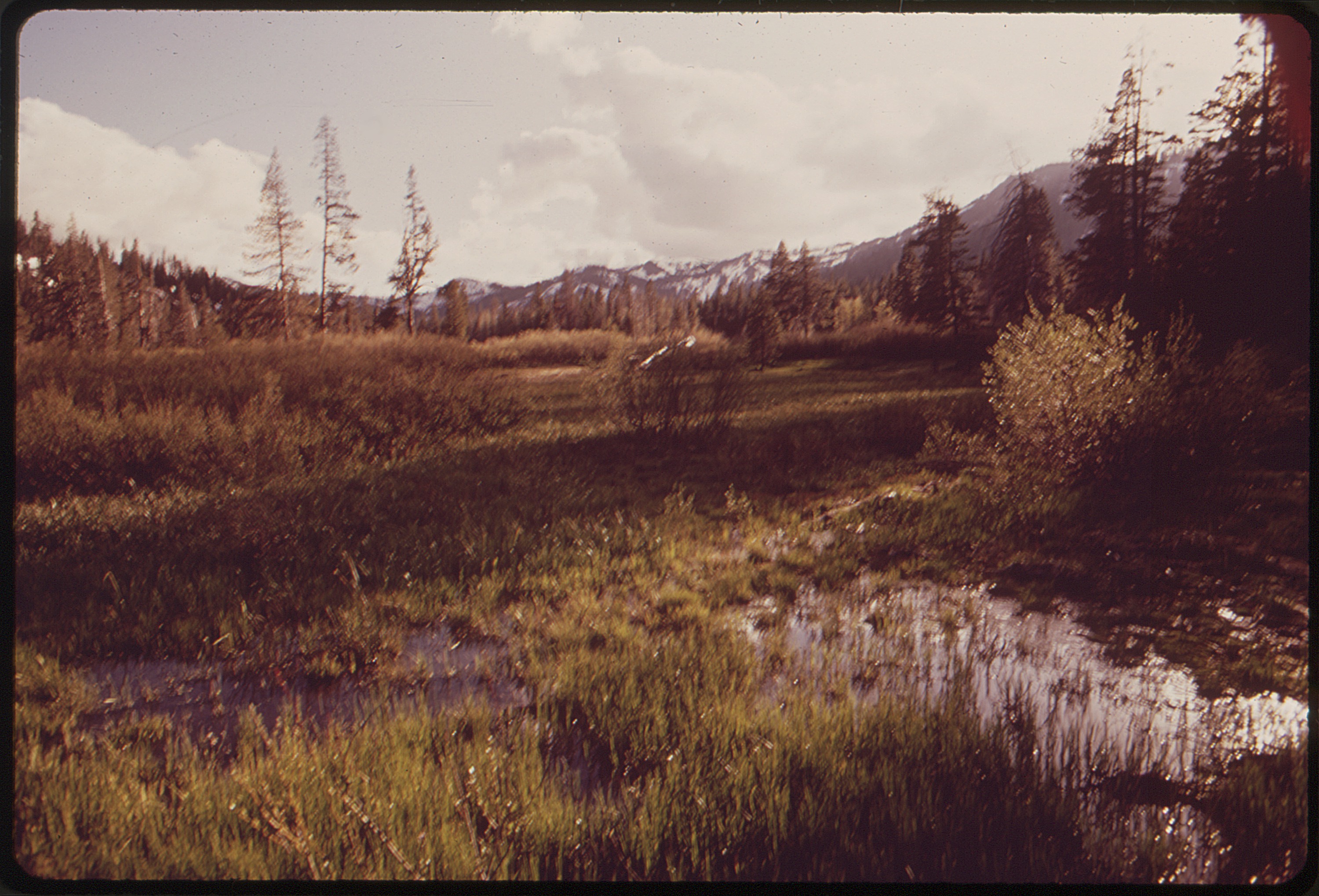
Context · Tahoe National Forest (California), the Cisco Grove area
Nevada - Tahoe National Forest, California - NARA - 543569.jpg · Wikimedia Commons · Public domain · open original
The night in question
On Friday 4 September 1964, three bow hunters from the Sacramento area went up into the Sierra on US 40, between Auburn and Truckee, near Cisco Grove, in the Loch Leven lakes area. One of them, Donald Shrum, about 27 according to the Air Force teletype, married and employed at a missile production plant, became separated from the group late in the afternoon and, rather than look for camp in the dark over rough terrain, decided to spend the night where he was. Seeing lights over the ridge, he thought it was a helicopter looking for him and lit three signal fires on the ridge overlooking Granite Creek valley. According to the teletype, the light turned out to be three silvery objects, round and flat, with a rotating light, that approached, dropped two unknown objects as they descended and circled his position at about 50 to 100 feet, with a whirring sound according to the teletype, although in Killick's letter the first light made no sound.
What followed is one of the strangest encounters in the Project Blue Book archive. Shrum heard loud crashing in the underbrush coming toward him and took refuge in the lower branches of a tall pine. From there he saw two human-like individuals approach, about five feet tall according to the letter of astronomer Victor Killick, in a silvery suit, with no apparent neck and strongly protruding eyes. He believed they had seen him and were trying to dislodge him from the tree; then a third, different individual appeared, which he called a 'robot' for lack of a better description, and in Killick's version there were two robot-like objects. He shot arrows at the robot without driving it off; according to Killick he shot three, one hit with a metallic sound and he recovered it later with a dented point. He set parts of his clothing alight with matches and threw them, and the beings reacted violently while the flying objects rose. A vapor emitted by the robots made him gag and black out; his bow wedged in a crotch of the limb and kept him from falling, and later, harassed, he climbed higher and strapped himself to the trunk with his belt. The beings communicated with a 'cooing' noise. When he came to at dawn, the objects and their occupants were gone.
Shrum rejoined his companions, who according to the teletype told him it probably had something to do with the meteorite the government was looking for; later accounts credit one of them, Vincent Alvarez, with also seeing the lights, which the file consulted does not record. On his family's advice they called Killick, in charge of the Sacramento City College observatory, who wrote to Mather AFB on September 9: he called himself skeptical, but said the family seemed healthy and rational, that Shrum came home 'as pale as a sheet' and that he found no ulterior motive; he added that this part of the story checked because there was no moon that night. Shrum had a complete medical examination on his own, fearing radioactivity or lung damage. Captain McCloud and Senior Master Sergeant R. Barnes, of the 552nd AEW&C Wing intelligence at McClellan AFB, interviewed and taped him on September 21 and noted that he appeared 'stable and consistent' and believed what he described. The Foreign Technology Division asked whether the occurrence could be attributed 'to an owl or other such birds or animals, coupled with an overactive imagination on the part of the witness'; in its reply of October 8, McClellan answered 'Yes', added that the area could not be searched because of the fire danger and forwarded the tape and the arrow. The Blue Book record card closed it as 'Other (psychological)': 'encounter with beings attributed to psychological causes', with the arrowhead and tape in the specimen file.
Why it matters
Cisco Grove matters as one of the most detailed close encounters of the third kind and, at once, as a test case for the limits of single-witness testimony. Its interest lies in an unusual combination of elements: a witness who held a coherent account for decades, a physical-effect component (loss of consciousness from the 'vapor', connecting to pattern 8a), an active defense with arrows and fire, and an arrow with a dented point that the Air Force kept in its specimen file. The often-cited corroboration, that Vincent Alvarez saw the same lights, comes from later accounts and not from the file consulted.
Even so, the core problem is structural: the extraordinary part of the account (humanoids, a gas-exhaling robot, an hours-long siege) rests entirely on one witness, in the dead of night, in a forest, under extreme fear and sleep deprivation, conditions that favor both misperception and the later elaboration of a real but ambiguous experience; Blue Book attributed it to 'psychological causes', although the interviewers themselves found him stable and the area was never searched. Even if Alvarez's late corroboration were accepted, it would show that something luminous was in the sky, not that the beings existed. Cisco Grove marks where narrative detail, however vivid and sustained, is no substitute for independent evidence: a single terrified witness is a powerful but uncalibrated instrument.
What's left on paper
Documented evidence
- Teletype from the 552nd AEW&C Wing, McClellan AFB (25 Sep 1964): summary of the interview taped on September 21; witness 'stable and consistent'
- Three silvery objects, round and flat, with a rotating light and a whirring sound, circling at 50-100 feet; two humanoids in silvery suits, neckless and with protruding eyes, and one or two 'robots'
- Reported physical effect: vapor from the robots that made him gag and black out (pattern 8a); later medical examination on his own
- Arrow with a dented point that, according to Killick's letter, sounded metallic when it hit the robot; kept in the Blue Book specimen file
- Letter from astronomer Victor Killick (Sacramento City College, 9 Sep 1964): skeptical, but found the family rational and without ulterior motive
Show 2 more items
- Blue Book record card: 'Other (psychological)'; McClellan answered 'Yes' to the owl-or-animals-plus-imagination hypothesis; the area was not searched
- Vincent Alvarez's corroboration comes from later accounts; the file only says the companions linked it to a meteorite
Sources
- UFO Insight — 'The 1964 Cisco Grove Encounter'
- UFO Casebook — 'Alien Encounter in Cisco County, 1964'
- Noe Torres & Ruben Uriarte — 'Aliens in the Forest: The Cisco Grove UFO Encounter'
- Proyecto Blue Book — expediente «4 Sep 64, Sacto Area, California» (NARA, espejo en archive.org) — Record card with the 'Other (psychological)' conclusion, the McClellan AFB telex summarizing the interview, the FTD's questions and Victor Killick's letter.
Entity form (1)
Related cases
same explanation · same country · same period
Herbert Schirmer · the Ashland patrolman
1967 · Tier A
same explanation · same country · same period
Eagle River · encounter with occupants and pancakes
1961 · Tier B
same explanation · same country · same period
Buff Ledge · Lake Champlain
1968 · Tier B
same explanation · same country · same period
Pascagoula · abduction reported by two fishermen (USA, 1973)
1973 · Tier B
Associated actors (1)