1991·West Carleton / Carp, Ontario, Canada
Canada.Carp / Guardian · Ontario
From 1989, Canadian investigators and later ufologist Bob Oechsler received anonymous parcels signed 'Guardian' with photos, forged government documents and a VHS video showing a large UFO sitting amid flames near Carp (Ontario). A neighbour, Diane Labanek, said in 1992 that she had seen the scene one night in August 1991. In October 1995, MUFON Ontario concluded that the whole thing had been a hoax from the outset.
Tier B · IndicativeWhat do they mean? →
Limited evidence: a single witness, testimony gathered years later, or an account without contemporary primary documentation.
What it was
90%natural or human cause
Most likely explanation: possible hoax
See the split across the six explanations
Natural or human cause
No known cause
Primary documents
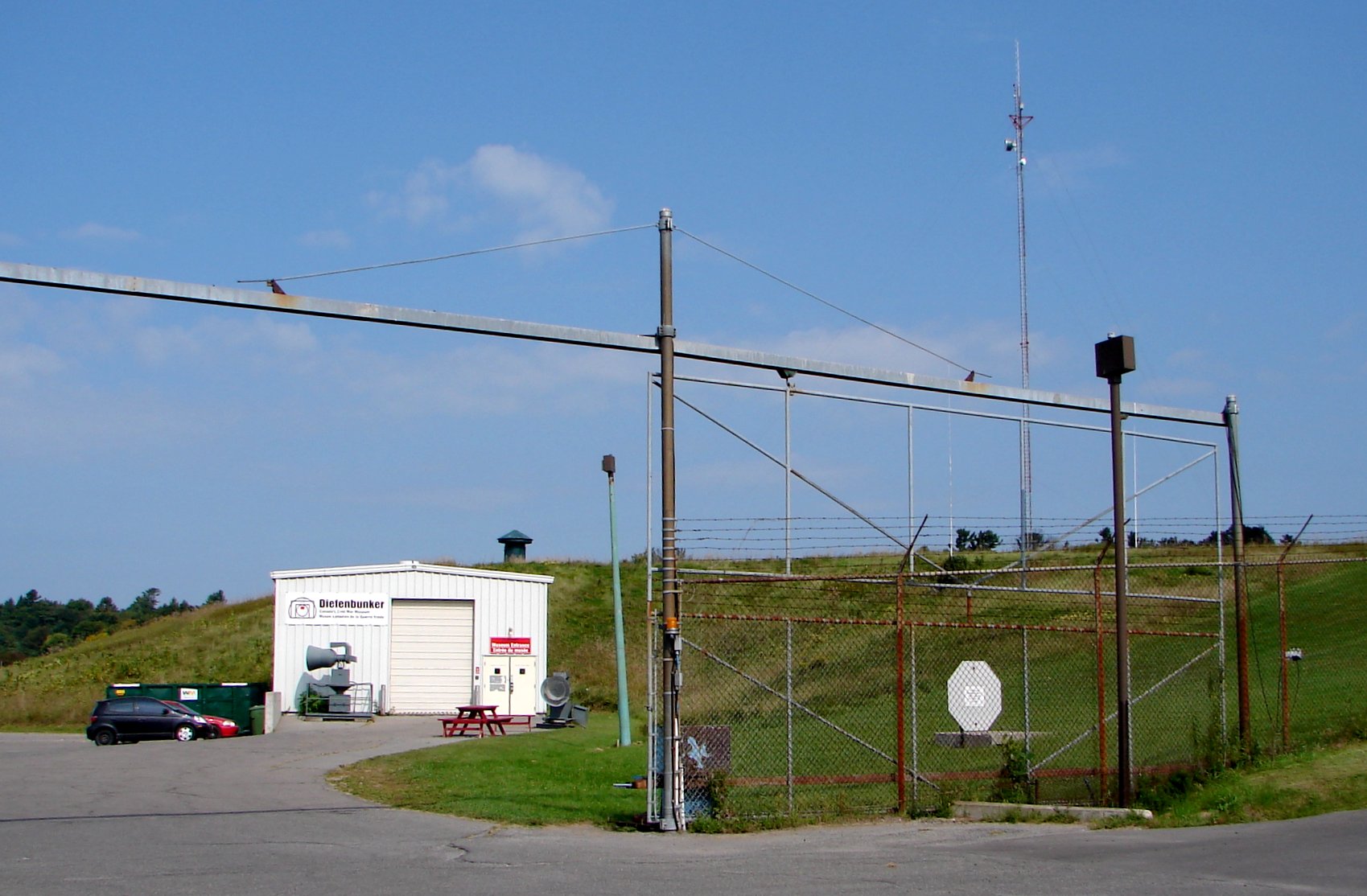
Context · the Diefenbunker in Carp (Ontario, Canada)
Diefenbunker.JPG · Wikimedia Commons · CC BY-SA 3.0 · open original
MUFON Ontario Newsletter, October 1995, special issue "The Carp case (The Guardian Caper)"
A special issue in which MUFON Ontario sets out its version of the case. It says that in 1989 the CUFORN network received from "Guardian" a story of a crashed UFO near Carleton Place, and that Diane Labanek then spoke of a light seen on 4 November 1989; that in October 1991 the thumb-printed VHS tape and Department of National Defence documents that proved to be forgeries arrived; and that Labanek later described a craft landed beside flares in August 1991. It summarizes the RCMP investigation opened in February 1993 on a complaint about low-flying helicopters, whose officer concluded that no charges could be laid against the presumed forger, and names Bobby Charlebois as the probable "Guardian". Copyrighted newsletter: it is linked.
MUFON Ontario, vía archive.org (Archives for the Unexplained) · view source
The night in question
The 'Carp case', or 'Guardian case', is considered one of the most controversial in Canadian ufological history, and a textbook example of a hoax built with forged documentation. Its 'real' seed was modest. According to the special issue MUFON Ontario devoted to the case in October 1995, Diane Labanek, a resident of West Carleton, near the town of Carp (Ontario), told investigator Graham Lightfoot, who was looking for witnesses to an alleged crash narrated by "Guardian" in 1989, that on the night of 4 November 1989 she had seen an intense light pass over her house toward a swamp at the far end of her field, and helicopters with searchlights earlier that evening; Lightfoot found no traces on the ground. In May 1992, before Lightfoot and Oechsler, she described a second episode: one night in August 1991, which she later dated to the 18th, around 10 pm (around 11 pm, by Oechsler's account in the Almonte Gazette), she saw from her children's bedroom what she took for a fire or flares at the far end of the field, a "craft" that landed beside them and turned its lights off after a few minutes, and then a helicopter that hovered over the area. According to the newsletter, she had told no one until then, and MUFON Ontario found no other witness to the "landing" among the residents of Manion Corners. A neighbour, Susan Gill, said she had seen through the trees a craft with lights over the Labaneks' field and, weeks later, that she had been aboard it, but she placed her experience on a rainy night, the one before, and in a later letter spoke of a fiction novel she was writing on those themes; the newsletter concludes that her account was used to pad the case.
What transformed that ordinary sighting into a famous case was a campaign of anonymous mailings. From 1989, investigator Tom Theofanous of the Canadian UFO Research Network and later, separately, ufologist Bob Oechsler, a former NASA contractor turned investigator, received parcels with no return address signed with the name 'Guardian'. They contained photographs, maps of the Ontario area, documents that appeared to be governmental, and proved forged, and, above all, a VHS videotape, labeled with a fingerprint and the word 'Guardian', showing what looked like a large UFO descending in a field beside red flames. The material seemed to give documentary and audiovisual backing to Labanek's account.
The assessment divided the community. Oechsler and, at first, investigator Graham Lightfoot believed Labanek was telling the truth and that the tape showed what she had seen; even image analysts came to back it: Bruce Maccabee presented it on television as an authentic landed UFO, and Robert Nathan opined that the video was not an obvious fabrication. However, the whole collapsed under scrutiny: the 'government documents' were forgeries, the anonymous provenance precluded any verification, and the video had features consistent with a staged scene. In February 1993, following a complaint about helicopters flying below 500 feet, which the newsletter attributes first to the Labaneks and later to a neighbour, Susan Gill, in both cases at Oechsler's urging to involve the police by using the "Guardian" video, the Royal Canadian Mounted Police opened an investigation, led by Constable De Haitre, to establish whether anyone could be prosecuted for low flying, whether the object was an aircraft and whether it was a UFO. According to MUFON Ontario's summary, based on a censored copy of the police report, the constable learned that military-style signs ("Defence Canada", "Killing Fields" and a "Test Area" sign with a hand-painted tank) had been seen in a field that turned out to belong to the Labaneks, with lettering similar to that of the "Guardian" documents, and concluded that no charges could be laid, as Oechsler had proposed, against the presumed sender over the forged documents. Oechsler, in a rebuttal the newsletter reproduces, says that the police file contained a letter from an expert at another Canadian government agency who "concluded that the object in the Guardian video was a Sikorsky S-76 helicopter", and that the police analysts linked the light flashing at 7 to 8 Hz to a rotor turning at 360-400 revolutions per minute and heard on the tape a sound consistent with rotating blades; he rejects this, because the flare smoke is not disturbed by any rotor, and says the police declined a demonstration with an S-76 and that Sikorsky itself found no one who shared that reading. It is an expert's conclusion quoted by the man who disputes it, not a published official report. In the same rebuttal, Oechsler states that a Department of National Defence report left the object in the video and the helicopters unidentified; according to MUFON Ontario, that department concluded it had no flights over the area at any of the times the Labaneks complained about. The same newsletter records another military opinion against it: in July 1992 Colonel Cajo Brando, of the Uplands base, watched the video several times and did not think it was a helicopter. The residue analysis Oechsler commissioned found no strontium, which in his view ruled out military flares, and he later spoke of lithium carbonate, typical of fireworks. In October 1995, in a special issue of its newsletter devoted to the case, MUFON Ontario concluded that the case had been "an out and out hoax" from the outset, in 1989, that the Labaneks, Bobby Charlebois (the presumed "Guardian", whom Diane Labanek described as a good friend who visited often), her nephew Pavel Farfara and possibly others had taken part in creating the video, and that the video, after analysis, was "inconclusive" and probably showed a pick-up truck or, according to the police investigation, a helicopter. The newsletter rests that reading on a municipal inspector's note of October 1990 that Farfara was already talking about UFOs landing on his aunt's property, ten months before the August 1991 episode, on Farfara owning a white pick-up truck similar in size and shape to the object in the video, and on the CUFORN copy ending with three frames of a windshield with its wipers. It is the conclusion of a group of investigators, not a court ruling, and no one was formally charged. Oechsler's reputation was damaged (he retired from UFO investigation on 1 September 1994) by his handling of this case and the Gulf Breeze one.
Why it matters
The Carp/Guardian case matters as a study of how a banal sighting can be hijacked and amplified by a deliberate campaign of false documentation into a 'great case', and as a warning about the weakest link in ufological evidence: provenance. Its value is methodological and directly akin to Gulf Breeze, Aztec and RS/33, other hoaxes: in all of them, the lesson is that spectacular material (a video, a photo, a 'secret' document) is worth exactly what its chain of custody is worth, and Guardian's was nil because anonymous.
Two layers must be separated. The base layer (Diane Labanek's account of flames and lights in a field) is known only from her testimony, given nine months later with no other witness MUFON Ontario found credible (the only neighbour who claimed to have seen it placed it on another night), and MUFON Ontario counts her among those who created the video; if anything real happened, it was mundane (a fire, lights of some kind) and on its own would never have made waves. The constructed layer (the 'Guardian' parcels with forged documents and the 'landing' video) is the fraud proper, confirmed by the demonstrated falsity of the documents and MUFON Ontario's ruling, although the object in the video is still not identified with certainty: a pick-up truck according to MUFON Ontario, a helicopter according to the expert cited in the police file. That some analysts did not immediately detect the trick in the video does not certify its authenticity; on the contrary, it shows how hard it is to refute a fabrication without access to the originals and the context. That residual technical difficulty is real, but on its own it supports no alternative hypothesis about what the video shows. The case also carried a real cost for those who defended it: ufologist Bob Oechsler, the recipient of the parcels and a proponent of their authenticity, retired from UFO investigation in 1994, a year before MUFON Ontario's ruling. Carp/Guardian is the case that teaches that a good hoax need not be perfect: it suffices to exploit the desire to believe and the impossibility of auditing an anonymous source.
What's left on paper
Documented evidence
- Diane Labanek told Graham Lightfoot of an intense light seen on 4 November 1989, after the first "Guardian" mailing (MUFON Ontario, Oct 1995, p. 2)
- Labanek's account, given in May 1992, of flares and a "craft" landed in her field one night in August 1991, which she later dated to the 18th; no other witnesses found (MUFON Ontario, pp. 7-8, 10 and 12)
- Anonymous parcels signed 'Guardian' sent to CUFORN from 1989 and later to Bob Oechsler: photos, maps, forged Department of National Defence documents
- VHS tape labeled 'Guardian' with a fingerprint, showing a large UFO 'sitting' amid flames
- Royal Canadian Mounted Police investigation (1993): hand-made military signs in a Labanek field, with lettering similar to the documents; no charges could be laid (MUFON Ontario, p. 13)
Show 3 more items
- According to Oechsler's rebuttal, a letter in the police file from an expert at another government agency concluded the object in the video was a Sikorsky S-76 helicopter; Oechsler rejects it, and Colonel Brando (Uplands, 1992) did not think it was a helicopter (MUFON Ontario, pp. 9 and 15)
- MUFON Ontario concludes in October 1995 that it was a hoax from 1989 and that the video, inconclusive, probably shows a pick-up truck or a helicopter (p. 25)
- Damage to Oechsler's reputation, who retired from UFO investigation (1994)
Sources
- MUFON Ontario Newsletter, número especial «The Carp case (The Guardian Caper)» (9 oct 1995), vía archive.org — First-hand source from the case's investigators: Labanek's accounts of 1989 and 1991 (pp. 2, 7-8, 10 and 12), summary of the Royal Canadian Mounted Police report (p. 13), Oechsler's rebuttal with the expert letter on the Sikorsky S-76 (pp. 14-15) and MUFON Ontario's conclusions (p. 25).
- Unsolved Mysteries Wiki — Guardian UFO — Secondary source (fan wiki).
- UFO Casebook — 'The Carp, Canada Case (The Guardian)' — Secondary source (aggregator).
- CBC Docs — 'We investigated an alleged UFO sighting near Ottawa'
- Rogers, I. — 'I was a teenage UFO investigator who explored an infamous alien sighting near Ottawa', CBC Docs POV (18 mar 2021) — Signed account by one of the case's investigators: most dismissed it as a hoax whose author was never identified.
- Alien Archivist — «The Guardian UFO Landing Video & Humanoid Photographs — Ontario, Canada, 1989–1992» (Substack) — Documented reconstruction of the case using the Almonte Gazette, MUFON Ontario's special newsletter (1995) and investigators' correspondence: the first recipient (Theofanous, from 1989), the time per Oechsler and the failed attempts to identify Guardian.
Related cases