1952·Spitsbergen, Svalbard, Norway
Norway.Spitsbergen 'Crash'
On 28 June 1952, the German newspaper Saarbrücker Zeitung reported that Norwegian fighters had found a crashed saucer on the Arctic island of Spitsbergen: a disc with jets around the rim to spin it, bearing 'Russian' inscriptions. The story, later embellished with an extraterrestrial origin and charred bodies, spread throughout the Cold War. Norwegian Air Force headquarters denied knowledge of the case as early as 1952, none of the names cited appears in Norwegian records, and researchers consider it a journalistic hoax.
Tier B · IndicativeWhat do they mean? →
Limited evidence: a single witness, testimony gathered years later, or an account without contemporary primary documentation.
What it was
88%natural or human cause
Most likely explanation: possible hoax
See the split across the six explanations
Natural or human cause
No known cause
Context image (not a document from the case)
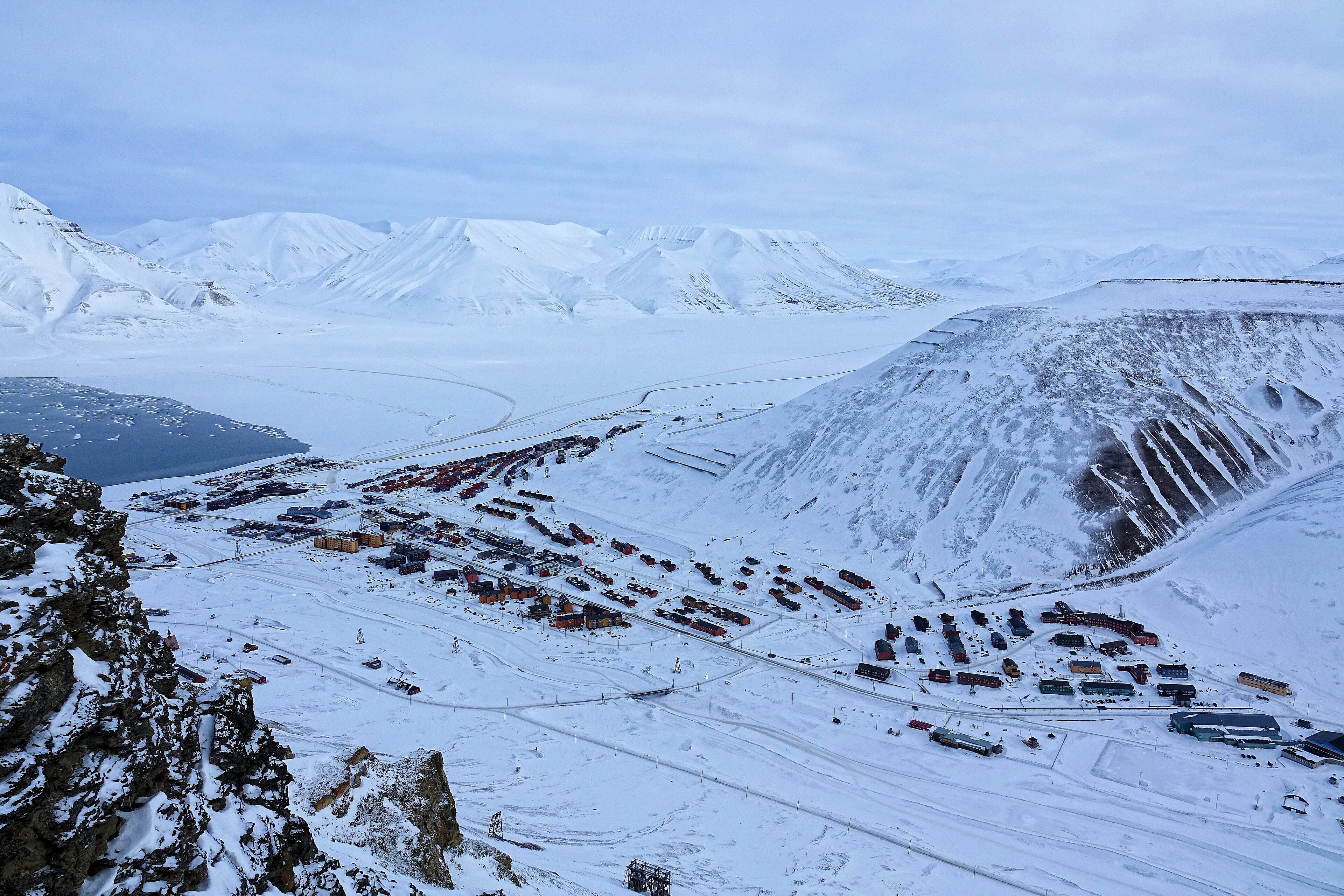
Context · Longyearbyen (Spitsbergen, Svalbard, Norway)
Longyearbyen-as-of-2022.jpg · Wikimedia Commons · CC BY-SA 4.0 · open original
The night in question
The 'Spitsbergen crash' is one of the most persistent craft-retrieval legends of the Cold War, and a textbook case of how a story without verifiable sources becomes 'fact' through sheer repetition. It first appeared on 28 June 1952 in the German newspaper Saarbrücker Zeitung, under the headline 'Auf Spitzbergen landete Fliegende Untertasse' ('A flying saucer landed on Spitsbergen'), signed only with the initials J.M.M. and datelined Narvik; the Berliner Volksblatt repeated it on 9 July and the magazine Der Flieger spread it in August.
According to the article, six Norwegian jets on maneuvers over the Hinlopen Strait lost their radios, and Air Captain Olaf Larsen saw in the snow a metal disc 40 to 50 metres across; five flying boats on skis took to the site a 'Dr. Norsel', a Norwegian rocket specialist, who found a radio direction finder with a plutonium core transmitting on all frequencies. The disc, 48.88 metres across, unmanned and remote-controlled, had 46 jets on its rim that spun it around a plexiglass central ball, and its instruments bore 'Russian symbols'; the text took it to be Soviet and closed with the German V-weapon designer Riedel calling it 'a typical V-7'. Later versions changed the story: on 26 July 1954 the Hessische Nachrichten credited a Colonel 'Gernod Darnhyl', chairman of a Norwegian General Staff board, with stating that the disc had not been built by any country on Earth, and that same year Sir! magazine, citing a retired Norwegian scientist, 'Hans Larsen Loberg', published a saucer downed on Heligoland with seven charred bodies, heavy water and pills for food; the two stories were later merged.
Every check points to a hoax. A 1952 clipping records that Norwegian Air Force headquarters denied all knowledge of the report and had never heard of 'Dr. Norsel'; in 1954 the Norwegian paper Verdens Gang asked in Oslo about Loberg and no one knew the name. Researcher Arne Borcke went through the Ministry of Defence material in 1973, which held only letters from curious people, and according to Ryan Wood, quoted by Kevin Randle, in 1985 the ministry's head of information, Arild Isseg, told British researcher Philip Mantle that the story seemed 'utterly unfounded'. The Norwegian embassy's 1958 letter to NICAP, cited as proof of secrecy, speaks of UFO material in general, not of this case. The Condon Report called it a story with 'no basis in fact', and in 1978 Norwegian researcher Jon-Ingar Haltuff concluded the account was physically and politically impossible. In 1991 Ole Jonny Braenne went through all of 1952 of the Svalbardposten, the local paper, and of the main Norwegian dailies without finding any mention; none of the names appears in the Norwegian Who's Who or in military records, and the only Norwegian jets of 1952, Vampires and F-84s, were based in the south of the country, out of range of Svalbard. None of the documents consulted supports the story; all of it traces back to a sourceless press note, embellished from copy to copy over decades.
Why it matters
Spitsbergen matters as a Cold War-era fraud anchor and as the European complement to Aztec, RS/33 and Carp/Guardian: all share the same anatomy: an extraordinary craft-retrieval claim resting on zero verifiable sources and sustained only by repetition. Its specific value is that it shows the press's role as a vector: here there was not even a con man with an object to sell, only an unattributed press note that the media ecosystem amplified into a 'case' cited for seventy years.
The chain against it is solid: the Norwegian denial from 1952 onward, names that exist in no record, the impossibility of Norwegian jets reaching Svalbard, the silence of the Norwegian press of the time, and the suspicious evolution of the story (from 'Soviet device' to 'otherworldly craft with bodies'), which is the typical signature of a legend that grows to each narrator's taste. It is also worth placing it in context: 1952 was the year of the great Washington UFO panic and of a worldwide surge of sightings, a climate in which a European newsroom had strong incentives to publish (unverified) a 'crashed saucer' scoop combining alien sensationalism with Soviet fear. Spitsbergen serves a hygienic function: it recalls that a story's age and ubiquity are not evidence of its truth, that a case can be repeated thousands of times without ever having a single source to support it, and that the context of a wave amplifies the spread of false stories as much as that of genuine sightings.
What's left on paper
Documented evidence
- First appearance in the Saarbrücker Zeitung (28 Jun 1952), signed J.M.M.: 'Auf Spitzbergen landete Fliegende Untertasse'; repeated by the Berliner Volksblatt (9 Jul) and Der Flieger (Aug 1952)
- Original account: a 48.88 m remote-controlled disc with 46 rim jets and 'Russian symbols', found by six jets led by Captain 'Olaf Larsen' and examined by a 'Dr. Norsel'
- Evolution: Colonel 'Darnhyl' and a non-terrestrial origin (Hessische Nachrichten, 1954); a Heligoland saucer with seven bodies according to 'Hans Larsen Loberg' (Sir!, 1954)
- Norwegian denials: Air Force headquarters (1952) and the Ministry of Defence (Borcke, 1973; Isseg to Mantle, 1985) had no record
- Condon Report: 'no basis in fact'; Haltuff (1978): physically and politically impossible
- Braenne (AFU, 1991): no mention in the 1952 Norwegian press, names absent from the records, Norwegian jets without the range to reach Svalbard
Sources
- Think AboutIt — '1946 & 1952: The Legends of UFO Crashes at Spitzbergen, Norway'
- Kevin Randle — 'Spitsbergen Crash/Retrieval and David Grusch' (A Different Perspective)
- UFO Casebook — 'The Legends of UFO Crashes at Spitzbergen, Norway, 1946 & 1952'
- Ole Jonny Braenne, «The Spitsbergen UFO crash/retrieval incident», AFU Newsletter 36 (1991), archive.org — Reproduces in translation the original 1952 and 1954 articles and documents the checks in the Norwegian press and records.
Related cases
same explanation · same period
Barra da Tijuca · the hoax the Air Force endorsed
1952 · Tier A
same explanation · same period
McMinnville · the Trent disc photographs (USA, 1950)
1950 · Tier A
same explanation · same period
Aztec · New Mexico
1948 · Tier B
same explanation · same period
Antônio Vilas-Boas
1957 · Tier B