1973·Mansfield, Ohio
United States.Coyne Helicopter
On 18 October 1973, at about 23:05, a U.S. Army Reserve UH-1H flying near Mansfield, Ohio, nearly collided with a red light that bore down on it; according to the crew, the object paused for a moment above them and, with the collective down, the altimeter showed a climb to 3,500 feet. The report the four crewmen signed on 23 November 1973 records it as a near midair collision with an unidentified flying object.
Tier A · AcceptableWhat do they mean? →
Institutional evidence: several identified independent witnesses, or contemporary official documentation, without an instrumental record to corroborate them.
What it was
51%no known cause
The evidence is not enough to decide between the explanations
See the split across the six explanations
No known cause
Natural or human cause
Primary documents
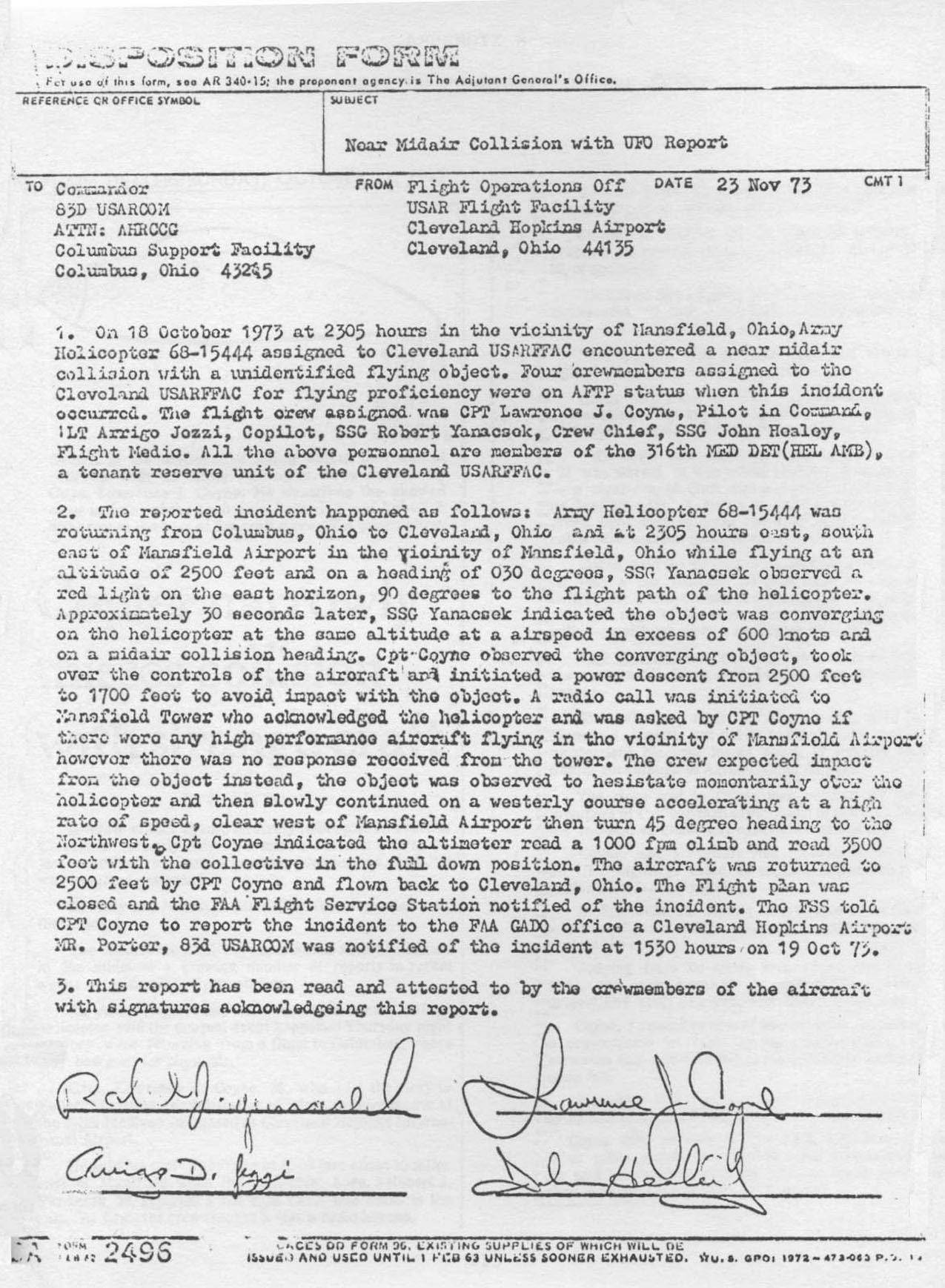
Army Disposition Form (DA Form 2496) "Near Midair Collision with UFO Report", 23 November 1973, signed by the four crewmembers
Report from the Flight Operations Office of the Army Reserve flight facility at Cleveland Hopkins Airport to the 83d USARCOM. It states that on 18 October 1973 at 23:05, near Mansfield, Ohio, helicopter 68-15444 was at 2,500 feet heading 030 when SSG Yanacsek saw a red light to the east converging at over 600 knots; Coyne descended to 1,700 feet, the object "hesitated" over the aircraft and moved off to the west, and the altimeter read a 1,000 fpm climb and 3,500 feet with the collective fully down. Mansfield Tower acknowledged the call and then gave no response. It is signed by Coyne, Jezzi, Yanacsek and Healey.
Ejército de EE. UU., 83.º USARCOM; respuesta FOIA, escaneo publicado por NICAP · Public domain · US Government work · open original
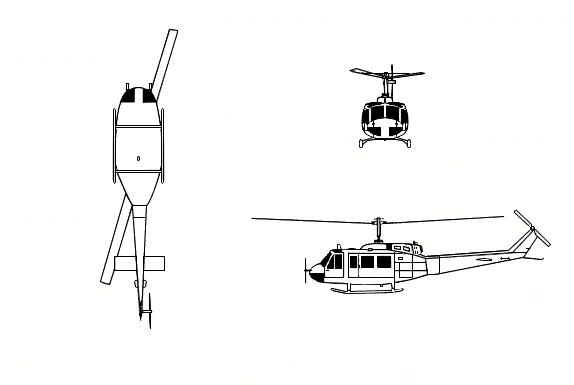
Context · a Bell UH-1 Iroquois, the helicopter type of the Coyne case
Bell UH-1 Iroquois 3-view line drawing.png · Wikimedia Commons · Public domain · open original
The night in question
On 18 October 1973, at 23:05 according to the official report (Coyne later said 23:10), U.S. Army Reserve UH-1H helicopter 68-15444 was returning from Columbus to Cleveland at 2,500 feet on a heading of 030, east-southeast of Mansfield Airport, Ohio. On board were four members of the 316th Medical Detachment: Captain Lawrence J. Coyne (pilot in command), First Lieutenant Arrigo Jezzi (co-pilot, who was flying), Sergeant Robert Yanacsek (crew chief) and Sergeant John Healey (flight medic). It was a clear, moonless night. Yanacsek saw a red light on the eastern horizon, 90° to the flight path, and about 30 seconds later reported that it was converging on the helicopter at the same altitude, at more than 600 knots and on a collision heading. Coyne took the controls and began a powered descent from 2,500 to 1,700 feet; in investigator Jennie Zeidman's reconstruction, first at about 500 feet per minute and then at about 2,000.
According to the report, instead of striking them the object 'hesitated momentarily' over the helicopter and continued slowly west, then accelerated sharply, passed west of Mansfield Airport and turned 45° to the northwest. The physical description came later: to UPI, two weeks afterwards, Coyne spoke of a 'big, gray, metallic-looking' hull about 60 feet long, shaped like an airfoil or a 'streamlined fat cigar', with a red light in front, a centre dome and a green light at the rear that swivelled like a spotlight and bathed the cabin in green. The uncontrolled spinning of the magnetic compass appears in later crew accounts gathered by Zeidman, not in the report or the 1973 press. The most striking point is in the report: Coyne saw the altimeter showing a 1,000 feet-per-minute climb and 3,500 feet with the collective in the full-down position. In Zeidman's reconstruction, when Coyne raised the collective the helicopter kept climbing to 3,800 feet, where he felt he had regained control. He told UPI there had been no noise, turbulence or noticeable g-forces.
Coyne radioed Mansfield tower to ask whether there were any high-performance aircraft in the area; the tower acknowledged and then gave no further response. According to Zeidman, contact was lost on both UHF and VHF and was later restored with Akron-Canton. The Air National Guard F-100s based at Mansfield were not airborne, Coyne told UPI. Zeidman later found ground witnesses who do not appear in the report: a woman and four children driving by the Charles Mill Reservoir saw a very bright red light and a green one converging with a helicopter, and when the red one stopped 'everything was green', the trees and the car; and in another house southeast of Mansfield a 14-year-old boy woken by the roar of a helicopter saw his room lit by an intense green light. The report, an Army disposition form titled 'Near Midair Collision with UFO Report', was signed by all four crewmen on 23 November 1973 and reproduced by Fawcett and Greenwood in Clear Intent (1984). Zeidman published her reconstruction through the Center for UFO Studies (CUFOS) in 1979.
The main skeptical explanation was offered by Philip J. Klass: a bolide from the Orionid meteor shower, active at the time, and a climb caused by the crew itself, which would have pulled on the controls by reflex without registering it. An ephemeris calculation gives that hypothesis a point in its favour: at 23:05 Eastern Daylight Time the Orionid radiant was only 1° above the east-northeastern horizon, and an earth-grazing meteor from that radiant crosses the sky precisely from east to west, long and slow, like the light Yanacsek saw. The 1973 accounts, moreover, give an approach of about 10 seconds and a momentary 'hesitation', not a long observation. Against it, Zeidman reconstructed a continuous observation of at least five minutes, incompatible with a meteor; no independent record of a bolide at that place and time is known; and the ground witnesses describe the green light over the helicopter. The piloting-error hypothesis remains the strongest objection to the physical component, because a reflexive climb is hard to exclude without an instrumental record of the controls.
Why it matters
Coyne offers a specific physical data point: the reported discrepancy between flight-control position (collective down, commanding descent) and actual altitude (a climb of ~1,800 feet). If accurate, it describes an apparent kinetic manipulation of a military aircraft, documented by four aviators who signed the report and supported, as to the green light, by civilian ground witnesses whom Zeidman found later.
The counterweight is central. Klass's objection (operator error, a reflexive collective pull-up under stress, plus a possible Orionid bolide for the light) is the most serious mundane explanation and, without a record of the controls, cannot be excluded: the 'climb against the controls' is in the signed report, but it rests on what Coyne read on the altimeter, not on an independent instrumental record. The geometry also gives the meteor an edge, since the Orionid radiant sat right on the eastern horizon, where the light came from. At the same time, the meteor fits poorly with the object's apparent halt and with the several-minute duration Zeidman reconstructed, and no record of the bolide is known.
What the case has is an institutional trail (a near-midair-collision report signed by all four crewmen and routed through the 83d USARCOM chain) and converging witnesses; it has no sensor record. It clearly illustrates a tension common to such cases: consistent professional testimony and a striking physical effect, but without the instrumentation that would close the debate between anomalous interaction and a perceptual-operational artifact under stress.
What's left on paper
Documented evidence
- Army disposition form 'Near Midair Collision with UFO Report' (23 Nov 1973), signed by all four crewmen
- The report records a 1,000 feet-per-minute climb and 3,500 feet on the altimeter with the collective full down
- Radio: Mansfield tower acknowledged and then did not respond; Mansfield's F-100s were not airborne (UPI, 4 Nov 1973)
- Ground witnesses found by Zeidman: a woman and four children by the Charles Mill Reservoir, and a boy who saw his room lit green
- Orionid radiant 1° above the east-northeastern horizon at 23:05, consistent with an east-to-west earth-grazing meteor
Sources
- «Near Midair Collision with UFO Report», formulario de disposición del 83d USARCOM (23 nov 1973), transcripción de Patrick Gross — Full text of the official report signed by the four crewmen, as reproduced in Fawcett and Greenwood, Clear Intent (1984), p. 239
- «Incident named after pilot», UPI, Mansfield News Journal (4 nov 1973), transcripción de Patrick Gross — Contemporary press with Coyne's statements
- Transcripción NICAP del expediente FOIA de Coyne (Army Reserve, 1973) — Secondary copy of the report; the site requires browser verification
- Zeidman, J. — 'A Helicopter-UFO Encounter Over Ohio' (CUFOS 1979) — Full technical reconstruction (later investigation with interviews); could not be downloaded from here because cufos.org requires browser verification
- NICAP — Coyne case directory — Secondary aggregator
- Klass, P. J., cited in Parabunk, «The 1973 Coyne/Mansfield helicopter UFO incident finally explained» (2018)
Related cases
Associated actors (1)