1974·Berwyn Mountains, Llandrillo (Wales)
United Kingdom.Berwyn Mountain · Llandrillo
On the night of 23 January 1974, the Berwyn Mountains at Llandrillo (Wales) shook with a roar and a glow that many took for a crashed UFO. The official evidence (MoD files declassified in 2010 and geological-survey data) points to the coincidence of a magnitude 3.5 earthquake (20:38) with a bright meteor seen over north Wales and England. Nicknamed the 'Welsh Roswell', it is a model case of how two natural events on the same night, which the press presented as simultaneous, spawn a cover-up retrieval legend.
Tier A · AcceptableWhat do they mean? →
Institutional evidence: several identified independent witnesses, or contemporary official documentation, without an instrumental record to corroborate them.
What it was
84%natural or human cause
Most likely explanation: meteor or fireball
See the split across the six explanations
Natural or human cause
No known cause
Read the full reasoning
The bang and tremor are another, natural layer: a magnitude 3.5 earthquake at 8.38pm, per the Daily Post. The hillside lights are a third: the paper records the theory of lampers, which a local farmer rejects, and History UK sees reason to believe something more extraordinary happened, citing a "bright red light, like a coal-fire red".Primary documents
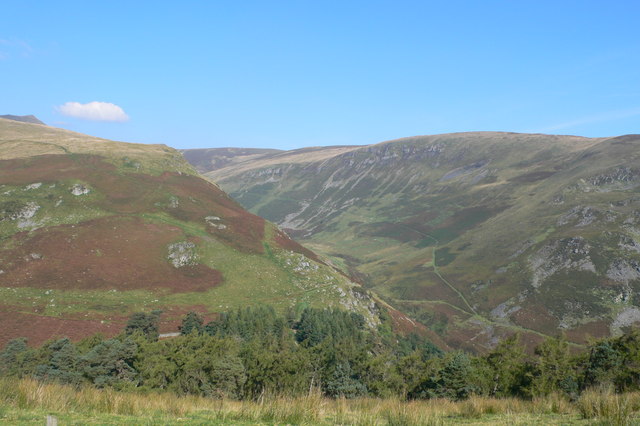
Context · the Berwyn mountains (Wales), near Llandrillo
Berwyn mountains - geograph.org.uk - 979691.jpg · Wikimedia Commons · CC BY-SA 2.0 · open original
'Explosion in North Wales', BUFORA Journal, vol. 4, no. 2 (spring 1974)
Evaluation by the British UFO Research Association's research department, signed by its director, Tony Pace, published weeks after the event. It says that at about 8.39 pm on 23 January 1974 a violent explosion shook Llandrillo, that the tremor was recorded at Edinburgh University and that the seismological station called it an earthquake lasting one to two seconds, possibly connected with the Bala fault. It places the fireball seen that day at about 9.58 pm, an hour and twenty minutes later, ceasing to glow at about 40 km above north Cheshire, and concludes that these were two separate natural events; it tentatively puts the lights on the mountain down to earthquake lights.
BUFORA Journal, vol. 4, n.º 2 (primavera de 1974), págs. 27-28; copia en archive.org · view source
The night in question
At 8:38 p.m. on 23 January 1974, part of north Wales felt a strong tremor. In the area of the Berwyn Mountains, above the village of Llandrillo in Merionethshire, residents described a roar followed by the house 'shaking violently' and, for several, a bright light in the sky. The combination (noise, vibration and glow on a mountain night) was enough for the idea to spread at once that something had crashed on the slopes. A local nurse drove toward the hills believing a plane had come down and there might be injured people; she found no wreckage but, according to some later accounts, lights and activity that would feed the more dramatic version.
The explanation the evidence supports is the concurrence of two independent natural phenomena. The Institute of Geological Sciences (now the British Geological Survey) recorded a magnitude 3.5 earthquake that night with its epicentre in the region, felt across a wide area of north Wales and as far as Formby, in England, about 20 km north of Liverpool. Separately, numerous observers in Wales and northern England reported that night a bright meteor (a bolide) crossing the sky; the press placed it at the time of the explosion, but the investigation by the British UFO Research Association (BUFORA) published in spring 1974 timed it at about 9:58 p.m., an hour and twenty minutes after the tremor, at magnitude −7, and concluded that the two were unconnected events the press had lumped together. An earthquake explains the roar and the vibration; a bolide explains the moving light. That both were told as simultaneous over a dark, rural district created the perfect illusion of an object falling, impacting and lighting up.
The legend grew in the opposite direction to the evidence. Over the years, second- and third-hand accounts spoke of a military cordon on the hills, of bodies removed in trucks and taken to defence facilities, of a covert recovery of craft and non-human crew. Some tabloids dubbed the episode, half in jest, 'the Roswelsh incident'. The problem with that version is that it rests on late second-hand accounts. What the press of the time recorded is that in the following days police, RAF personnel and mountain rescue teams, supported by reconnaissance aircraft, searched for the remains of a meteorite and found nothing. When the British Ministry of Defence began declassifying its 'UFO files' in the late 2000s, the documents released by the National Archives in 2010 showed precisely the opposite of a cover-up: the MoD had collected witness statements and attributed the episode to the combination of earthquake and meteor, with no trace of a recovery operation.
An interesting human residue remains, though not an anomalous one. Some of the 'lights on the hillside' seen by those who climbed that night may correspond to hare poachers with torches, common in the area, and to the headlights of those who drove up to investigate, although a local farmer rejected the poachers theory, and according to History UK the files record witnesses who described on the hillside a red light "like a coal-fire red", a "large perfect circle" with other lights moving. The strength of the case lies, therefore, not in what fell (nothing is recorded as having fallen) but in what it reveals about myth-formation: an intense but prosaic sensory event, with no immediate explanation available to witnesses at the time, becomes over the years, helped by the press and UFO culture, a cover-up story that no one can 'un-crash'.
Why it matters
Berwyn is a control case: the clean example of how a covert-recovery myth is born with nothing to recover. Its analytical value is twofold. First, it is extraordinarily well explained (an instrumentally recorded M3.5 earthquake plus a bolide seen by many independent witnesses) which makes it a yardstick for other cases: if an 'inexplicable' episode has this quality of mundane evidence, it is no mystery. Second, its public trajectory is a laboratory of how the absence of an immediate explanation, the press and the Roswell imaginary manufacture, over years, a story of bodies and military trucks that the MoD's own declassification disproves. It is the reminder that the default stance toward a 'crashed UFO' should be skepticism, and that sometimes the sky simply did two things at once.
What's left on paper
Documented evidence
- Magnitude 3.5 earthquake logged by the Institute of Geological Sciences at 20:38 on 23 Jan 1974, felt from north Wales to Formby (England).
- Multiple independent reports of a bright meteor/bolide over Wales and northern England that night; according to BUFORA (1974), at about 9:58 p.m., an hour and twenty minutes after the tremor.
- MoD UFO files declassified by the National Archives (2010): attribute the event to earthquake + meteor; no trace of a retrieval operation.
- Absence of physical debris, verifiable military witnesses of the alleged cordon, and documentation of a covert recovery.
- Plausible explanation of the 'lights on the hillside': poachers with torches and the headlights of those who drove up to investigate.
- BUFORA Journal, spring 1974: Edinburgh University's seismological station recorded a one-to-two-second earthquake at 8:39 p.m.; police, RAF and mountain rescue searched for a meteorite and found nothing; residents saw lights on the mountain, which the author tentatively put down to earthquake lights
Sources
- Berwyn Mountain UFO incident — Wikipedia — Synthesis with the M3.5 earthquake, the meteor and the MoD files declassified in 2010.
- The National Archives (UK) — MoD UFO files (release 2010) — Official documentation attributing the episode to the coincidence of earthquake and meteor. · Original (dead link): https://www.nationalarchives.gov.uk/ufos/
- History UK — «Berwyn Mountain UFO: The Welsh Roswell» — Secondary: quotes the MoD files.
- Daily Post (North Wales Live) — «North Wales farmer recalls 'whole place shaking violently' during Berwyn UFO mystery» (feb 2023) — Press: farmer Huw Lloyd rejects the poachers theory.
- BUFORA Journal, vol. 4, n.º 2 (primavera de 1974) — «Explosion in North Wales» (archive.org) — Contemporary investigation: time of the tremor recorded at Edinburgh, the police and RAF search, and the magnitude −7 fireball timed at about 9:58 p.m., an hour and twenty minutes later; concludes they were two unconnected events.
Related cases