1954·Tananarive (Antananarivo), Madagascar
Madagascar.Tananarive · Madagascar
On 16 August 1954, over the capital of Madagascar (then Tananarive, a French colony), thousands of people (some 20,000, by the estimate of the main witness, Air France's Edmond Campagnac) watched a green light pass at low altitude followed by a metallic object, cigar-shaped in his 1964 account and football-shaped in later versions.
Read the rest of the summary
The accounts describe the street lighting cutting out as it passed, panic in a livestock park and a similar object over La Sakay. According to Air France staff, General Fleurquin entrusted an investigation to the Jesuit Coze, the observatory director, of which no trace has been found in the Air Force records.
Tier B · IndicativeWhat do they mean? →
Limited evidence: a single witness, testimony gathered years later, or an account without contemporary primary documentation.
What it was
52%no known cause
The evidence is not enough to decide between the explanations
See the split across the six explanations
No known cause
Natural or human cause
Context image (not a document from the case)
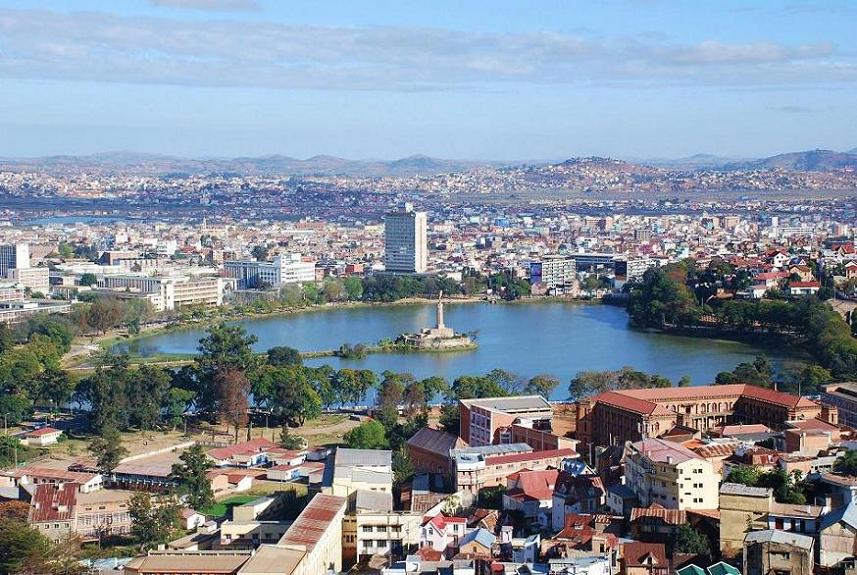
Context · Antananarivo (Madagascar)
Lake Anosy, Central Antananarivo, Capital of Madagascar, Photo by Sascha Grabow.jpg · Wikimedia Commons · CC BY-SA 3.0 · open original
The night in question
On Monday 16 August 1954, the capital of Madagascar (then Tananarive, in the French colony) was the scene of a mass sighting. Staff at the Air France office, among them Edmond Campagnac, head of the company's technical service on the island, saw a large sphere of an "electric green" falling from the east in a straight line, inclined at about 45 degrees, which, Campagnac wrote in 1964, "immediately made us think of a meteorite"; it seemed to pass by the Queen's Palace and disappeared behind the hills to the south. Half a minute later, according to that account, it reappeared over the Governor's Palace, came down toward the centre and travelled along the Avenue de la Libération some 100 metres up and at about 400 km/h: in front, a large, very bright green "lens" and, some 40 metres behind, a cigar-shaped "fuselage" the size of a DC-4 with an aluminium sheen, followed by a few orange sparks, all in complete silence; the observation lasted about two minutes. Later versions, such as the one compiled by Patrick Gross, speak of a football-shaped craft with bluish flames, 50 to 150 metres up. Campagnac estimated in 1964 that some 20,000 people saw it. The next morning, at Ivato airfield, a friend told him he had had to ask for help to round up his herds, scattered the previous evening around six by the craft's passage over La Sakay, some 100 kilometres away in a straight line; later versions speak of 150 kilometres to the south and a farm school. As for the date, Campagnac did not remember the exact day, only that it was a Monday in August, at six in the evening and already at dusk (other versions say five); the date comes from a Malagasy policeman's calendar.
What sets Tananarive apart from an ordinary mass sighting are the reported physical effects and the quality of the witnesses. Campagnac wrote in 1964 that when the craft entered the avenue the lights of the whole city went out. After a 1969 television broadcast in which he told the story, another witness, former warrant officer Grimout, wrote that he was at a dentist's on the same avenue and that the blackout began three or four seconds after he saw the craft and lasted about ten minutes, although he described a dark mass with some ten lights like portholes; he believed the press had only spoken of a general power failure. After that broadcast four viewers phoned to confirm the sighting, and in 1988-1989 a Malagasy witness came forward, former policeman Razafimahatratra, on duty outside the Métro cinema, who saw a "flying saucer" over Analakely at six; his report burned in the 1975 town-hall fire. But Grimout placed the passage between 6:30 and 7 p.m. and gave it another path (north to south, then a 90-degree turn following the Tamatave railway), and Joël Mesnard, who searched the Madagascar press, found no report of the event. The animals in the park where peasants kept livestock for the markets panicked as the object passed, and at La Sakay the herds scattered, a detail suggesting a real, physical stimulus, not merely a visual one. The combination of low altitude, controlled and silent flight, an effect on the power grid and an animal reaction makes for a picture hard to reduce to a simple collective optical illusion.
The institutional response was unusually serious for the time and place. According to Air France staff, General Fleurquin, head of the French Air Force in Madagascar, gathered a scientific team to investigate, and Campagnac wrote in 1964 that the survey, ordered to reconstruct the trajectory, fell to the Jesuit Coze, director of the Tananarive observatory, who had seen the green sphere "falling" from the observatory and also first thought it was a meteorite; he added that Coze, seriously ill, had promised him a copy of the report, and that some 5,000 witnesses "must have been" questioned. But, according to Patrick Gross's compilation, no trace of that investigation has been found in the Air Force records, and the earliest published version he cites is an article in the Malagasy newspaper Fandrosoam Baovao of 21 January 1955, followed by Campagnac's own account in the GEPA group's 1964 bulletin; the most widespread versions come from a 1974 France Inter interview and Jean-Claude Bourret's 1976 book. The figure of thousands questioned is Campagnac's estimate, not a datum from the report, which he said he had not received. In 2004, the newspaper Journal de l'Île de La Réunion located and interviewed Campagnac, described as 'one of the most credible witnesses', who held to the account half a century later.
The skeptical file must be taken seriously: more witnessed is not more anomalous. A mass sighting is vulnerable to a common prosaic stimulus misinterpreted in a chain: a bright green bolide or meteor (green is typical of nickel-rich meteors) could explain the fast luminous sphere, which Campagnac himself and the observatory director at first took for a meteorite (Eric Maillot, of the Cercle Zététique, whose grandfather lived in Madagascar, holds it was a meteor, and Gross records the criticism that the strange features were "late additions" due to "faulty memory"), and the object following it could be a fragment or an after-image. The electrical blackout, without preserved technical records from the power company, is hard to verify and may have been coincidental or amplified in memory. And the absence of photographs or instrumental records (radar, cameras) leaves everything in the testimonial plane, however massive. Even so, the details a meteor does not explain well (the apparent low altitude, the controlled trajectory, the reappearance from behind the hills, the metallic object following the light, the La Sakay sighting and the animal reaction) keep the case in the zone of indeterminacy: too witnessed and with too many effects to dismiss, too short on instrumentation to conclude.
Why it matters
Tananarive is the African case that tests the value of the mass sighting. It matters because it combines what almost never coincides: a crowd of thousands of witnesses, an official investigation the witnesses speak of (General Fleurquin, the Jesuit Coze), though with no trace in the archives, and physical effects (an electrical blackout, animal panic) that point to a real stimulus and not merely a perceptual one. At the same time, it is the reminder of testimony's limits: without a photograph, without radar, without a single instrumental record, the best witness base in the world still cannot say what the object was. The number of witnesses does not increase the anomaly, and Tananarive illustrates this clearly. Its place is twofold: it extends the geographic map to Madagascar and the global south, and it serves as a template case for discussing what a mass sighting can and cannot establish.
What's left on paper
Documented evidence
- Sighting by thousands of people over the capital (some 20,000 according to Campagnac), Monday 16 Aug 1954, at dusk (around 18:00 in the 1964 account).
- Qualified witness: Edmond Campagnac, head of Air France's technical service in Madagascar; account held 50 years later (2004 interview).
- A luminous green lens followed by a cigar-shaped metallic "fuselage" (football-shaped in later versions), some 100 m up and silent; herds scattered that evening at La Sakay, some 100 km away.
- Reported electromagnetic effect: electric lighting blacked out as the object passed, recovering afterward.
- Animal reaction: panic of the livestock in the city's zebu pen and scattering of the La Sakay herds.
- Investigation attributed to General Fleurquin and the Jesuit Coze (Tananarive observatory) by Air France staff; no trace in the Air Force records.
Sources
- 1954 — Tananarive, Madagascar — Multiple Witnesses to UFOs (The Black Vault Case Files) — Synthesis of the event, the effects and the official investigation.
- Gross, Patrick — 'Tananarive, Madagascar, 1954' (ufologie.patrickgross.org) — Critical compilation of sources and versions of the case, including Campagnac's testimony.
- Edmond Campagnac, «Une observation exceptionnelle», Bulletin du GEPA nº 6 (2º trimestre de 1964), en la traducción rumana de Ion Hobana, OZN. Observatori credibili, relatări incredibile, cap. «O observaţie excepţională» — First-person account by the main witness, ten years on: green sphere taken for a meteorite, cigar-shaped «fuselage», blackout, La Sakay 100 km away and Coze's survey; includes the letter of witness Grimout.
Related cases
same object · same period
Sandia green fireballs
1948 · Tier A
same object · same period
Chiles-Whitted · two airline pilots and a windowed object (USA, 1948)
1948 · Tier A
same object · same period
Ghost Rockets · Försvarsstaben
1946 · Tier A
same object · same period
Ghost rockets · Finnish origin (Finnish Defence Forces)
1946 · Tier B