1978–1981·Torriglia (Marzano), Genoa
Italy.Zanfretta · Torriglia
On the night of 6 December 1978 night watchman Pier Fortunato Zanfretta radioed, in real time, an encounter with an object and beings at Torriglia (Genoa).
Read the rest of the summary
The Carabinieri telex of 8 December recorded no witness to the encounter, a horseshoe-shaped imprint about two metres across in the grass and a reliability rating of 'buono' (good); the January 1979 report added more than 50 residents who had been seeing luminous objects for months, and the Genoa magistrates' court shelved the file for lack of any offence. Eleven 'abductions' (1978–1981) recovered under hypnosis followed, in a heavily documented and heavily disputed case.
Tier B · IndicativeContacteeWhat do they mean? →
Limited evidence: a single witness, testimony gathered years later, or an account without contemporary primary documentation.
What it was
56%natural or human cause
Most likely explanation: psychological, medical or social cause
See the split across the six explanations
Natural or human cause
No known cause
Read the full reasoning
Of the first episode, the Carabinieri telex of 8 December 1978 records 'NESSUN TESTIMONE' (no witness), and brigadiere Nucchi's report (3 January 1979) lists no witnesses of that night. Against it, that report says a neurological exam found him 'sanissimo di mente' (perfectly sane) and that he used no alcohol or narcotics.Primary documents
Telex from the Carabinieri company of Chiavari to the Interior Ministry and the Air Force General Staff (8 Dec 1978, 1 p.)
The first official report on the case, 'UNCLAS Nº 387/1-2', signed by Capt. Carusi and with a receipt stamp of 8 December. It first records a luminous flying object seen for a few moments from Albora di Propata at about 1,500 metres, with 'fair' reliability, and then the account of night watchman Zanfretta at Marzano di Torriglia, while inspecting the villa 'Casa Nostra': a light source, a red oval object over ten metres across and a 'luminous form with human semblance about three metres tall' that climbed into the object, which took off vertically with a loud whistle towards the south-west. It notes that his colleagues found him on the spot in a state of agitation, 'no witness', a horseshoe-shaped print about two metres across on the ground and a 'good' degree of reliability.
Arma dei Carabinieri, Compagnia di Chiavari (copia publicada por Rino Di Stefano) · Official act of the Italian public administration, excluded from copyright (Law 633/1941, art. 5) · open original
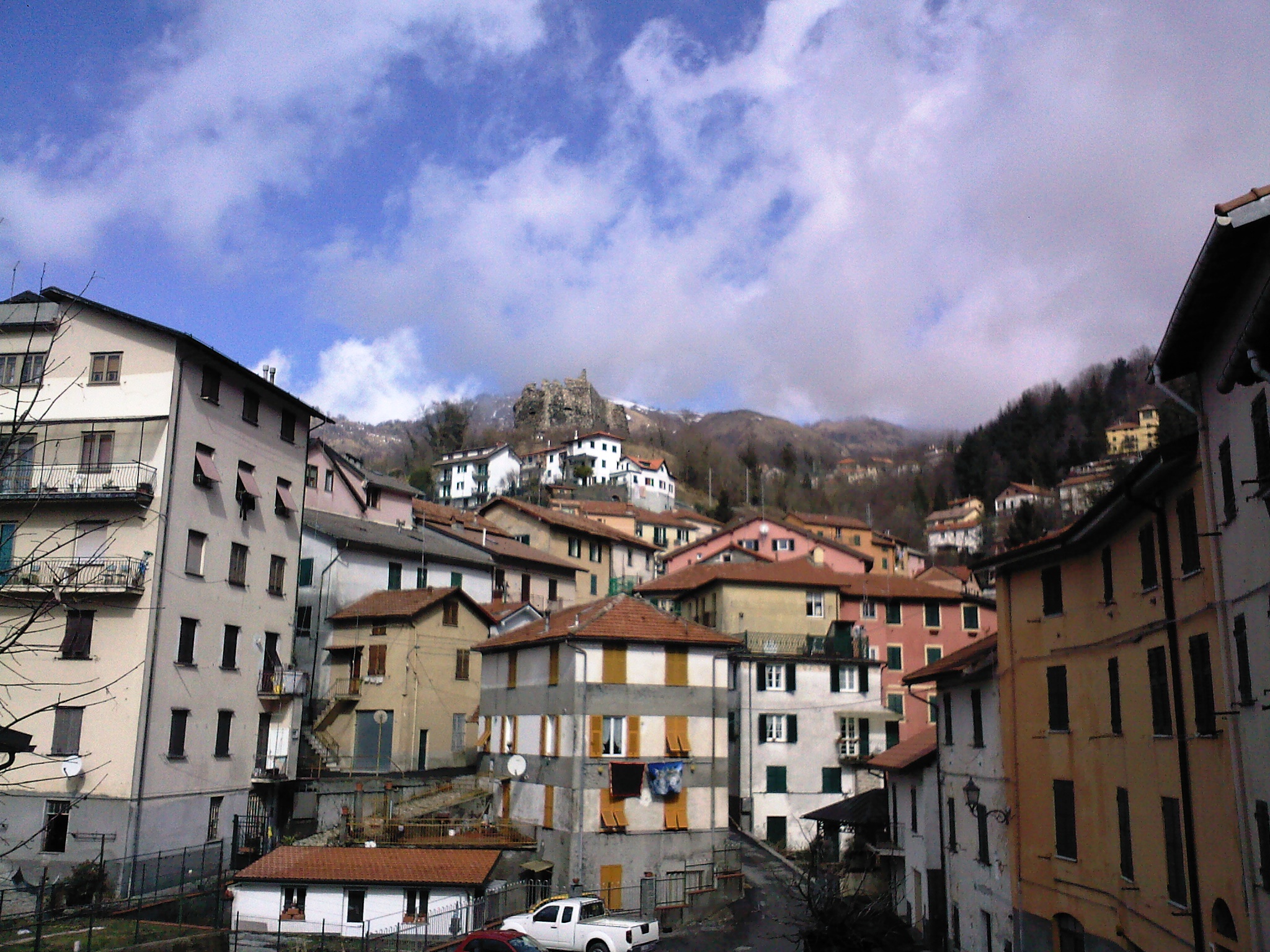
Context · Torriglia (Genoa, Italy), near the Zanfretta case
Torriglia Genova Liguria Italia Italy Genoa - panoramio.jpg · Wikimedia Commons · CC BY-SA 3.0 · open original
The years in question
On the night of 6 December 1978, Pier Fortunato Zanfretta, a 25-year-old night watchman for a private security firm, was on his usual round in Marzano, a hamlet of the municipality of Torriglia in the mountains above Genoa. According to the Torriglia Carabinieri report, around 00:33 he saw torchlights behind a shuttered villa known as 'Casa Nostra' and, thinking of thieves, went into the neighbouring meadow; reaching the back corner he felt a blow to his back and, turning, faced a humanoid being about three metres tall, "bulky and horrendous", and a strongly luminous object that soon took off vertically with a whistle. According to the chronology published later, Zanfretta spoke by radio with the company's dispatch during the event, and later accounts added wrinkled skin, triangular yellow eyes and a red, oval object more than ten metres across that radiated heat. His colleagues, who went looking for him after about an hour of radio silence, found him in a state of severe shock, unable to speak coherently for a while.
What sets Zanfretta apart from most contact accounts is the institutional response. On 8 December the Carabinieri company at Chiavari sent a telex to the Interior Ministry and the Air Force General Staff: it recorded no witness to the encounter, noted a horseshoe-shaped imprint about two metres across on the ground, and rated the reliability 'buono' (good). On 3 January 1979, brigadiere Antonio Nucchi, commander of the Torriglia station, sent the Genoa magistrates' court a report describing the imprint in the meadow beside the villa, about 2 metres across and 3 long; it says Zanfretta always appeared very hot and sweaty, especially on his head, despite the hoarfrost at Marzano, and his car's bodywork was hot "as if it had been left in the summer sun"; that in a second episode, on the night of 27 December at Scoffera, the car stopped responding and drove some three kilometres on its own, and that there, in the earth at the roadside, two heeled shoe prints 45 to 50 centimetres long with concave soles could be seen; that an examination at the neurology department of San Martino Hospital found him 'sanissimo di mente' (perfectly sane), apart from slight hypertension; and that he did not drink or use narcotics; the brigadiere adds that he had known him personally since 1971 and that he had always been considered a serious person. It adds that in the Torriglia area, for some months, many residents had been seeing very large, luminous flying objects, among them gamekeeper Barbacetto and a Guardia di Finanza brigadiere named Esposito, with a list of more than 50 people: they are not witnesses of that night. The magistrate ordered the file shelved for lack of any offence on 31 December 1979, and the closure was registered on 11 January 1980. The sceptical researchers summarised by Wikipedia hold that the grass circle matched the spot where the villa's owners tied their horse during the day, that the heat of his clothes was consistent with his having sat in the car for a while, that the footprints of the second episode were consistent with simple puddles, and that third-party sightings were never authoritatively verified; the National UFO Centre (CUN) stated on several occasions that it did not consider the story reliable. It is the official trail (not the spectacle of the account) that places the case within a corpus of documented evidence.
From there the case branches into the far more slippery terrain of recovered memory. Journalist Rino Di Stefano, who covered the case from the start and later published a book in several editions, proposed subjecting Zanfretta to regressive hypnosis to 'remember' what had happened. The first session, on 23 December 1978, was conducted by medical hypnotist Mauro Moretti before journalists and ufologists. Under hypnosis, Zanfretta described being taken aboard, examined and communicated with. Between 1978 and 1981 he reported eleven such encounters, with growing detail: a mother object, a glass sphere handed over as 'proof', messages. This phase is the one most analysts treat with maximum caution: regressive hypnosis is well documented as a mechanism that generates vivid, confident false memories, not as a reliable retrieval technique, and the claims of the later encounters lack even the radio alert of 6 December, which itself had no witnesses.
The skeptical file is robust. The signature of the first episode (collapsing on a solitary night round, paralysis or disorientation, figures and then an elaborate narrative under suggestion) is consistent with a combination of misperception, stress and, above all, the amplifying effect of hypnosis and the press, which turned Zanfretta into a celebrity. Italian critics showed that several 'pieces of evidence' had prosaic explanations or were presented in a biased way by outlets interested in the business. Even so, a core remains that no explanation fully closes: the radio alert, the horseshoe-shaped imprint, the neurological examination that found him sane and the residents who had been seeing lights in the area for months do not fit cleanly into 'he made it all up'. The case therefore lives on the border between sincere testimony contaminated by suggestion and a real, misinterpreted event.
Why it matters
Zanfretta is the Italian case that defines the problem of testimony in its sharpest form: an institutionally documented core (a Carabinieri telex rating reliability 'buono', an imprint in the grass, a clean neurological examination, residents who had been seeing lights for months) wrapped in a later layer (eleven abductions under hypnosis) that is almost impossible to assess. It matters precisely because it cleanly separates those two layers, which the popular account fuses. The first withstands some scrutiny; the second is the textbook example of why recovered memory is not evidence. It shows how an ambiguous event, once passed through the filter of hypnosis and the press, becomes a saga that can no longer be dismantled or confirmed. It is the European counterweight to Communion and Pascagoula: high cultural profile, mixed evidential base, with nothing physical surviving independent analysis beyond an imprint in the grass.
What's left on paper
Documented evidence
- Encounter around 00:33 on the night of 6-7 Dec 1978, reported to the Carabinieri by the security company; Zanfretta was found in severe shock after about an hour of radio silence.
- Horseshoe-shaped imprint about 2 m across and 3 m long in the meadow beside the 'Casa Nostra' villa (Carabinieri telex of 8 Dec 1978 and Nucchi report of 3 Jan 1979).
- The telex records 'nessun testimone' (no witness) to the encounter; the Nucchi report lists more than 50 residents who had been seeing large, luminous flying objects around Torriglia for months.
- Report by brigadiere Antonio Nucchi to the Genoa magistrates' court (3 Jan 1979): neurological examination at San Martino Hospital ('sanissimo di mente') and a finding that he did not drink or use narcotics; file shelved for lack of any offence (31 Dec 1979, registered 11 Jan 1980).
- Eleven regressive-hypnosis sessions (1978–1981) conducted by Mauro Moretti, the source of the abduction claims, not independently verifiable.
- Sceptical reading (Wikipedia): the grass circle matched the spot where a horse was tied, the heat of his clothes his having sat in the car, the second episode's footprints puddles, and third-party sightings were never verified; CUN did not consider the story reliable.
Sources
- Zanfretta UFO Incident — Wikipedia — Synthesis with the chronology and the sceptical researchers' reading (hypnosis, horse, puddles, CUN).
- Di Stefano, Rino — 'The Zanfretta Case: Chronicle of an Incredible True Story' — Journalist who covered the case from 1978; the main primary source (and an interested party, to be weighed).
- Carabinieri, compañía de Chiavari — télex al Ministerio del Interior (8 dic 1978)
- Pretura Unificata di Genova, expediente 203/79 — informe del brigadier Antonio Nucchi (3 ene 1979) y archivo
Entity form (1)
Related cases
same explanation · same period
Emilcin · Jan Wolski
1978 · Tier B
same country · same period
Cecconi G-91R · Treviso
1979 · Tier S
same explanation · same period
Robert Taylor · the only UFO investigated as a crime (Scotland, 1979)
1979 · Tier A
same explanation · same period
Dulce · Phil Schneider
1979 · Tier B
Associated actors (1)