1984·Sky over Minsk, Byelorussian SSR (Tbilisi–Tallinn route)
Soviet Union (Belarus).Minsk case · two Aeroflot airliners (USSR)
On September 7, 1984, the crew of an Aeroflot Tu-134 en route Tbilisi–Tallinn observed over Minsk a luminous object emitting light beams and changing shape; the controller guided a second airliner, on the Leningrad–Tbilisi route, towards the object, and its co-pilot saw it too. The Trud newspaper published it in January 1985 ('At 4:10 Sharp'). The leading explanation, proposed by James Oberg, is a naval missile test launch from the Murmansk area, which he himself calls technically unproven.
Tier A · AcceptableWhat do they mean? →
Institutional evidence: several identified independent witnesses, or contemporary official documentation, without an instrumental record to corroborate them.
What it was
78%natural or human cause
Most likely explanation: rocket or missile
See the split across the six explanations
Natural or human cause
No known cause
Primary documents
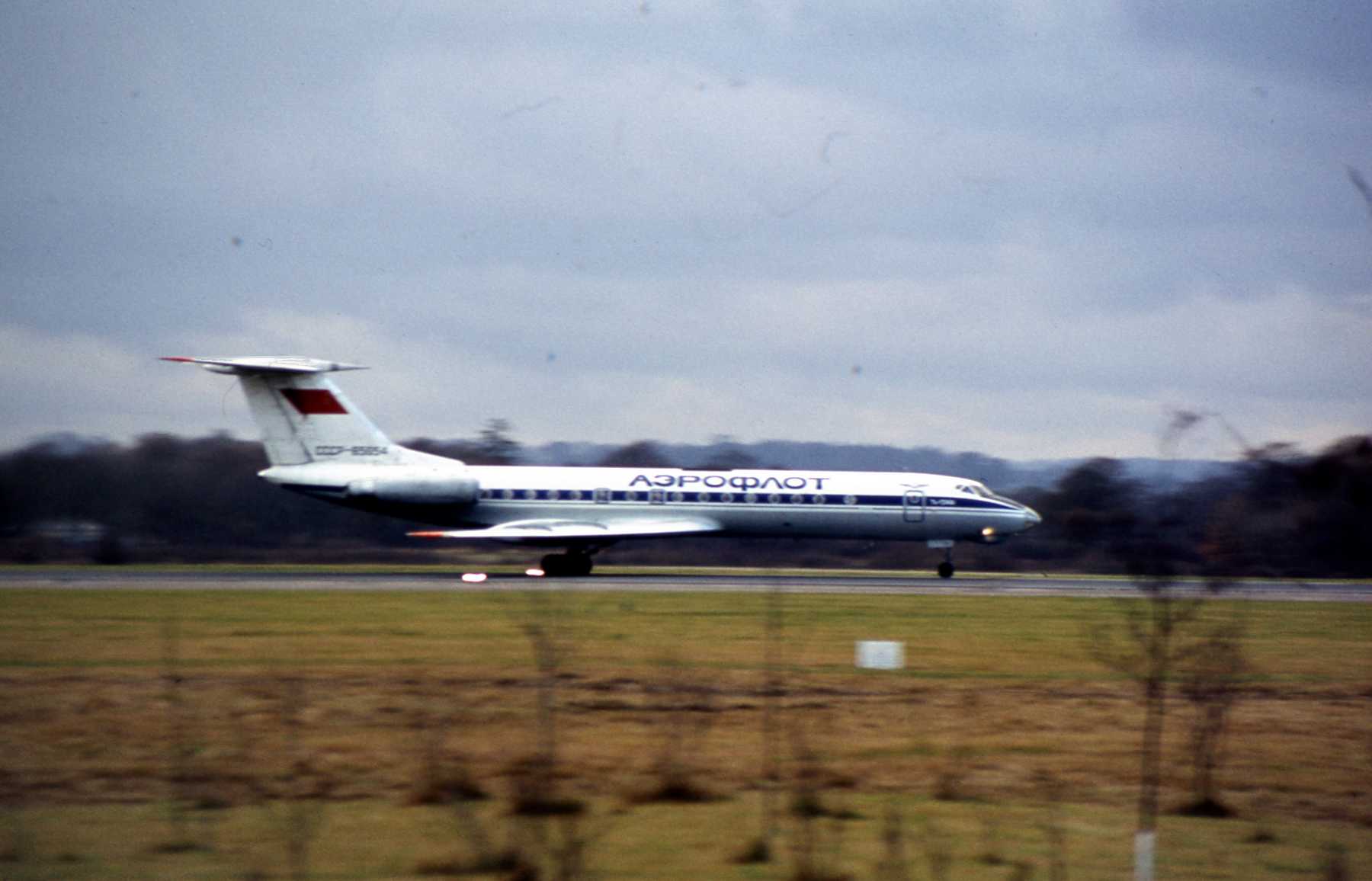
Context · an Aeroflot Tupolev Tu-134, the aircraft type of the Minsk case
MercerMJ Aeroflot Tupolev Tu-134 (8664128490).jpg · Wikimedia Commons · CC BY-SA 2.0 · open original
"Airliner Crew Reports UFO Sighting": JPRS translation of the Trud article of 30 January 1985 (released by the CIA), 5 pp.
English translation by the U.S. Government's JPRS of the article "At 4:10 Precisely" by special correspondent V. Vostrukhin (Trud, 30 January 1985, p. 3), with commentary by N. Zheltukhin, deputy chairman of the VSNTO Commission on Aerodynamic Phenomena; released by the CIA in 2010. It recounts flight 8352 Tbilisi–Rostov–Tallinn, a Tu-134 with a crew from the Estonian Administration, 120 km from Minsk at 4:10: the yellow speck, the beam, the cones, the "cloud" that escorted the aircraft to Tallinn, the Minsk controller who first saw nothing and later spoke of northern lights, and what the Tallinn controller said about two extra blips. Zheltukhin concludes that the crew saw a UFO.
CIA Reading Room, documento 0005516658, vía archive.org · view source
The night in question
At 4:10 a.m. on September 7, 1984, an Aeroflot Tupolev Tu-134 flying the Tbilisi–Tallinn route observed, near Minsk (Byelorussian SSR), a yellow point from which a beam of light emerged and turned into a cone; the object repeatedly changed shape (rays, concentric circles, a 'cloud', an amorphous mass). Co-pilot Gennady Lazurin and other crew described it. The controller directed towards the object a second airliner flying from Leningrad to Tbilisi; according to the written statement of its co-pilot, Yuri Kabachnikov, they saw a bright green cigar-shaped object with three beams of light, which turned, stopped and briefly lit them up.
The Trud article, translated into English by the US government's JPRS translation service, gives more detail. Flight 8352 had a crew from the Estonian Administration of civil aviation: commander Igor Cherkashin, co-pilot Lazurin, navigator Yegor Ognev and flight engineer Gennady Kozlov. At 4:10 they were 120 kilometers from Minsk, and although the article itself notes that pilots know distance cannot be judged by eye, all four had the same impression: the object was hovering 40 to 50 kilometers away from them; Lazurin began sketching it at that moment. The Minsk controller first replied that he saw nothing, either on the surveillance radar screen or in the sky, and later that he was observing 'the northern lights on the horizon' and that this matched the direction he was given. According to the article, the commander of the airliner coming from Leningrad, about 100 kilometers away, replied that he saw nothing; the Minsk controller, who by then could see the cloud, gave him the coordinates, and only about 15 kilometers before they crossed did that crew see it and describe it exactly. Cherkashin's crew kept seeing the cloud past Riga and Vilnius all the way to Tallinn, and while passing the Peipus and Pskov lakes they estimated that the object was as long as Lake Pskov. According to the article, the Riga and Vilnius controllers kept placing the odd pair, and after landing the Tallinn controller told the crew that on the airport's surveillance radar screen the Tu-134A did not appear alone: two more blips followed it, although no other aircraft was in the air, and while those two stayed continuously visible, the airliner's own blip vanished and reappeared. It is a second-hand account, from the controller through the crew, and the article cites no radar record.
The episode caused a sensation when the trade-union newspaper Trud, one of the highest-circulation papers in the USSR, published it on January 30, 1985 under the title 'At 4:10 Sharp'. That an official daily devoted space to a pilots' sighting was notable in a controlled press system, and it had consequences for the paper: the trade-union secretariat (VTsSPS) declared the publication 'erroneous and harmful', reprimanded Trud's editor and removed him soon after, with no public explanation ever given of what was seen. Decades later, James Oberg proposed in the Skeptical Inquirer (2009), as a prosaic hypothesis, a naval missile test launch from the Murmansk area, over the Barents Sea, which he himself calls technically unproven until Russia releases the records. According to Oberg, the drawings Lazurin made in flight show the same sequence of shapes as sketches of rocket launches, and that same morning there were witnesses on the ground in Sweden and Finland.
Why it matters
There were professional crews of two airliners, guided by air traffic control, and national press coverage (extraordinary in the USSR of the era), and yet the strongest explanation is not exotic: according to James Oberg's hypothesis, a naval missile test launch from the Murmansk area that same morning.
The strength of the conventional explanation is that it predicts the observed phenomenology precisely. Mikhail Gershtein, chairman of the ufological commission of the Russian Geographical Society, explained it in Komsomolskaya Pravda (2009) as the trail of a multistage rocket, lit by the Sun and visible at great distances from different points on the ground and in the air: the gas cloud grows fast at first, which gives the illusion that it is approaching, and upper-atmosphere winds distort it. Space analyst James Oberg, a specialist in the Soviet space program, proposed the link to a launch by comparing the drawings Lazurin made in flight with sketches of rocket launches, among them those of a witness in Sweden, and gathered sightings from the ground in Sweden and Finland that same morning; he himself calls it technically unproven. The two extra blips on the Tallinn radar do appear in the 1985 Trud article, but as what the controller told the crew after landing, with no record cited; Oberg counts among the pieces of the story that others, alerted by radio, looked for something odd in the sky or on radar and a few found it.
The same issue of Trud printed a commentary by N. A. Zheltukhin, deputy chairman of the Commission on Aerodynamic Phenomena of the All-Union Council of Scientific and Technical Societies (VSNTO) and corresponding member of the USSR Academy of Sciences. According to Zheltukhin, the commission's Estonian section (I. Volke, E. Parve and others) had investigated the case. He himself raised the natural assumption of a global atmospheric or geophysical process of a type still unknown to science, thousands of kilometers away, that seemed close to the pilots through an optical illusion, but he rejected that explanation because, in his view, the aviators 'succeeded in determining the distance to the object', and he concluded that the Tallinn crew had encountered what the commission called a UFO. That distance estimate is exactly what Oberg disputes: in his account, pilots tend to underestimate the distance of what they see, and the witnesses in Sweden and Finland who saw a bright light that same morning were looking northeast, along directions that, plotted on a map, converge over the Barents Sea.
The case documents how the Soviet apparatus punished the newspaper that published it, and it is a methodological caution: trained pilots on two airliners are not enough to declare an anomaly unless known stimuli like re-entries, bolides and space launches have first been ruled out. The conventional explanation accounts for what the crews saw; it does not address the second-hand account of two blips that followed the airliner on the Tallinn radar, for which the Trud article cites no record.
What's left on paper
Documented evidence
- Observation by the crew of an Aeroflot Tu-134 (Tbilisi–Tallinn route) over Minsk, 4:10 a.m. Sep 7, 1984
- Luminous object with a beam/cone changing shape; described by co-pilot Lazurin and other crew
- The controller guided a second airliner (Leningrad–Tbilisi) towards the object; its co-pilot, Yuri Kabachnikov, saw it too
- Published by the Trud newspaper on Jan 30, 1985 ('At 4:10 Sharp'); the trade unions declared the publication 'erroneous and harmful' and the editor was removed
- Leading explanation (Oberg, Skeptical Inquirer 2009): a naval missile test launch from the Murmansk area, technically unproven
Sources
- Skeptical Inquirer — 'The Minsk UFO Case' (2009) — Oberg's analysis and his hypothesis of a naval missile launch from the Murmansk area.
- Trud — 'A las 4:10 en punto' (30 ene 1985) — síntesis del caso
- Trud, «Ровно в 4.10» (30 ene 1985, p. 3), traducción JPRS «Airliner Crew Reports UFO Sighting» · sala de lectura de la CIA (C00174708), espejo de archive.org — Full text of V. Vostrukhin's article and N. A. Zheltukhin's commentary, in the JPRS English translation (CSO 8144/0029). Contemporary source: crew, estimated distances, the Minsk controller's replies, the size estimate and the commission's conclusion.
- Komsomólskaya Pravda — «Диспетчер минского аэропорта - экипажу Ту-134: „Держите курс на НЛО“» (sep 2009) — Reproduces the account of flight 8352 (Tbilisi–Rostov–Tallinn), the written statement of co-pilot Yuri Kabachnikov of the second airliner, the trade-union resolution against Trud and Oberg's hypothesis.
Related cases
same explanation · same country · same period
Cosmonaut Kovalyonok · Salyut-6 station · object in orbit
1981 · Tier B
same object · same period
Canary Islands · the luminous bell of 5 March 1979
1979 · Tier S
same object · same period
Petrozavodsk (USSR)
1977 · Tier A
same object · same period
Canary Islands
1976 · Tier A