Case No. 144·Soviet Union
1981·Low Earth orbit over the South Atlantic / Indian Ocean, Salyut-6 space station
Soviet Union.Cosmonaut Kovalyonok · Salyut-6 station · object in orbit
On May 5, 1981, around 18:00 Moscow time, cosmonaut Vladimir Kovalyonok —Major General, twice Hero of the Soviet Union— observed from a porthole of the Salyut-6 station an object flying alongside the spacecraft over southern Africa. Initially elliptical like a 'barbell', the object became translucent revealing an internal structure and then showed a gas-like emission at one end before disappearing. Kovalyonok called his crewmate Viktor Savinykh, who also observed it. No rocket or missile test compatible with that day was recorded. It is the corpus case with the highest possible witness cohort (two cosmonauts on duty) within the Soviet space program.
Year
1981
Tier
A
Probability
50%
Category
Incident
Institutional evidence: multiple verifiable witnesses or official documentation. Three independent axes: the «tier» measures the strength of the evidence; the «probability» estimates how genuinely unexplained the case is —a natural phenomenon can remain unexplained, so it does not equal «non-prosaic»—; and the partition of explanations (below) says what it most plausibly was. So a well-documented case can have a possible hoax as its most plausible cause, and a Tier B is not, for that reason, a hoax.
Primary documents · viewer
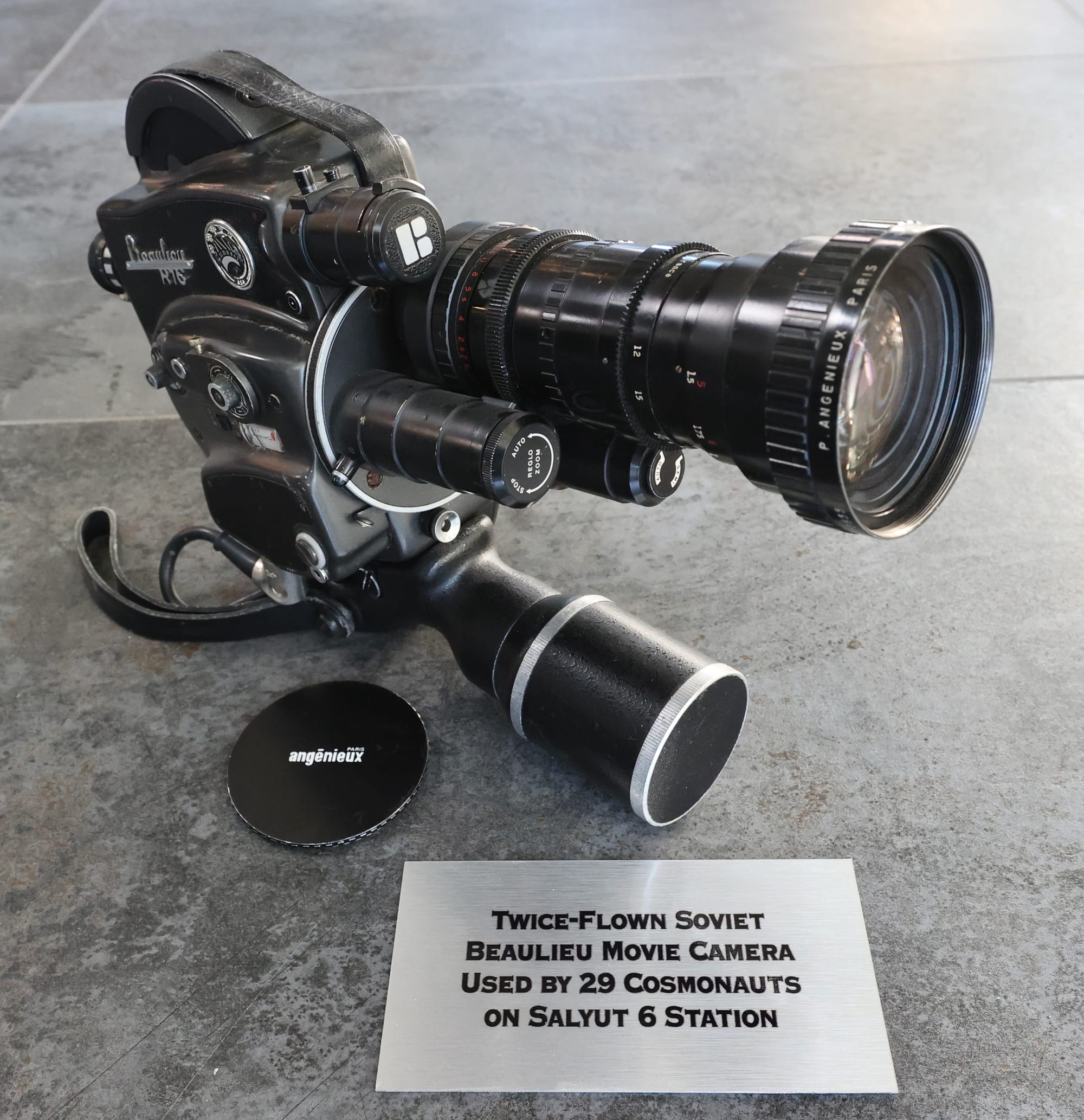
Context · the Salyut-6 station, from which cosmonaut Kovalyonok observed the object
Salyut 6 cine camera (53594100081).jpg · Wikimedia Commons · CC BY 2.0 · open original
Part 01
The night in question
On May 5, 1981, around 18:00 Moscow time, the crew of the Soviet space station Salyut-6 was executing routine operations in low Earth orbit during the crewed Soyuz T-4 expedition. The commander was Vladimir Vasilyevich Kovalyonok —career cosmonaut, Major General of the Soviet Air Force, twice Hero of the Soviet Union— accompanied by flight engineer Viktor Savinykh.
Kovalyonok had just finished an exercise session when, through an observation porthole, he saw in front of the spacecraft an object flying on a parallel trajectory. The station was overflying southern Africa heading toward the Indian Ocean. In his later accounts, Kovalyonok stressed that the object was small in angular appearance —comparable to the size of a finger held up before the eye—, initially elliptical. By his description, as he watched, the body became translucent, showed an internal structure, and then separated into two connected pieces, 'a bit like dumbbells' (dumbbell/barbell). At one end a gas- or plasma-like emission appeared — Kovalyonok described it as 'reactive object'-like.
Kovalyonok called Savinykh, who left his post and approached the porthole. According to the commander himself, they tried to photograph the phenomenon, but while Savinykh went to fetch the camera the object 'exploded' or dissipated, leaving a puff of smoke, and vanished before it could be recorded. That thwarted instrumental capture is the reason the case —despite its witness cohort— has no photograph: not negligence, but an event that ended too quickly. After the mission, Kovalyonok reported the incident to the SETKA-MO program (↗), the Soviet UAP-investigation program then in its third operational year.
The strongest skeptical interpretation comes from U.S. space journalist James Oberg, a specialist in the Soviet program: Oberg argues that many cosmonaut 'sightings' correspond to distant rocket launches or missile tests, whose fuel and exhaust clouds in vacuum, lit at grazing angles, produce translucent, shape-shifting objects that dissipate within minutes — exactly the described profile. Kovalyonok himself, in later interviews (notably the Russian documentary 'Космонавты и НЛО'), maintained he believed he had observed an unaccredited artificial terrestrial object, not an anomalous entity, though he could not identify it; the cross-check of Soviet and U.S. launch schedules for that date and trajectory, per the available accounts, found no recorded compatible test. The case remains on the record as an unresolved sighting within the SETKA archive and the cosmonautics literature, with the launch-exhaust hypothesis a live but unconfirmed prosaic candidate.
Part 02
Why this case moved the needle
It is the corpus's case with the highest institutional witness cohort: two Soviet cosmonauts on duty, one of them a Major General of the Air Force twice Hero of the Soviet Union, observing an object from a state space station during an active crewed mission. The evidential modality combines elements no other corpus case assembles simultaneously: (a) witnesses with maximum-level military institutional credentials, (b) observation site that is national space infrastructure, (c) report entered into the state SETKA archive, (d) negative cross-check of compatible launches. Its value for the corpus is geographic (closes the Soviet gap post-Petrozavodsk) and modal (institutional cosmonaut testimony without Western equivalent until the sworn pilot testimonies of Fravor/Dietrich in 2017). Tier A and not Tier S because it is testimony without coordinated instrumentation (camera, radar) and because Kovalyonok himself did not rule out a terrestrial artificial explanation — the case remains open, not anomalous.
Part 03
What's left on paper
Documented evidence
- Witness cohort of two cosmonauts on duty: Vladimir Kovalyonok (commander, Air Force Major General, twice Hero of the USSR) + Viktor Savinykh (flight engineer)
- Observation site: Salyut-6 space station, Soyuz T-4 expedition, over southern Africa heading toward the Indian Ocean, May 5, 1981 ~18:00 Moscow time
- Detailed technical description by Kovalyonok himself: 'barbell' shape (elliptical/bilobed), becoming translucent with visible internal structure, gas/plasma-like emission at one end ('reactive object')
- Report formally entered into the SETKA-MO program (↗) in its third operational year
- Negative cross-check: no Soviet or U.S. rocket/missile/satellite test recorded for that date and trajectory
- Sustained later testimony by Kovalyonok in interviews (notably the Russian documentary 'Космонавты и НЛО'): maintains the reading of unidentified terrestrial artificial object, not extraterrestrial
Sources
- Kovalyonok, V. — entrevistas posteriores y declaraciones documentadas (década 1990–2000) — The cosmonaut himself publicly maintained the description of the event.
- UFO Evidence — 'Russian Cosmonaut sees UFO while in orbit aboard Salyut-6 Space Station' — Documentary reconstruction of the case with chronology and sources.
- Oberg, J. — 'Have cosmonauts seen launches?' (análisis técnico) — Skeptical review by a specialist in Soviet cosmonautics — cross-checked against the launch schedule.
- Documental ruso 'Космонавты и НЛО' (Cosmonautas y UFOs) — Direct interview with Kovalyonok about the incident.
Patterns it exhibits (2)
Location
Low Earth orbit over the South Atlantic / Indian Ocean, Salyut-6 space station · -33.00°, 28.00°
Distribution of explanations
This case is classified among the model's hypotheses: the bar splits 100% by how much each explanation weighs (the uncertainty is spread across the hypotheses the case supports). Summed across the corpus they produce the comparable partition. It is a different question from the Probability above: that one estimates how likely the case is a genuinely unexplained phenomenon; this one splits which the explanation would be.
Modal hypothesis: Misidentification 59% · sums to 100%
Confused with: Space (satellite/reentry)
Structured analytical judgment, not a calibrated frequency. Forced classification: the mass the evidence cannot assign is spread across the hypotheses the case does support.
Related cases