1977·Petrozavodsk, Karelia, USSR
Soviet Union.Petrozavodsk (USSR)
On 20 September 1977, around 4 a.m., numerous witnesses in Petrozavodsk (Karelia) and as far away as Finland watched a luminous "jellyfish"-shaped object with descending beams for some 10 to 12 minutes. Izvestia published the account with statements to TASS, the Academy of Sciences asked for such phenomena to be investigated, and the episode gave rise to Setka, the 13-year Soviet state program; its leaders later attributed it to the launch of Kosmos-955 from Plesetsk.
Tier A · AcceptableWhat do they mean? →
Institutional evidence: several identified independent witnesses, or contemporary official documentation, without an instrumental record to corroborate them.
What it was
88%natural or human cause
Most likely explanation: rocket or missile
See the split across the six explanations
Natural or human cause
No known cause
Quote in the original language
«знаменитое Петрозаводское явление, обусловленное запуском искусственного спутника Земли "Космос-955" с космодрома Плесецк»Primary documents
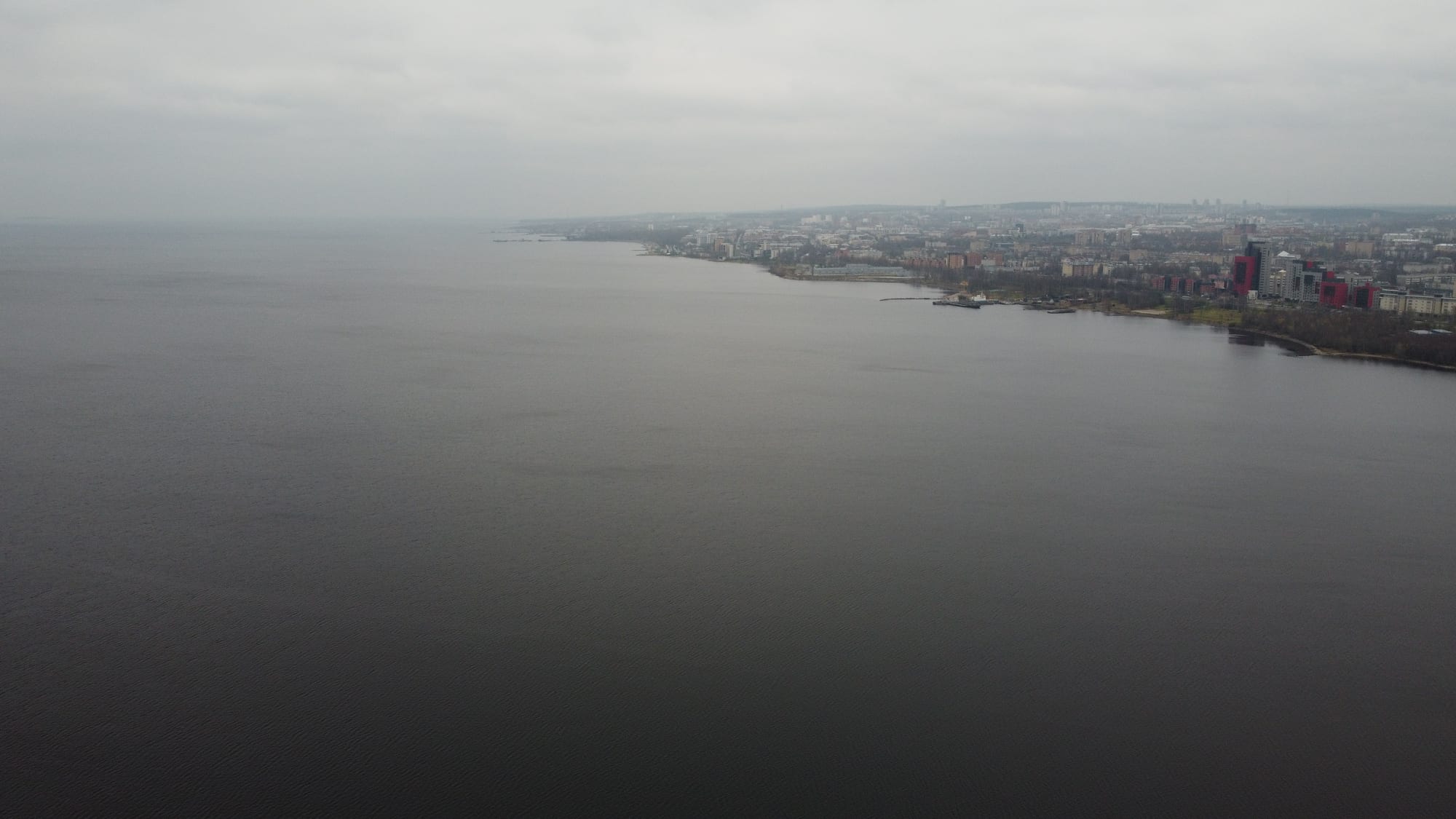
Context · Petrozavodsk (Karelia), where the 'jellyfish' phenomenon was seen
Petrozavodsk Bay (2).jpg · Wikimedia Commons · CC BY-SA 4.0 · open original
SETKA Program · Soviet state UAP investigation (1978–1991)
An account of the Soviet state program SETKA published in 2000 by its operational heads, Yuli Platov and Boris Sokolov, in the Academy of Sciences journal (Vestnik RAN). It arose after the 1977 Petrozavodsk night as two topics in the 1978 defense plan: Setka MO (Ministry of Defense) and Setka AN (Academy of Sciences). Over thirteen years it gathered about 3,000 reports, and more than 90% were explained as rocket launches and balloons; Petrozavodsk was the Kosmos-955 launch plus a failed missile test. It left the Borisoglebsk accidents unidentified and recorded no landings or contacts. It is the heads' own account, with no Soviet documents published.
The night in question
On September 20, 1977, around 04:00 Moscow time, thousands of residents of Petrozavodsk (capital of the Karelian Republic in the northwestern USSR) saw in the still-dark sky a luminous object very consistently described as a 'jellyfish': a bright core from which beams or filaments of light descended, which moved, expanded and cast a glow over the city before dissipating. According to the witnesses, it all lasted 10 to 12 minutes, and they included ambulance crews, police, sailors and dockers at the port, servicemen, airport staff and an amateur astronomer. It was not confined to Karelia: it was seen in places far away, such as Finland, where it was caught on several photographs, indicating a high-altitude origin able to be sunlit while the surface remained dark.
Instead of the Soviet apparatus's usual silence or denial, Izvestia published on 23 September the note "An unidentified natural phenomenon", with the statement of the director of the Petrozavodsk hydrometeorological observatory to a TASS correspondent: Karelia's meteorologists had observed "no analogues in nature". Letters from the public reached the Academy of Sciences, and official queries came from neighbouring northern European countries asking whether it was a military experiment dangerous to the environment. The Academy's president, Alexandrov, wrote to the Military-Industrial Commission that the Academy "can no longer ignore, nor can it explain" phenomena like Petrozavodsk, and asked for a joint study with the Ministry of Defence.
The conventional explanation, which the Soviet program's own scientific leads, Platov and Sokolov, came to treat as established, is the launch of the Kosmos-955 satellite from the Plesetsk cosmodrome that same pre-dawn; they add that other effects that accompanied it were due to a failed test launch of a ballistic missile in the same region at almost the same time. Plesetsk (then a military installation whose existence the USSR did not officially acknowledge) lies a few hundred kilometers away, and a rocket's exhaust plume and stage separation lit by the sun in twilight conditions produce exactly the radiant jellyfish-shaped morphology reported. Some skeptics note minor discrepancies of timing and appearance versus a standard launch, but the coincidence of time, geometry and geographic spread makes Kosmos-955 the dominant candidate.
At the institutional scale the episode had a larger consequence: in October 1977 the Scientific-Technical Council of the Military-Industrial Commission, meeting in the Kremlin, recommended adding it to the defence research plan, and in 1978 two topics began, "Setka MO" (Ministry of Defence) and "Setka AN" (Academy of Sciences), to study anomalous atmospheric and space phenomena and their effect on military equipment and personnel. The program ran for 13 years, until 1990; physicist Yuly Platov was deputy chairman of the Academy's expert group. According to his assessment, published in 2000 with Sokolov, about 3,000 reports were received over 13 years, nearly all analysed and identified, of which just over 300 events were classed as unusual or anomalous, and practically all mass night-time sightings were identified as effects of rocket launches or aerospace tests; units serving at the test ranges sent almost no reports, because those effects were familiar there. It is a finding that reinforces, rather than weakens, the reading of Petrozavodsk as a human artifact.
Why it matters
Petrozavodsk drew from the official Soviet press an unusual public acknowledgement in the midst of the Cold War and gave impetus to Setka, a state program that lasted some 13 years. It demonstrates that the institutional pattern 'the wave forces the state to investigate itself in secret' was not an American peculiarity of Blue Book but a structural response the USSR replicated almost point for point.
The case contributes in two simultaneous directions that should not be mixed. Toward the classified-program (human) narrative: the probable cause (Kosmos-955 from an officially nonexistent Plesetsk) and Setka itself document that military secrecy generates sighting waves and forces the state to investigate itself. Toward the mundane/natural narrative: the Setka file as a whole, where most reports turned out to be launches and tests, is strong empirical backing for the prosaic nature of most of the phenomenon. Petrozavodsk is not an unsolved mystery: it is a solved mystery whose lesson is about how state secrecy manufactures enigmas.
What's left on paper
Documented evidence
- Note "An unidentified natural phenomenon", Izvestia, 23 Sep 1977, with statements to TASS from the Petrozavodsk observatory
- Letter from Academy of Sciences president Alexandrov to the Military-Industrial Commission and the October 1977 Kremlin meeting that gave rise to Setka
- Platov and Sokolov (Vestnik RAN, 2000): Petrozavodsk was caused by the launch of Kosmos-955 from Plesetsk; about 3,000 reports in 13 years, nearly all mass night-time sightings identified as launches
- Photographs of the phenomenon taken in Finland
Sources
- The Moscow Times — A Look at the Official Soviet X-Files Investigation
- Wikipedia: Petrozavodsk phenomenon — Secondary source (encyclopedia)
- Platov, Yu. V. and Sokolov, B. A. — 'The study of unidentified flying objects in the USSR', Vestnik RAN 70(6), 2000 (in Russian) — Primary source: assessment by the Setka program's leads, with the Izvestia note, Alexandrov's letter and the identification with Kosmos-955
- Sokolov, B. and Platov, Yu. — 'A History of State UFO Research in the USSR', Skeptical Briefs 10.4 (Dec 2000) — English version of the same account, by the same authors.
Related cases
same object · same period
Canary Islands
1976 · Tier A
same object · same period
Canary Islands · the luminous bell of 5 March 1979
1979 · Tier S
same object · same period
Campo de Mayo · the Gendarmería Cessna's coloured sphere
1972 · Tier A
same object · same period
Northern Spain · the fan of light of 23 February 1971
1971 · Tier A