1972·NASA · Apollo 17 photographic archive (lunar surface, Taurus-Littrow)
United States / cislunar space.Apollo 17 · VM6 triangular formation (PURSUE)
The Apollo 17 VM6 plate (December 1972) shows, when the lower-right quadrant of the lunar sky is magnified, three luminous dots in a regular triangular formation.
Read the rest of the summary
It had circulated for decades in amateur catalogs; in 2026, within PURSUE, the Department of War opened case NASA-UAP-VM6, and a preliminary government analysis, having obtained the original film for a joint analysis with NASA, described it as 'potentially the result of a physical object in the scene'. The historical skeptical reading is a photographic artifact (emulsion error, lens flare or a reflection on the window), which that analysis calls into question.
Tier A · AcceptableWhat do they mean? →
Institutional evidence: several identified independent witnesses, or contemporary official documentation, without an instrumental record to corroborate them.
What it was
68%natural or human cause
Most likely explanation: film or photo defect
See the split across the six explanations
Natural or human cause
No known cause
Primary source · PDF
NASA-UAP-VM6 · Apollo 17 plate (PURSUE Release 01)
Official primary document on war.gov/UFO. Accessible mirror: github.com/wretcher207/the-ufo-files.
Primary documents
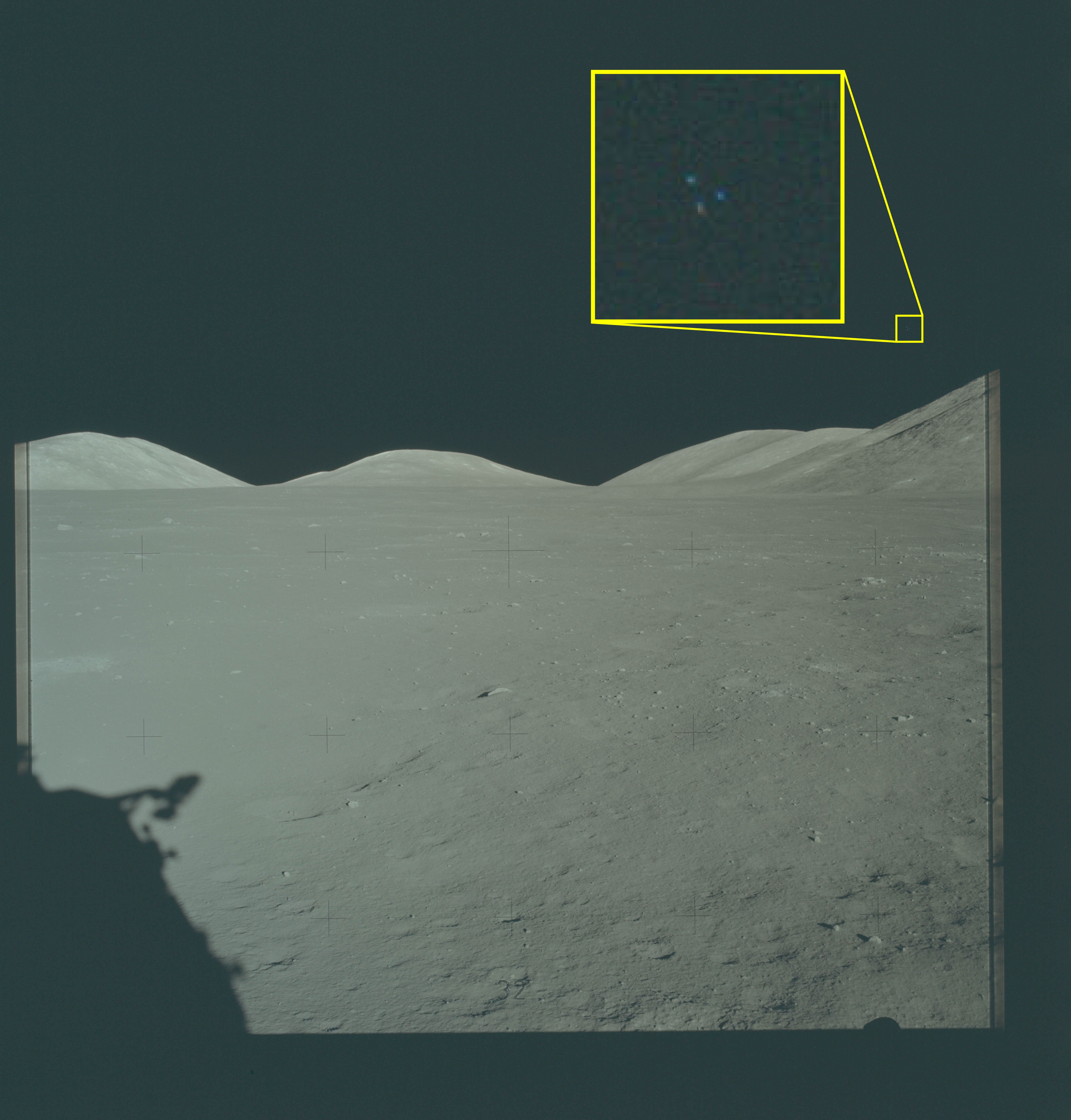
NASA-UAP-VM6 — Apollo 17 plate with the triangular formation
NASA · Department of War (PURSUE Release 01) · Public domain · US Government work · open original
NASA-UAP-D2 — Apollo 17 air-to-ground transcript (Dec 1972): particles, flashes and streaks
NASA · Department of War (PURSUE Release 01) · Public domain · US Government work · open original
NASA-UAP-D5 — Apollo 17 Crew Debriefing for Science (Jan 8, 1973): unexpected UV/X-ray background
NASA · Department of War (PURSUE Release 01) · Public domain · US Government work · open original
NASA-UAP-D6 — Apollo 17 Technical Crew Debriefing (1973)
NASA · Department of War (PURSUE Release 01) · Public domain · US Government work · open original
The night in question
The VM6 image belongs to the photographic archive of the Apollo 17 mission (December 1972), the last crewed lunar-surface mission of the Apollo program. On one archival plate, when the lower-right quadrant of the lunar sky above the horizon is magnified, three luminous dots appear arranged in a regular triangular formation. The anomaly went essentially unnoticed for decades: the photograph circulated in amateur forums and catalogs, but without any official status backing it. The astronauts themselves, during the mission, remarked on bright particles drifting past the spacecraft ('we've got a few very bright particles or fragments or something that go drifting by as we maneuver', said Ron Evans) and speculated that they were ice or paint fragments shed from the S-IVB stage; but those remarks concern what they saw out of the window, not this plate. The plate's official caption records no explanation and says 'there is no consensus about the nature of the anomaly'.
What changed in 2026 was not the photograph but its institutional reading. Within the PURSUE system (the federal UAP-records release ordered by the Trump administration and executed by the newly renamed Department of War, with NASA participation) the Department of War opened an official case on the plate, NASA-UAP-VM6 ('DOW has opened a case', the caption says), and included it in the first tranche published on war.gov/UFO on May 8, 2026. In assessing it, the agency used language markedly less evasive than is usual in its files: according to the caption, 'new preliminary US government analysis' suggests the anomaly is 'potentially the result of a physical object in the scene'. For an office that in the vast majority of its files takes refuge in 'non-identification' without committing to any interpretation, calling something 'potentially a physical object' is a deliberate nuance, not a filing formula.
The caption paired the reassessment with a concrete step: the government 'has obtained the original film from the Apollo 17 mission', and 'the results of the full NASA and DOW analysis will be released when completed'. The caption does not say how that analysis is being done. It remained pending with no published results, so the case formally remains unresolved. It is important to separate the two layers: the photographic layer (three dots in a triangle above the lunar horizon) and the institutional layer (a federal agency reclassifying a historical plate with stronger language and reopening the primary material). The second layer is what is genuinely new; the first has been available for half a century.
The skeptical reading that circulated before 2026 is that of a photographic artifact: film emulsion errors, lens flares or light reflecting off the lunar module window. A 1972 negative exposed in the lunar vacuum, with no atmosphere to clear particles, is a natural candidate for contamination by ice, paint flakes from the module, dust on the focal plane, or internal lens reflections; three dots aligned in a triangle do not require an extraterrestrial object when a trio of fragments at different depths of field produces exactly that signature. The government's preliminary analysis points away from the artifact reading: it suggests 'a physical object in the scene', not a camera fault. What prevents fully closing it as a trivial artifact is, again, the institutional layer: the Department of War could have filed it as a reflection and did not, choosing instead to obtain the film and declare it 'potentially a physical object'. That choice does not turn the plate into evidence of anything non-human (it is not), but it does make it a case of official reframing whose outcome depends on a technical reanalysis not yet delivered.
Why it matters
This case matters for its institutional value, not its probative strength. As physical evidence, a 1972 archival plate with three dots in a triangle is weak: the mundane explanations (film emulsion error, lens flare, a window reflection, shed ice or paint) cover the phenomenon effortlessly. What makes it relevant is the reframing layer: the Department of War, within the first PURSUE release, chose not to file the plate as a trivial reflection and instead cataloged it formally, described it as 'potentially a physical object' (more committed language than its usual standard) and obtained the original film for a new analysis. That gesture is the relevant analytical datum: a federal agency choosing to elevate, rather than bury, a historical NASA-origin material, and exposing it on a public portal with a stable URL. The case's outcome is tied to a technical reanalysis not yet published; until then, its place is as an example of how the 2026 disclosure apparatus reprocesses old archives by new criteria, not as proof about the nature of the phenomenon. The plate alone moves none of the underlying narratives; the official reframing does illustrate the real-time institutional-transparency pattern that defines the PURSUE cycle.
What's left on paper
Documented evidence
- NASA-UAP-VM6 archival plate from the Apollo 17 mission (December 1972): three luminous dots in triangular formation above the lunar horizon
- Official case opened by the Department of War within the first PURSUE release (war.gov/UFO, May 8, 2026)
- Official caption, citing preliminary US government analysis: 'potentially the result of a physical object in the scene', unusually direct for these captions
- The government obtained the original Apollo 17 film for a joint NASA-Department of War analysis (results pending)
- Historical skeptical reading: photographic artifact (emulsion, lens flare, window reflection); the astronauts speculated about S-IVB ice or paint for the particles they saw out of the window, not for this plate
Sources
- war.gov/UFO — NASA-UAP-VM6 (PURSUE Release 01, documento primario) — Official slide published on the Department of War portal.
- the-ufo-files — apollo-17-vm6 (mirror público accesible del release PURSUE) — Curated mirror with writeup and reference to the primary document.
- Department of War — 'Releases Unidentified Anomalous Phenomena Files in Historic Transparency Effort' — Official statement of the first release, which includes the NASA material.
- WION (Tarun Mishra) — 'Declassified: The Bizarre Truth Behind Apollo 17's Lunar Triangular Formation', 10 may 2026 — Summarizes the historical skeptical reading of the plate as a photographic artifact.
- CBS News — 'UFO files reveal Apollo 17 crew saw mysterious objects, lights' — Quotes the crew's remarks on particles and flashes (Evans, Schmitt, Cernan).
Related cases
same object · same period
Lake Cote · IGN aerial photo
1971 · Tier A
same explanation · same country · same period
Malmstrom ICBM shutdown
1967 · Tier A
same explanation · same country
STEREO and SOHO · the “UFOs” beside the Sun
2011 · Tier S
same explanation · same country
When the sensor itself explains why the object flickers
2019 · Tier A